

‘;
document.currentScript.insertAdjacentHTML(“beforebegin”, banner);
let giftListenerCb = function (e) {
let date = new Date(e.detail.expiration_date);
let formatted = date.toLocaleDateString(“en-US”, {
month: “long”,
day: “numeric”,
year: “numeric”,
});
document.querySelector(“.article__gift-banner-exp”).textContent = formatted;
document.querySelector(“.article__gift-banner”).hidden = false;
window.removeEventListener(“hasValidGiftLink”, giftListenerCb);
};
window.addEventListener(“hasValidGiftLink”, giftListenerCb);
}
Alex Trebek was never shy about his favorite thing on Jeopardy!
It wasn’t the witty clues. It wasn’t the big streaks, the pop-culture crossovers, or the gutsy wagers.
It was the Teen Tournament, the high school student showdown that Trebek loved with a fatherly devotion. “I started it four years ago, and it’s kind of like my baby,” the late host told a reporter in 1990.
After Jeopardy! announced its inaugural teen competition, in which 15 kids would face off for a grand prize of $25,000, hotel ballrooms filled around the country. In Cleveland, Trebek—“handsomeas a matinee idol in the Rock Hudson mold and sporting a white satin Cleveland Browns jacket,” per the Plain Dealer at the time—turned up at an audition of 200 teenagers, where he talked up his theory of what set Jeopardy! apart from other game shows. “I think Jeopardy! has contributed to the idea that it’s OK to be bright,” he said. “And here’s a quote—I’m pontificating again—Jeopardy! reinforces the learning ethic in this country.”
In the Teen Tournament’s first years, would-be contestants were given a 100-point written test at auditions, for which the passing score was 60. Trebek took it after the tournament launched, notching “a very respectable 86.”
Between 1987 and 2019, Jeopardy! hosted a Teen Tournament nearly every year—and sometimes twice. Trebek held it up as a sort of paragon of American sensibilities. “With all the comments brought forth about today’s youth, the Teen Tournament is the ideal showcase to display the talent and energy that is the reality of our young people,” he told a reporter in 1989. Viewers, it seems, tended to agree.
Wrapping the show’s identity around an explicitly educational theme was no mere gimmick: It was also great TV. From the outset, the Teen Tournament was an eye-popping ratings success. In its network TV heyday, Jeopardy! pulled in 25 million viewers a night, with the Teen Tournament reliably delivering the show’s highest ratings year in and year out. (Jeopardy! still rules the syndicated roost, but these days more often draws in the neighborhood of 7.5 million nightly viewers.) The tournament became a staple of the February sweeps period, when networks would attempt to woo advertisers with “big-money, lots-of-frills segments,” as the Los Angeles Times wryly noted in 1988.
Indeed, the tournament was enough of a priority for the studio—and perhaps for the host—that after Trebek had a heart attack in 2007, he pledged to be back in action to tape the contest the following month.
The tournament evolved: In 2019, champion Avi Gupta took home $100,000 and nary a box of Rice-A-Roni, a parting gift of the past. America’s teenagers and sensibilities changed, too. But Trebek’s devotion never wavered. 2018 champ Claire Sattler remembered the host tearing up as he told the parents in attendance that they should be proud of their children for making it into the tournament.
Trebek was still thinking about the Teen Tournament when, just months before his 2020 death, he credited contestant Dana Venator’s personal anecdote during the 1987 Teen Tournament as his all-time favorite in his memoir. Trebek had asked Venator about her bagpiping hobby; to spare nearby listeners from her beginner’s speed bumps on an instrument with a lot more aural heft than a violin, Venator told him she’d taken to wandering into the woods to practice, “where no one can hear me.”
“What I found most endearing about her interview was how giddy and wide-eyed she was about the entire Jeopardy! experience,” Trebek wrote. “She seemed so tickled by every aspect.”
If Venator was emblematic of the humility, wonder, and joy that made Jeopardy! great to Trebek, the Teen Tournament as a whole was even more so. Any adult trivia shark taking the Jeopardy! stage for the first time is bound to feel some of what Trebek saw in Venator. But there was something special, Trebek believed, when the contestant in question was still in high school. “The adults who are watching the teen shows want to be inspired when they think of their kids,” he said. “They want to know that the future of this country is in good hands.”
But something strange has happened to Trebek’s beloved annual tournament: It’s vanished. The last Teen Tournament was played in 2019. Although recent seasons of Jeopardy! have been packed with tournaments—and, as of this summer, a second spinoff in Sports Jeopardy!—the closest the show has come to featuring high school students in the last seven years was a reunion tournament in 2023 for Teen Tournament alumni who’d since moved on to college.
What happened? Well, fear not, Teen Tournament fans: It’s coming back, executive producer Michael Davies told me last week. “Every year I go to Sarah [Whitcomb-Foss, Jeopardy!’s co–executive producer], and I say, ‘Gee, I really want to do Teen and College.’ ” (The College Championship last took place in 2022.)
The question is when—and where. “Several networks and platforms have approached us with interest about doing Teen and College, either in primetime or on streaming,” Davies said. “We’ve got so close a couple of times, and it just hasn’t quite happened. But it’s just a matter of time.”
Another factor behind the delay is that Davies has prioritized Jeopardy!’s “postseason,” the multi-tournament spectacle that he has rolled out over the past several seasons. Tournament fatigue is real, Davies acknowledged, and he has sought to find a balance with standard, nontournament episodes. “We’ve been slowed down in trying to bed in the postseason and being sensitive to the Jeopardy! audience who wanted more regular play.”
But Davies also recognizes that seven years is a long time to let Trebek’s beloved competition gather dust. “At a certain point, I’m going to have to say either we’re going to do it for a streamer or for a network in prime, or we will figure a way to get it into the regular season, the 46 weeks of syndicated Jeopardy!, because we are committed to bringing it back.” Should it return to syndication, Davies imagined the Teen Tournament as a semiannual May showdown, alternating every other year with a revamped College Championship.
Davies also has his eyes on reviving a tournament absent even longer than the Teen version: Kids Week, which last aired in 2014. “I think there was a feeling at Jeopardy! that when they did it with kids, it was like, ‘Oh my God, losing was too hard’—that it was emotionally too tough on the kids who were playing,” he said. But he disagrees. Look at the National Spelling Bee, he says, or the children’s version of the British quiz show Mastermind. The kids are all right.
Besides the longtime fans of the tournament, the news will no doubt be a thrill to a very particular audience: the people who played on the Teen Tournament themselves.
Over the years, I’ve heard myriad tales from alumni of funny and at times awkward encounters with Trebek, strange nights in Los Angeles, white-knuckled hours in the greenroom, and at least one behind-the-scenes Teen Jeopardy! romance. Davies’ revelation came at the tail end of a few months of collecting their tales, from the first test to gameplay to the aftermath. Through interviews with former teen contestants and a journey through the many Jeopardy! chronicles of the past, what follows is an attempt to capture what made more than 30 years of Teen Tournaments special—and why the Alex Trebek Stage shouldn’t be left only to the grown-ups.
As with nontournamentJeopardy!, early seasons required aspiring contestants to mail in postcards for a drawing that might yield an invitation to a regional in-person audition. For many, getting to the audition was as harrowing as passing it.
Avi Stadler (1990 semifinalist): For three years, I sent postcards to the show, hoping to be invited to test. In 1989, I finally received a letter inviting me to audition—but the nearest location was Mobile, Alabama, a six-hour drive from home. My parents thought I was completely insane for asking them to take me. Fortunately, my grandmother loved an adventure. She and I road-tripped to Mobile, I took the test, passed, and was ultimately selected. My grandmother loved telling the story of waiting in the hotel lobby as contestants filed out of the testing room. Desperate to know if I had passed, she grabbed another kid and asked who made it. When the kid described me, she reportedly started dancing and hooting in the lobby.
Matthew Zielenski (1995 champion): My parents said they sent postcards from various post offices, and it must have worked, as I was selected to take a screen test.
Jeff Xie (2014 champion): I tried out for the online test four times—each time from seventh to 10th grades—before finally getting the call.
Sultana Islam, mother of Sahir Islam(1997-B champion), as told to the New York Times: Traffic was awful, and the drive took six hours. We arrived late, and the testing had already started. Sahir was embarrassed and didn’t want to go in, but I insisted. They were very nice and let him have extra time at the end.
Shannon Shelton(1995 semifinalist), as told to the Florida Times-Union: It was a horrible seven-hour drive, and it was raining all the way.
Peter Severson (2005 semifinalist): I’m from Sioux Falls, South Dakota. I finished the AP History test on a Friday around noon, then my dad and I drove to Omaha to fly through Minneapolis to Nashville. The next morning, I inadvertently consumed expired milk at the breakfast buffet before taking the 50-question screening test with about 70 other teenagers.
The Lexington Herald-Leader on 1993 championFraser Woodford’s audition journey: After he was chosen, Woodford went to Orlando, Florida, at his own expense—actually, he wiped out his father’s frequent flyer points—to try out for the show.
Evan Eschliman (2012 semifinalist): If you put a bunch of teenagers who are auditioning for Jeopardy! together in a room, you’re not going to have the most gregarious interactions. There was just a lot of sweat.
Jamie Weiss (1990 champion): The closest audition to where I grew up in the D.C. area was Pittsburgh, and the date was the Saturday or Sunday after Thanksgiving. We were in Philadelphia for the holiday weekend, and my grandfather offered to fly out the whole family for the taping if I ended up getting selected, as Sony only paid the travel and hotel for me and one parent. My dad and I drove over to Pittsburgh for the tryout. My grandfather and grandmother and my mother and sister came out to Los Angeles on his dime as a result.
Rebecca Slitt (1992 semifinalist): I think I remember the moment when they decided that I’d made it. I’d gotten a question that I had to think really hard about, and answered, “What is … Vladivostok?” with this quizzical expression in my voice. I noticed the people running the auditions kind of glancing at each other, like, OK, that will play well on camera.
Email subject line sent for many years to parents and guardians after their teenagers took the online test: Your child wants to become a contestant on Jeopardy!
Erin Hart (2011 semifinalist): Adult contestants all get “the call” themselves, but for minors, they call your parents. My mom got the call when she was at work, and the producers said they were going to coordinate with the local news station that aired Jeopardy! and have them surprise me at my school. My parents had to somehow keep it a secret for days. Even harder, my mom is a hairdresser, and so when she got the call, there were multiple co-workers and clients around her, including one of my classmates, who all had to be sworn to secrecy. I was sitting in AP Calculus one day, and the principal showed up and asked to speak to me. Everyone was confused because I was very much a goody two-shoes; why on Earth would the principal want to speak to me? I was panicking until some news cameras came in after him and the reporter said, “So we hear you like to watch Jeopardy! on WSBT …”
Catherine Briley (2012 second runner-up): My principal called me to her office, with my mom standing there crying, then announced to the entire school that I had been selected for the tournament. I could hear all the students cheering in the halls. It was a pretty cool moment, and one you sort of dream of.
Xie (2014): I was surprised by my family as I was coming back home from school. We actually had a cake that said “Congrats on Jeopardy!” that night.
Finally, it was time to travel to the studio to play—usually, but not always, in Southern California.
Hart (2011): My family didn’t have a lot of money, so traveling to California—I’m from Michigan—was actually my first time on an airplane.
Beth Mullins(1990 semifinalist), as told to the Clarion-Ledger: I’ve never been out West before. It gave me a little perspective on what life is like out there.
Gus Splittorf (1995 quarterfinalist): My dad had accrued thousands of frequent flyer miles with Delta, so all three of us headed out from Cleveland Dec. 31, 1994, and arrived at LAX around 9 p.m. local time (so, technically, I saw 1995 come in twice because of the time difference). We spent New Year’s morning watching the Cleveland Browns playoff game on TV and took a bus tour during the afternoon, with plenty of stops pertaining to O.J., given the time period.
Peter Steffen(1994 first runner-up), of seeing Rodney Dangerfield during his stay at the Beverly Hilton, as told to the Courier: He just got married. We saw an older man getting into a car with a younger woman. It looked like a grandfather and his granddaughter. Someone told me he lives there, but I don’t know if that’s true or not.
Splittorf (1995): We ended up at Steven Spielberg’s submarine-themed restaurant, Dive! And then, being the well-behaved contestants that we were, we went back to someone’s room and rented a movie on pay-per-view before calling it a night.
When the day came, as with modernJeopardy!tournaments, contestants were left in the greenroom as they waited for their turn to play, with some sequestered for hours on end to preserve the integrity of wild-card bids. Then, as now, the show’s contestant minders would try to keep the players entertained.
Michael Block (1988 champion): What I can say is that there were some real personality quirks among us all—guilty as charged. Think about the quirks of real people like Elon Musk and of fictional ones like Sheldon Cooper from The Big Bang Theory, and you’ve got our group. I remember feeling like I was surrounded by greatness: a really talented and brilliant bunch of fellow teens.
The Courier, on the entertainment of choice during the 1994 tournament: Steffen said the studios tried to find a movie that couldn’t possibly have any answers to the day’s questions—or rather questions to the day’s answers—and Conan the Barbarian fit the bill.
Hart (2011): We watched Monty Python and The Princess Bride on the greenroom TV.
Morgan Flood (2012 quarterfinalist): If I remember correctly, we played Spoons for a while, and I am almost positive that we had The Princess Bride on in the background, because we talked about it with Alex at the end of the show.
Xie (2014): The makeup people were the same makeup people that did the makeup on Dancing With the Stars.
Islam(1997-B), as told to the New York Times: I saw Neve Campbell in the Sony cafeteria, and one hour later there was a question about her.
David Graham(1988 second runner-up), as told to the Hartford Courant: I was afraid because I’m not a really serious, serious student, and going in I figured I’d be stuck with 14 robots. But I was pleasantly surprised. They were all like me.
Once the games began, nerves could run high.
Zielenski (1995): I was definitely in the Nerd Herd back in the day (still am), and I had a sense that if I did not do well I would hear about it when I returned. I think that was in the back of my mind the whole time, one way or the other.
Nathan Budde(1999 quarterfinalist), as told to the Columbian: You could tell some were nervous in the isolation room—pale and shaking.
Elizabeth Nyman(1999 second runner-up), as told to the Florida Times-Union: I was scared to death, dying the whole time. The way they taped my microphone, they could hear my heart beating backstage.
Jeff Haylon (2012 quarterfinalist): My hands were shaking so badly that I had to rest them on the stand in front of me with the buzzer. I don’t believe this is allowed anymore, but it was that or have people concerned I was undergoing a medical emergency of some kind.
Eschliman (2012): I was sitting in the audience while everyone else was taping, and when it was my turn to tape, I had sweated through my dress shirt. They ushered me backstage, had me raise my arms, and used a blow-dryer to try to mitigate the pit stains.
Zielenski (1995): I was often dry heaving and sipping on water. The others must have thought I was nuts.
Kareem Crayton(1991 semifinalist), as told to the Montgomery Advertiser: I was kind of nervous, but I just kept my hands in my pockets. They said I looked calm, but it was just a facade.
Meryl Federman (2007 champion): They sequestered us three finalists—me, Greg Peterson, and Kyle Neblett—over lunch in an attempt to keep us from getting worked up by the rest of the contestants. Of course, the joke is slash was always that the true people you need to keep calm are the parents.
Leonard Cooper(2013 champion), as told to the Brown Daily Herald: I was a lot more relaxed going into it than everyone else. If you look at the last games, I was in the most casual thing they could possibly let me wear. I actually tried to go up wearing a Hendrix shirt.
Flood (2012): I wore Flash Converse because they were “lucky” and I usually wore them for quiz bowl matches back home.
Zielenski (1995): I wore a shirt and tie, which in retrospect was incredibly stupid, as I could barely breathe as it was.
Splittorf (1995): I wonder now if college-age Ken Jennings was watching that night and said, “Look at that dweeb on the far left—I can do better than him!” My 19-year-old son is enough of a smartass that whenever there is news of a new mega-winner on the show—i.e., Amy Schneider, Matt Amodio, Jamie Ding, etc.—he will always mention their current streak and follow it with: “I forget, Dad—how many games did you win?” Each time he says that, I change the locks when he leaves, but he always manages to find his way back in.
The teen energy could be strong.
Colleen Mahoney Hoelscher (2001 second runner-up): I’m not going to name names, but two of my fellow contestants ended up dating each other for several years. Which is probably the most teenager-y story you can imagine, two young nerds falling in love in the Jeopardy! greenroom.
Sharon Gerber (1997-A quarterfinalist): The board broke down Day 1, leaving us all in the greenroom for hours playing games, watching movies, and having a pretty rad time. It delayed shooting a full day, which was probably hell for production but was pretty much a Breakfast Club situation for a lot of us, although no one paired off at the time.
Emily LaMonica (2016 semifinalist): My group did not tape in L.A. but in D.C.—we suspected that was the case because it was an election year. The staff took us on a tour of a few different places in the city, including the Washington Monument, Lincoln Memorial, Jefferson Memorial, and Vietnam War Memorial. I mostly spent the time trying not to get carsick on the bus and felt very weird about the staged photos and video footage. We ate at Ben’s Chili Bowl, which was tasty but certainly did not help the carsickness.
Mahoney Hoelscher (2001): We had a wrap party at Dave & Buster’s, where we quickly figured out that [longtime head of the contestant department] Maggie Speak was a softie who would just reload your card with more tickets every time you ran out.
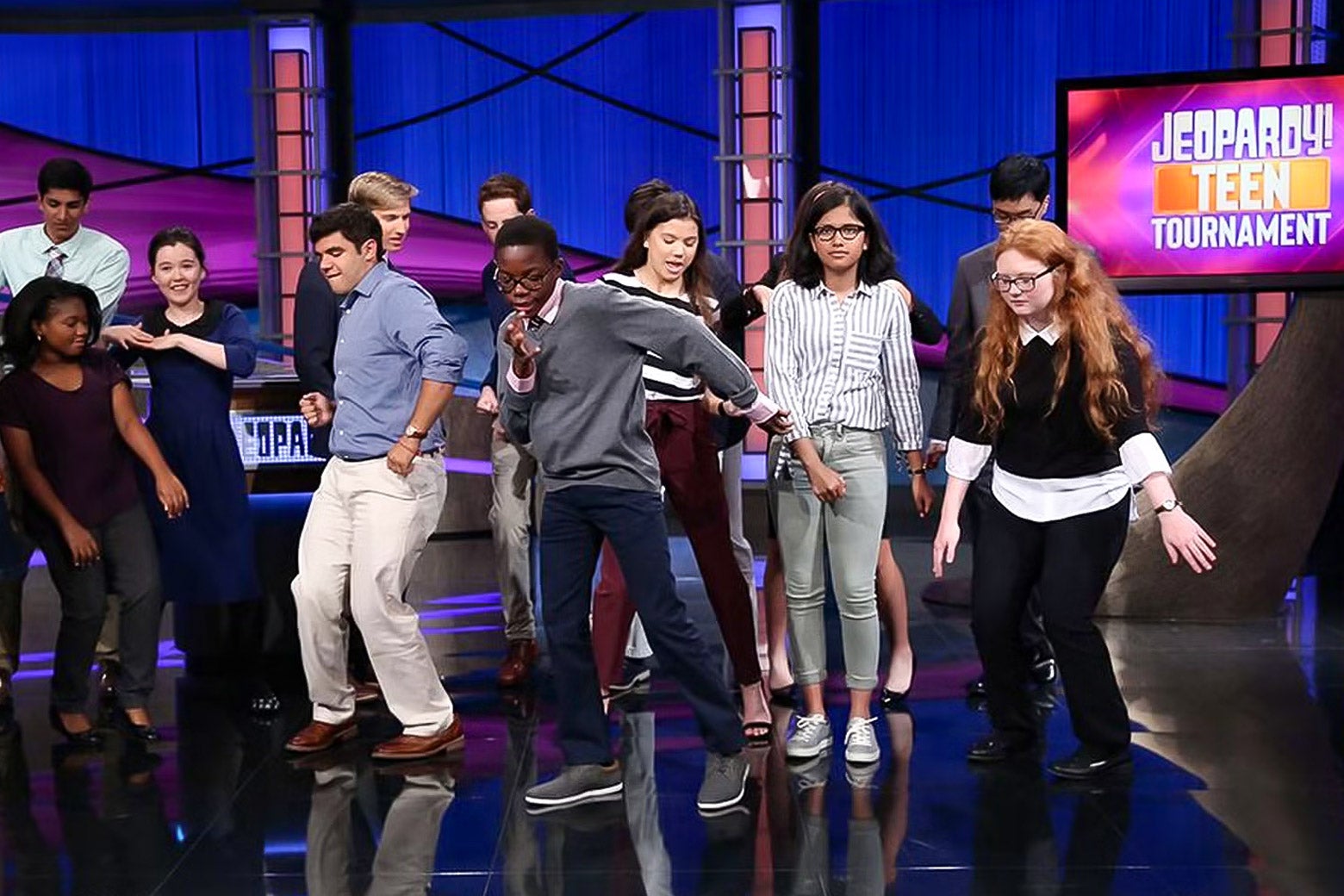
Laura Ansley (2006 quarterfinalist): At the end of the whole thing, we convinced the producers to let us have a dance party on the stage. They plugged my iPod into the sound system, and we danced to Fall Out Boy’s “Dance, Dance.” Alex Trebek was invited but did not join us.
Speaking of Trebek: Some contestants marveled at their chance to meet an idol. Others reeled at encountering a host who, for production reasons—he had already seen the game material the young contestants would shortly be facing—was often kept at a remove.
Splittorf (1995): Alex let it be known that he would mock any of the applicants who said like or um during their questions to him, so we all did our best to avoid those.
Kira Whelan(1997-B semifinalist), as told to the Los Angeles Times: He has the best sense of humor. He related to the teens very well and treated us with a lot of respect.
Xie (2014): He used to make such funny jokes about him and his wife getting drunk during the intermissions.
Ryan Godfrey (1989 semifinalist): The night after the first taping, we all had dinner with Alex on the set of Soul Train, which was the next studio over. I don’t think I had ever seen Soul Train at that point, so I wasn’t quite as appreciative of how strange and wonderful that detail was as I later came to be. If I remember right, we ate turkey tetrazzini. Alex was very friendly and seemed to enjoy talking to and joking with all of us. I remember him wearing some kind of late-’80s version of a leisure suit with an open collar.
Slitt (1992): We didn’t fully understand that Alex wasn’t allowed to talk to us outside of the context of the show, so at the time I just thought he was really aloof. We ran into him in the hallway and all started squealing and waving and he just turned and walked away, and we were deeply disappointed. Now I understand why, of course.
Woodford(1993 champion), as told to the Lexington Herald-Leader: He’s not as nice as he appears to be on TV, although I still like him. He is the star of the show and he knows it.
Eschliman (2012): When he takes a picture with you, if you’re taller, he stands on his tiptoes. I got a little tiptoe.
The Courier, on the 1994 tournament: At one point, when the monitor wasn’t working, Trebek pulled off a shoe and threw it at the screen.
Steffen(1994), as told to the Courier: You won’t see that when it airs, though.
Zielenski (1995), on the moments after winning his tournament: All the contestants came out to congratulate me, and my parents and sister were summoned from the audience to join me. Mom and Dad are gone now, and it is a bit poignant to see the moment on the tape. I have no idea what Alex said to all of us.
Weiss (1990): I still have a signed photo in my office that he must have signed after the tournament because it says “A Winner!” at the top.
Eschliman (2012): I was the last taping, and I really had to pee. A producer said to me, “The closest bathroom is technically a women’s bathroom, but you can use it anyway. I won’t tell.” Then the man in front of me turns around, and it’s Alex Trebek, wearing khakis and a white V-neck. And the V-neck is so deep—like, his chest hair spilled over. And he just goes, “You’ll be safe.” He also was wearing a gold chain, which I thought was interesting.
Hart (2011): When I won my quarterfinal, the second place, Raynell Cooper, got a wild card, and third place, Carlee Jensen, was just outside of the wild-card range, so she was the alternate for Day 2. As we were talking onstage while the credits rolled, Alex said, “You know, Carlee, there are some poisons you could slip in a teenager’s drink that would knock them out for, oh, 24 hours. You’re still in this!”
LaMonica (2016): I was a senior in high school at the time of filming, and my friends dared me to ask him to be my prom date. I at least knew that this was a bad idea to do during the contestant interview, so I waited until after the group picture was taken. I said something along the lines of “Excuse me, Mr. Trebek, I know this is so silly and you can say no, but will you go to prom with me?” His response? Well, I actually included that I asked Alex to prom on my Hinge profile, and one man opened the match to my profile with “What did he say?” I told him the truth, that “he gave me a curt no,” and the conversation sparked from there. I’m marrying that man next year.
Following the tournament, the more material prizes varied over the years.
Splittorf (1995): I won $1,000 for my appearance, and the products I won included several hair-care products, a PC version of the Jeopardy! computer game, a year’s supply of V8 (a book of 24 manufacturer’s coupons good for a free bottle of any size of any variety of V8), and the Hooked on Phonics learning system. When my show reran just before Labor Day 1995, the product plugs at the end of the rerun were slightly different, and my parents were surprised when more V8 coupons, and a few other things came to our house to reflect that. Since I was off to college by then, they held on to them and filled my Christmas stocking with them when I was home for winter break.
Mitchell Epner(1987 first runner-up), Lee Press-On Nails, and a year’s supply of Charleston Chews. Some of my Dartmouth classmates made certain that the Charleston Chews did not last beyond the end of first term
The Columbianon Budde (1999): Budde earned $2,500 for his first-round appearance as well as other prizes, including a watch he now wears. He’s still waiting to get some frozen seafood, a muffler discount, a steam vacuum, and toaster pizza. Budde doesn’t even know what a “Jennifer Convertible” is, but something with that name is supposed to be arriving one of these days, too.
Slitt (1992): Some of it went to college applications, and the rest went to fixing my mom’s car after I crashed it, because, hey, I was 16. That was also back in the days when we got things as prizes, so my family ate a lot of Rice-A-Roni for a few months.
Severson (2005): All of us also received a computer package in addition to our cash winnings: a laptop, printer, modem, and maybe a router? I took that laptop with me to Princeton and used it for my whole college career, always referring to it as my Jeopardy! laptop. I composed my senior thesis on it, which got the only A-plus of my college career. Thanks, Alex!
Zielenski (1995): I had promised to buy my niece a swing set with the money, and I did. I also bought my first car—an Escort.
LaMonica (2016): I spent a portion of my winnings on my first car, a 2002 navy two-door Chevy Blazer that I named Stella and miss very dearly.
Emma Arnold(2018 first runner-up)lready pre-spent $300 of it on new ice skates
Cooper(2013)I was able to buy a new guitar, an amp, and car. But there was also money there for emergency expenses that came up. It gave a bit of a buffer as far as paying for things here and there. I was able to cover college tuition for my brother and things like that
Weiss (1990): I remember writing my first-year first-semester tuition payment check on my own checking account, which, at 17, I thought was pretty neat.
Contestants were swept into a media frenzy: After winning it all at the 1994 tournament, Matt Morristaped an episodeofThe Jon Stewart Showon MTV. Others made the rounds for other feats: After 2011 second runner-up Raya Elias-Pushettincorrectly guessed “pussy furry” as the answer to a clue, the moment was featured onThe Soupand got awrite-up in Salon. Sabrina Duong famously asked the age-old question “What areThose?” in a Final Jeopardy! response, occasioningwidespreadcoverage.
Everyone remembers what it was like when they got home.
Splittorf (1995): The day my show aired was a snow day, so I was home from school, which in my mind was perfect since I didn’t have to answer too many questions about whether or not I was excited, nervous, etc., for everyone to watch it. Then, a day or two later, one of my teachers showed it in class, so a reporter showed up and watched it there with us. There was a great photo of me from that newspaper article with my head buried in my hands while sitting at my desk.
Block (1988): This turned into a big deal in my hometown of Staten Island. The day of my televised final victory, they had a party for me at my high school, and the borough president showed up and proclaimed it “Michael Block Day.” Not sure I’ll ever live that down.
Severson (2005): I was interviewed by two different stations ahead of my first episode airing, but unfortunately, I came down with a wicked head cold at the same time. You can tell I’m sick as a dog in the interviews. They ended up coming to my parents’ house later that night to film me rewatching a recording of the episode, which was definitely not weird at all. I remember getting lunch at Subway once and being recognized by a stranger.
Stadler (1990): I started receiving letters and phone calls from a superfan. This was preinternet, but she somehow tracked me down. She sent brownies to my dorm at Duke, mailed me a signed copy of My Name Is Asher Lev (she seemed fascinated that I was Jewish—a topic I had discussed with Alex on the show), and eventually showed up at my dorm one weekend hoping to meet me. Ironically, I was out of town at a quiz bowl tournament and missed her. She had driven all the way from Texas to North Carolina. I often think about that experience—I was on television for 44 minutes and ended up with a superfan. It makes me marvel at what real celebrities must deal with.
Muffy Marracco (1992 quarterfinalist): A boy named Lev Osherovich saw my episode, thought I was cute and funny, and tried out and made it on for the 1993 tournament. He was on with a friend of mine, Pat Larash, who gave him my address, with my blessing. We began as literal pen pals, moved to email in college, and wound up dating for a year.
Godfrey (1989): The Teen Tournament was also important to me because my wife, who I met almost 15 years later, remembered seeing me on it and thinking I was cute.
Epner(1987),were from elementary school classes on Long Island. A bunch of teachers decided that writing a letter to me would be part of the week for second graders
Zielenski (1995): Several people wrote me a letter of congratulations. My parents made me answer every letter.
Weiss (1990): One local radio station, WAVA, had a morning show called The Don and Mike Show that aired from a studio in northern Virginia. They called my house one morning unsolicited, and I ended up on the air the day after the first episode, I believe, and then a few more times, before inviting me back after the finals aired with five of my friends. They hired a limo that drove the six of us around D.C. all morning, and they called the limo occasionally to check in.
Mahoney Hoelscher (2001): The producers used B-roll footage from our tour of Philadelphia going into commercial breaks and at the end of the episode. For whatever reason, their favorite shot was of me chowing down on a cheesesteak. I was on four episodes, and they aired it a lot. You can imagine how much teasing I got for that back at my high school.
Sattler (2018 champion): For about a year after the tournament, I did have people occasionally recognize me in public, but it was usually very positive and respectful. A couple of people had (and still do have) parasocial relationships with me, which weren’t super fun to learn how to navigate at 17, but I’ve gotten much better at protecting myself as I’ve grown up. Online, I did face quite a nasty response to my original appearance as a 16-year-old. Mostly from grown men.
Many Teen Tournament alumni have found that their time playing on the show was just the beginning of their relationships with the other contestants in their cohort.
Weiss (1990): The night after the final episodes taped, 12 or 13 of the 15 contestants went to the movies at the theater at Universal Studios near our hotel and saw Back to the Future II. It was during that movie, sitting in the darkened theater, that I remember it sinking in what had just happened and that several million people were going to watch it on television a month later.
Hart (2011): I struggled to fit in in high school. Through the tournament, I got to meet a bunch of other smart, precocious nerds, and I could be a smart, precocious nerd without people looking at me weird. At one point in the greenroom, we all sang the entirety of Potter Puppet Pals’ “The Mysterious Ticking Noise”—peak 2010 culture—with each of us taking a different part.
Slitt (1992): Before the internet, it was much harder to find “your people,” and it was an utter revelation to suddenly be in a whole group of kids who all shared the same love of trivia.
Hoelscher (2001): At the end of the week, we exchanged email addresses and AIM usernames, and quite a few of us stayed in touch for the next few yearsf my fellow contestants
LaMonica (2016): For the majority of high school, I was extremely depressed and in the throes of pretty serious mental health issues. One of the only places I felt confident was within my school’s quiz bowl team. My adviser encouraged me to apply to Jeopardy! and I figured it couldn’t hurt, but getting all the way into the tournament really showed me how much potential I had not only as “the smart one” but as someone who Jeopardy! wanted to take a chance on. I’m extremely proud of how far I’ve come since then and really credit Jeopardy! for dumping me into the deep end of keeping my cool in front of a crowd.
Sattler (2018): Thanks to Jeopardy!, I now have a couch to crash on in virtually every major city in the U.S. That’s very useful for a budding comedian. They’re some of my oldest, most cherished friends. And I am not excited to buy plane tickets for all the weddings in the next five to 10 years. But I wouldn’t change it for the world.
What if this really is the end of the Teen Tournament?
Sattler (2018): I wonder how much the lack of return of the Teen Tournament since 2019 is because of the modern internet and its impact on the teens who would compete. I was pretty offline in 2018, and I still got run through the emotional wringer by it, so I can only imagine how teens today might be treated and impacted if the tournament were to return.
Hoelscher (2001): Being on the Teen Tournament was quite literally my dream come true, but it’s also very weird to achieve your childhood dream at the age of 15. Is it possible to have a midlife crisis as a teenager? That’s probably an overstatement, but it’s more or less what it felt like at the time. Like, what do I do now?
Xie (2014): I think it also inspires kids that being on game shows and learning cool stuff isn’t that scary; it’s for everyone. If teens like you and me can do it, what’s stopping the next random kid from, say, Ohio, from trying to learn everything they can? Especially when I think about what Jeopardy! is becoming, this sport where you have to try to become the best—what happened to just learning Jeopardy! because it’s fun? Because we love to learn? Sometimes it’s about the relatability of the game show.
Weiss (1990): I’ve always thought that since they ended the Teen Tournament, a reunion tournament of past teen participants would be really good television. I was 15 when I taped those shows in January 1990, and I’m 52 now. But gather up 15 of the winners and finalists from the tournaments of the 1990s, and I think you’d have a pretty good two weeks of television.
These conversations have been lightly edited and condensed for clarity.
