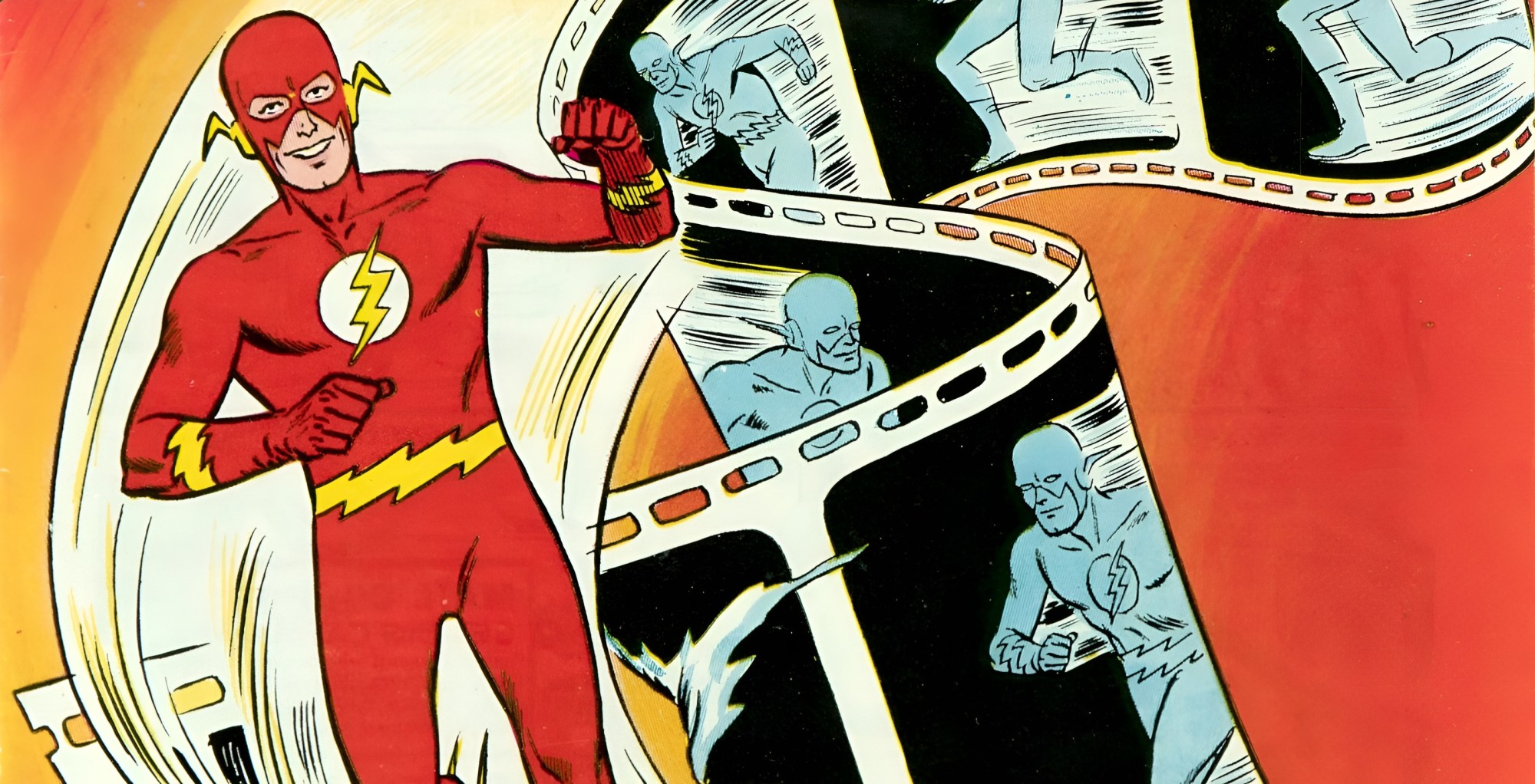
For decades, “comic books” and “super-heroes” have been synonymous. But for a few years in the 1950s, the super-hero genre looked like a fad of the previous decade, soon to be relegated to a footnote in the history of the medium. In July of 1956, over one hundred and seventy comic book titles were published. Of those, only nine were super-hero comics. All but two starred Batman or Superman, some of the only super-heroes popular enough to survive the genre’s virtually extinction earlier in the decade. But the month’s most consequential issue wouldn’t be Batman and Robin’s encounter with a “Caveman at Large,” or Superman’s face-off with “the Girls Cops of Metropolis” (it was the fifties, after all). That month, DC would unknowingly publish the most important comic book of the 1950s. In the pages of DC’s anthology try-out comic Showcase, editor Julius Schwartz, writer Robert Kanigher, and penciller Carmine Infantino would launch a bold experiment to see if one of DC’s Golden Age heroes could be reworked for modern audiences. The result was Barry Allen, the Flash.
Videos by ComicBook.com
In this single issue, DC’s creative team ushered in the “Silver Age of Comics,” which comic fans and historians literally define as beginning with this issue. The Barry Allen Flash was a new kind of super-hero, his origins rooted in modern science, his costume sleek and evocative. Showcase#4 changed the medium, but this isn’t the only reason it’s coveted by collectors: the comic is also vanishingly rare, with less than six hundred graded copies on the Certified Guarantee Company (CGC)’s census. For comparison, the census records more than three-thousand copies of Fantastic Four#1, the other definitive issue of the Silver Age. Comics published before 1960 are considerably rarer (flip through the back issue bins next time you’re at a comic convention or store and see this in action), and DC key issues are generally scarcer — especially in high grade — than Marvel. Showcase#4 is both, meaning that when even a mid-grade copy like this CGC-graded 6.0 at Heritage comes up for auction, it is an event. With two weeks left to bid at the time of writing, the price has already climbed to more than $12k. Heritage’s most recent sale of a copy in comparable condition was a 5.0 in May of 2026, selling for more than $30k.
How DC Gave Barry Allen the Definitive Silver Age Origin Story
Image Courtesy of DC Comics
DC’s Showcase was used as a testing ground for new characters and concepts, enabling the publisher to gage reader response to a new idea without investing in publishing a new comic. Its first three issues are a reminder of state of the comic book medium in the mid-fifties: issue one showcased firefighters, issue two was a frontier western titled “Kings of the Wild,” issue three followed Navy Frog-Men. Schwartz had no more confidence in the rebooted Flash that any of these previous concepts. If anything, he had less. Sales data bore out that super-heroes were in a continued decline. The decision to experiment with a new, modernized super-hero character was a by-product of the newly-adopted Comics Code, which put strict guidelines around material suitable for publication. It brought a (temporary) end to the lucrative horror and crime comic genres, necessitating that publishers adapt, as DC did, or die, as competitor E.C. Comics did after cancelling its popular horror titles like Tales from the Crypt.
The Flash would receive an updated origin, doused with chemicals in a laboratory accident after the chemicals are struck by lightning. His Golden Age counterpart, Jay Garrick, received his powers from “hard water” (water with a high mineral content) vapors. This was in contrast to many of DC’s other Golden Age heroes, who either lacked real super-powers or received theirs through supernatural intervention. Kanigher elected to have the new Flash acknowledge his predecessor, established here as a comic book character that Barry Allen read in his youth. When Barry discovers he has super-speed powers similar to the Flash, he takes on the name, modeling his costume’s logo and color-scheme off of the other hero. A few years later, Gardner Fox would revise this in The Flash#123, adding that Jay Garrick exists (along with DC’s other Golden Age heroes) on a parallel Earth.
In this inaugural issue, the Flash also battles his first super-villain, the largely-forgotten Turtle-Man. Turtle-Man derives his name from his unique way of committing crimes, which makes him the “Slowest Criminal on Earth,” and was inspired by a Golden Age opponent of Jay Garrick’s, the Turtle. Turtle-Man commits his crimes in stages, completing them only after authorities have let their guard down. In this issue, he opens a bank vault, waits, thenreturns days later to steal the money within. It probably sounded better when Kanigher pitched it. Reader response to the issue was nevertheless extremely strong; Kanigher’s use of Flash’s powers is imaginative and downright brilliant, with scenes like Barry watching a waitress drop plates in slow-motion, or his introduction as a scarlet blur being tracked by radarstill serving as some of the coolest visuals in the character’s history. It took DC until the following year to produce a follow-up story, in Showcase#8. That issue would also introduce Captain Cold, one of the Flash (and DC at large)’s best-loved villains.
Why Fans Agree Showcase#4 is the Most Important Comic of the 1950s
The Flash would make two further appearances in DC Showcase#13-14 before being moved over to his own title, The Flash, in 1959. The comic would begin at issue #106, retaining the numbering from the original Jay Garrick run. It hit the ground running, introducing another classic foe for the Flash with Mirror Master. The early years of the John Broome-scripted, Carmine Infantino-drawn Barry Allen run would introduce a host of still-iconic characters, including heroes Elongated Man and Kid Flash, as well as villains like Weather Wizard, Captain Boomerang, Trickster, and fan favorite Gorilla Grodd. Outside his own title, the impact of Barry Allen on the larger DC Universe became clear: when sales remained strong for the Flash’s later Showcaseappearances, DC made the decision to revive another classic Golden Age hero, Green Lantern, in 1959’s Showcase#22. Aquaman would be the next to make his return, joining with the Flash, the new Green Lantern, and four other DC heroes to form the Justice League of America (itself a reimagining of the Golden Age “Justice Society“) in Brave and the Bold#28.
In the decades since, the Flash has remained one of DC’s most prominent heroes, with former Kid Flash Wally West taking over the mantle in 1987. The Wally West Flash would become a fan favorite in the ever-popular DC Animated Universe, while Barry Allen would head two different television series, including CW’s long-running The Flash. All of this sprang forth from DC’s bold experiment with Showcase#4. Even the Marvel Universe owes a debt to Barry Allen, as the Fantastic Four’s creation was famously inspired by the success of the Justice League of America. Now, collectors have a rare chance to own the issue that single-handedly revived the super-heroes comic genre and set virtually everything else in this article into motion. While the Overstreet Price Guide lists the value of a 6.0 graded Showcase#4 as $30k, the $32k selling price of the 5.0 copy earlier this year gives every indication that the 6.0 up for auction right now could redefine the issue’s value. But for a hero who can outrun Superman, breaking records is nothing new.
Black Canary’s First Appearance Is Already a Collector’s Grail but This Copy Is One-of-a-Kind
Reddit User Rediscovers His Entire Transformers Collection After 30 Years (And There Is Something Very Rare About Them)
<img src="https://comicvibe.com/wp-content/uploads/2026/09/Pokemon-Ash-Classic-Anime.jpg" alt="Pokemon Card Shows Urged to Ban Puppies After Players Attempt to Trade Live Animals for High-Value Cards”>Courtesy of The Pokemon Company
Collectibles
2 days ago
Pokemon Card Shows Urged to Ban Puppies After Players Attempt to Trade Live Animals for High-Value Cards
Collectibles
3 days ago
One of Dune’s Weirdest Collectibles Is Getting a Second Life Ahead of Dune 3
Collectibles
3 days ago
Long Before Disney Parks Merchandise Became A Collecting Obsession, There Were These Model Kits
Gaming
3 days ago
LEGO Astro Bot Set Leaks Ahead of Official Reveal
Images Courtesy Fanatics Collect and The Pokémon Company
Collectibles
3 days ago
Six Supremely Rare Eeveelution Pokémon Cards Combine for a Staggering Sum Near $600k at Auction
Collectibles
4 days ago
These Xenomorph Halloween Costumes Are Some of the Least Kid-Friendly Movie Tie-Ins of All Time
Courtesy of The Walt Disney Company
Collectibles
4 days ago
A Unique Star Wars Lightsaber Signed by Mark Hamill Sold at Auction for a Low Price for a Strangest Reason