

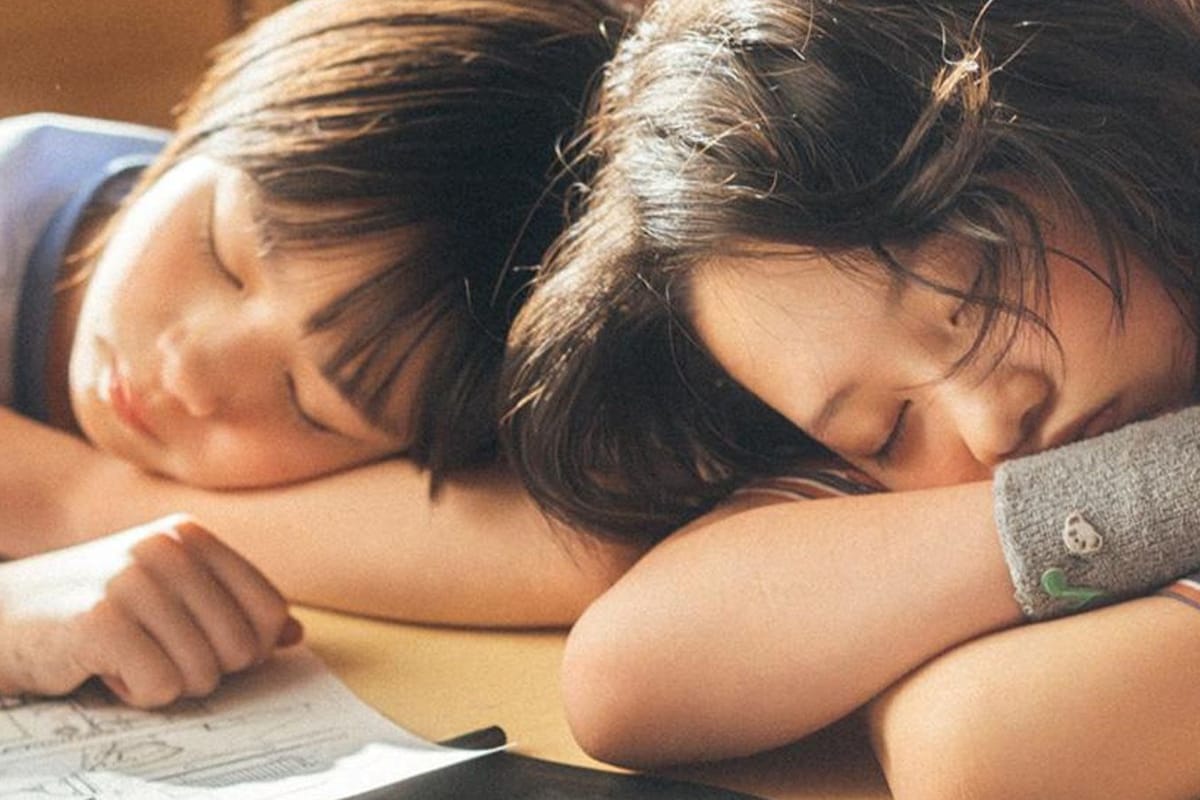
The Japanese director rebounds from a rare sci-fi misfire with his unabashedly emotive tale of girlhood friendship, grief and manga obsession, which premiered at Venice Film Festival
I’ve had shivers all night thinking about Look Back, Hirokazu Kore-eda’s elegant weepie adapted from the manga by Tatsuki Fujimoto, itself turned into a feature-length anime by Kiyotaka Oshiyama just two years ago. Apparently, Kore-eda was inspired to make the film after being drawn to the image of a girl with her back turned on the cover; sensing in its story of two girls’ indelible bond a “desperate resolve” he recognised from his own film Nobody Knows, he decided to turn it into a live-action film. A return to form after the sci-fi bomb Sheep in a Box, premiered at Cannes in May, it’s proof that you can’t keep a good man down for long – especially one as prolific as Kore-eda, directing his eighth feature in ten years here. (That’s not counting his Netflix series.)
Our story starts with Fujino (Natsuki Deguchi), a young girl whose talent for manga wins her the admiration of her classmates and a regular spot in the school newspaper. When classmate Kyomoto (Aju Makita), a shut-in with severe social anxiety, starts making waves in the paper with mangas of her own, Fujino is incensed, obsessively developing her art through trips to the library. Kore-eda stages these scenes through a deft montage featuring Fujino, back perpetually turned from the camera, as she works on her craft oblivious to the attentions of her family. Hers is a solitary pursuit but we sense that, somehow, she is reaching out to her reclusive classmate by creating a dialogue with her work.
At the end of the school year, Fujino is tasked with taking Kyomoto’s graduation letter to her house, where a hastily scribbled manga finds its way under her classmate’s door. The moment leads in turn to a collaboration and fast-blossoming friendship between the pair, Fujino helping Kyomoto to take tentative steps towards a life she’s seemingly abandoned. (It’s never clear if Kyomoto is living in the house alone, which social services might want to have a word about.) These scenes are shot with an unabashed warmth that lands on just the right side of sentimentality, lent beautiful shading by the leads’ delicate performances and Yuta Bandoh’s slow-building, Studio Ghibli-esque score. (Bandoh co-soundtracked Miyazaki’s The Boy and the Heron with his regular composer Joe Hisashi.)
Later, when the pair part ways in bitter circumstances, a tragic event unfolds that risks tipping the film into melodrama. But this is where the Look Back gets really interesting, as a sliding-doors moment sets off ripples in the spacetime continuum to ask potent questions about a character’s guilt, and the age-old question of why people are driven to create. It’s a film that wears its heart on its sleeve quite openly – and perhaps its charms will be lost on those more attuned to the director’s earlier, more astringent work – but the swelling emotion of its first half pays off in ways both cathartic and complex.
