

Director Yukimitsu Ina and animation producer Hitomi Tateno, a former Studio Ghibli animator, adapt Machiko Kyō’s manga about the Okinawan schoolgirls sent to nurse Japanese soldiers in frontline cave hospitals in 1945; GKIDS opens the film in North American theaters September 4.
In 1945, a group of 222 students and 18 teachers of the First Okinawa Girls’ High School and Okinawa Women’s Normal School formed into a nursing unit for the Imperial Japanese Army during the Battle of Okinawa. Known as the Himeyuri (“morning star lily”) Student Corps, the students were told that the Japanese army would defeat the American invasion easily, and that they would be safe from danger. Many brought their school supplies and uniforms with them to study and prepare to return to school.
But, instead, the young girls were deployed to frontline cave hospitals under constant gunfire and bombings. Few students and teachers managed to survive the war. And none came back the same.
In 2009, Machiko Kyō created a single-volume manga that explored the deep bonds and dark trauma experienced by the Himeyuri students. The manga was called “Cocoon” and now Yukimitsu Ina makes his directorial debut with an anime film adaptation of the story: Cocoon – One Summer of Girlhood. Produced by Sasayuri with studio founder Hitomi Tateno (former Studio Ghibli animator) serving as animation producer, the film is being distributed by GKIDS for its North American theatrical release on Friday, September 4.
“I had seen the manga at the bookstore and the art was really lovely, so it caught my eye,” shares Tateno. “Looking at the cover, I had guessed it was about the Himeyuri Corps. I took a small peek inside but didn’t want to read it further because it’s a very emotional wartime story. Then, when the NHK Broadcasting Center brought it to me, that was when I truly read it. But the decision to make it into an anime came from director Ina’s storyboards.”
Ina adds, “Miss Tateno had brought the story to me and there were several pieces of the manga that really left an impression on me. When I started to draw it out and recreate it in my own head, I thought it would make a really good anime film.”
And it was Ina’s storyboards that left a lasting impression on Tateno. “I was mesmerized,” she admits. “He had kept the core story but created a whole different new world. The girls, they’re eventually gone. Most of them die. But they have the power to try and survive within them. And director Ina really portrayed that in his image board. That’s when I thought, ‘We have to make this film.'”
The animation producer — who brought together legendary veteran animators like Akihiko Yamashita and Shinji Otsuka (Princess Mononoke and The Boy and the Heron) for the project — was determined to bring Ina’s storyboards to life. But some scenes were harder than others, and not because of the technicality. The film centers around characters San and Mayu, who attend their all-girls school on a warm and tranquil island. When war reaches their shores and they are ordered to help nurse the wounded in a military hospital hidden away in a cave, death and brutality escalate. For Tateno, one of the most difficult scenes to animate was when one of the soldiers attacks San and violates her.
“We really struggled with how to depict that attack,” notes Tateno. “It’s a difficult thing and it was stressful for me because I didn’t know the correct answer. But I had a responsibility as a female to tell this story right. We decided to have the eyes covered so you can’t see what’s happening, but you can still imagine what’s happening to her. In war, the person or the country or the entity that loses is the one who is violated. That violation may be things getting stolen — like land or belongings — or it can be a girl’s innocence.”
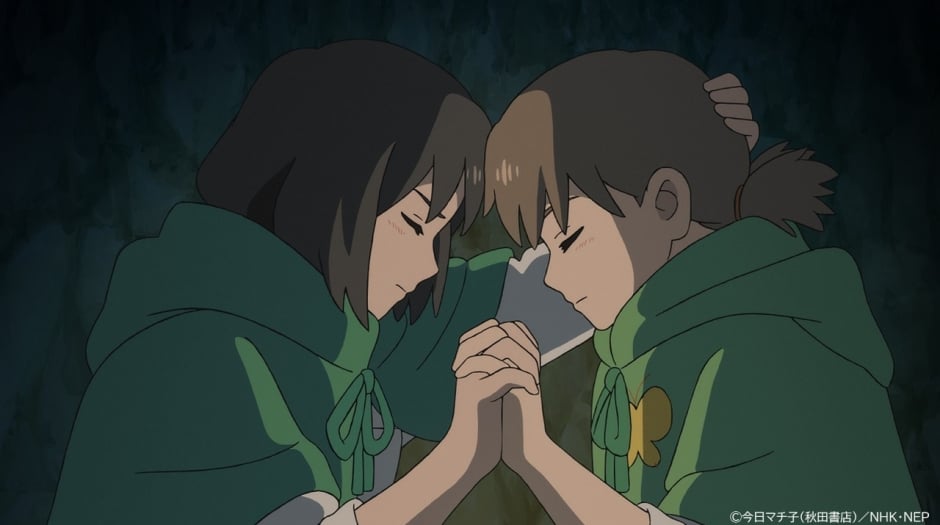
The scene is a major turning point in the story, where these resilient girls come to the conclusion that there are worse things than death, and some losses are too much to bear. “San’s experience is so horrific that the girls decide they would rather die than be violated,” says Tateno. “So, they make a suicide pact. That scene, with them in a circle, holding hands and holding this bomb, that was a hard scene, too. We wanted everything they were thinking and feeling to be conveyed in that scene. I could feel it. I felt all those emotions of what the individual girls were going through. That was really difficult. In any culture, the onew who lose the most in a war are the women and children.”
And the girls in Cocoon are both. They are young girls who start out spending carefree days on a sunny island paradise. They live in a nursery of girlhood and sisterhood, a haven from the outside world. Then, they are thrust into an incredibly dark, violent reality. While the story may originate from the Himeyuri students, the film is a universally devastating yet beautiful plea for peace.
“When I took on this project, what I really put importance on was that no matter what generation or gender saw the film, they would look at it as something that could happen in the modern day,” says Ina. “I wanted it to be relatable for people in Europe or America, not just Japan. In fact, if you look at the architecture in the film, it’s very a mixed style from different cultures, like French and Iranian. I didn’t want cultural differences to be a conscious thing that people would think about when they watched the movie.”
The motifs of butterflies also symbolize universal messages in the film. “Butterflies are symbols for peace and life,” explains Ina. “When you think of a cocoon, and a butterfly emerging from it in a new life, it’s a big contrast to war. With the first death that we actually see on screen, there’s a butterfly there. Even though this horrific thing is going on, there’s still a butterfly flying around. That was purposeful.”
For as magnificent as butterflies are, they are also incredibly fragile. The most beautiful and powerful parts of a butterfly — its wings — are made up of thin layers of chitin with a network of veins, covered in thousands of tiny overlapping scales. These scales give the wings their colors and patterns, and help with flight. Touching a butterfly’s wing too roughly can tear scales or damage the wing membrane, impairing flight, thermoregulation, and camouflage. This can shorten its lifespan.
The parallel between the fatal consequences of roughly handling a butterfly and the mental degradation girls in the film experience after being repeatedly mistreated was not lost on Ina. “The butterflies also tie into that fleeting life, that’s full of danger but can still be beautiful,” he says. “It all really connects and I hope others notice it.”
Victoria Davis is a full-time, freelance journalist and part-time Otaku with an affinity for all things anime. She’s reported on numerous stories from activist news to entertainment. Find more about her work at victoriadavisdepiction.com.
Tags
Innocence Lost in War
Cocoon – One Summer of Girlhood
Cocoon
Yukimitsu Ina
Hitomi Tateno
Machiko Kyō
Akihiko Yamashita
Shinji Otsuka
Sasayuri
GKIDS
Studio Ghibli
NHK
Anime
Anime films
Animated Feature Films
feature film animation
animated films
Feature Films
Features
Movies
Manga
People
Princess Mononoke
The Boy and The Heron
2D
2D animation
More From ANIMATIONWorld:
You’re currently viewing the most recent post.Previous Post
Studio Ghibli: No Future?
