

‘Ruin and decay bring a chance of rebirth’: Hidetaka Miyazaki on uniting players in a damaged world
As FromSoftware’s new multiplayer game The Duskbloods nears release, the legendary game director behind Dark Souls talks connection, pessimism and of course, feet
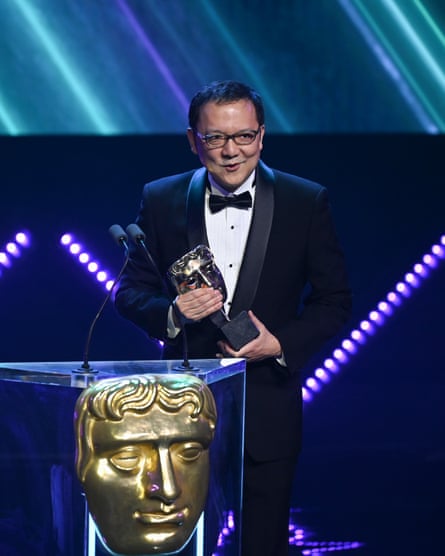
Since 2009’s Demon’s Souls, Japanese video game director Hidetaka Miyazaki has shown the world a different way to think about game design. His games defy convention with punishing fights, obscure rules, and unknowable, inhospitable worlds. The “Soulslike” genre – named after Demon’s Souls and its sequel Dark Souls – is now ubiquitous, influencing multimillion-sellers from God of War and Star Wars: Jedi to Hollow Knight. Miyazaki’s most recent success, 2022’s Elden Ring, which credited Game of Thrones author George RR Martin as a co-creator, sold over 30m copies and inspired Alex Garland to adapt it for the big screen at A24. It earned Miyazaki a spot on Time magazine’s “most influential” list, an accolade he shares with just one other game developer: Mario creator Shigeru Miyamoto.
Miyazaki is now 51 and has been FromSoftware’s president since 2014, elevated from game designer to CEO after the success of the Souls series. He has a cherubic face that could pass for 35. He rarely speaks publicly, and never on camera. When he does speak, he answers questions like one of his characters – softly, sadly, his head bowed, making eye-contact only when I am speaking. Outside the studio where we speak is the sprawl of Tokyo’s Shinjuku, an ever-changing maze where tourists get lost and pop-up stores appear and vanish without a trace. Today, a J-pop band performs in the square as the cicadas scream from the trees. A gilded statue of Malania, one of Elden Ring’s toughest bosses, looms over this dimly lit conference room inside From’s headquarters, a bonfire checkpoint away from the chaos.
FromSoftware’s in-game universes are filled with clues – enemies, places and scraps of information from item descriptions paint a vague image of the world, and the player fills the blank space. You never fully understand these domains, although countless YouTube video game theorists have tried – as have other developers in awe of his work. “Of all the many things Miyazaki and his team do well, creating a sense of mystery is the greatest,” explains Dishonored director Harvey Smith, who has more than 40 days’ playtime in Elden Ring. “It’s so incredibly hard to do in video games, which are technical systems … But Miyazaki somehow creates an atmosphere of wonder. Even when finishing, you are left ruminating on fun, murky elements that feel half understood. It’s a delicious sense of intrigue.”
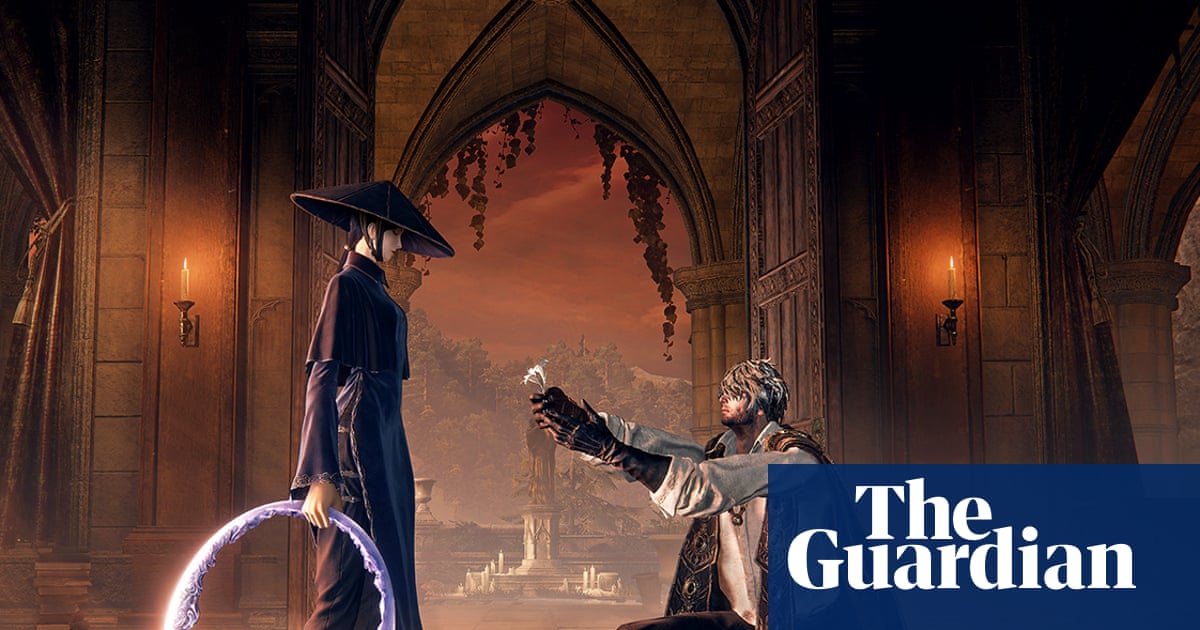
Rather than the single-player action game that Miyazaki’s audience craves (fans are desperate for a sequel to his 2015 gothic masterpiece Bloodborne,for instance), his latest project The Duskbloods is a multiplayer Switch 2 exclusive. Eight players face off against ghoulish horrors, fighting each other to avoid being culled at the end of each round. The survivors are whittled down over three phases culminating in a final three-way battle. The Duskbloods is releasing to an audience with shifting tastes and trends, and it is certainly a risk. “I’m very nervous,” Miyazaki says. “With every title we release there is this mounting tension.”
The game opens with an arresting image: one hand reaching out for another. A male character is slumped on a chair, dejected; the shot moves in close to focus on their draped fingers. From below the frame, a pale hand slowly reaches out and caresses them before gently clasping his wrist. Hands are a recurring motif in Miyazaki’s games; in Elden Ring, massive crawling hands burrow up from underground to attack you, and hand-like giants are revered as deities.
“It’s not necessarily something I’m consistently aware of – maybe it’s something subconscious coming through,” Miyazaki says when I ask about this imagery. “Take a look online and there’s a rumour that I have a bit of a thing for feet, but I’m not honestly sure where this comes from. I feel like I’m trying to depict some side of human nature or the human existence that is difficult to describe.” (His games have featured, by my count, at least six barefoot female characters.)
Perhaps all the hands and feet are symbolic of human connection. One hand reaches for another; bare feet connect skin with earth. Miyazaki has been exploring that theme since Demon’s Souls, whose novel, stranger-centric multiplayer was inspired by a time his car slipped on an icy hill and a stranger helped to push him to safety. In Demon’s Souls and the Dark Souls series, players paint runes on the ground, which other players can then use to summon help in a fight, creating moments of spontaneous togetherness before an inevitable parting.
While The Duskbloods primarily puts players in opposition, it also explores temporary alliances and conflicting objectives, buoyed by Miyazaki’s love for tabletop role-playing games and board games. Players can even become betrothed to each other, forming an alliance. “I feel it’s less a traditional romance and more a sense of secure trust with a character in the world, and that’s something I personally yearn for,” he says. “It’s not necessarily a romantic pairing – it’s having someone that you can ultimately rely on. This concept is carried through from characters like the maidens in Elden Ring … it’s a transient, ephemeral love, which is maybe a motif I’m striving for.”
The Duskbloods is preoccupied with ruin and rebirth, a thematic cornerstone of From’s games – much as Godzilla was a product of nuclear paranoia in Japan. Even as Miyazaki and I talk, a deadly magnitude 6.8 earthquake hits the Kumamoto prefecture on Kyushu island, a thousand miles away. If the very ground beneath your feet is unreliable, that can shape your outlook on life, a concept explored extensively in Japanese literature and entertainment, recently on the hit television show Shōgun.“[Ruin and rebirth] is an ongoing theme in a lot of my games, I realise,” Miyazaki says. “That theme on a cosmological scale applies to The Duskbloods as an interesting philosophical area to explore.”
Miyazaki describes himself as a pessimist, a tendency that he believes comes across in his output. That should be obvious to anyone who’s finished any of his games, in which you keep throwing body and blade against seemingly impossible odds, reborn each time you die at a bonfire checkpoint, to try again. Even when you triumph, nothing ultimately seems to change: these games culminate in bleak, morally ambiguous gut-punches, leaving you not as a conquering hero but as the perpetuator of a hopeless cycle. “If we have two ideas of a brighter or dark future, I would tend to sway towards the darker one,” Miyazaki says. “[But] if you explore the ruin and the decay in those worlds, it also lets you explore some chance of rebirth, and I think having that tiny pinprick of light or hope can be something beautiful, something fleeting.”
Sekiro, Dark Souls, Bloodborne, and Elden Ring are all separate series, but they share the same bones. They’re reborn in different forms, to explore fresh ideas, places and perspectives while still playing, feeling and sounding like a FromSoftware game. While it’s immediately clear The Duskbloods is a Miyazaki game, it too wears a different skin, inspired by extraction shooters like Escape from Tarkov and those tabletop role-playing games the director loves. “There’s no intentional FromSoftware [mantra] – ‘this is the way we make our games’ – because if you start to do that it becomes stale and conservative, and you start having to adhere to a set of rules and philosophies, and it just doesn’t become interesting, you can’t make anything that’s as fun,” Miyazaki says.
“So I feel like at least what’s worked for us philosophically is trying to adhere to what we find interesting first. I think that has created a good throughline through our games, and that’s what we concentrate on to [conceive] a new title.”
Back in his early days at the studio, when he was only a coder on the Armored Core series of games, Miyazaki volunteered to take on a struggling project at From – the game that would become Demon’s Souls. (The game was already in trouble, so he felt he had nothing to lose.) He changed everything about the game, and then the game changed everything about his life, as he climbed from coder to company president. From failure was born a game that changed the landscape of video games. Ruin and rebirth.
But does Miyazaki think he has changed? “I don’t intend to,” he says, a smile curling on his lips. “But I probably have.”
-
This article was amended on 3 September 2026 to correct the release year of the original Demon’s Souls.
Explore more on these topicsShare
Reuse this content
