

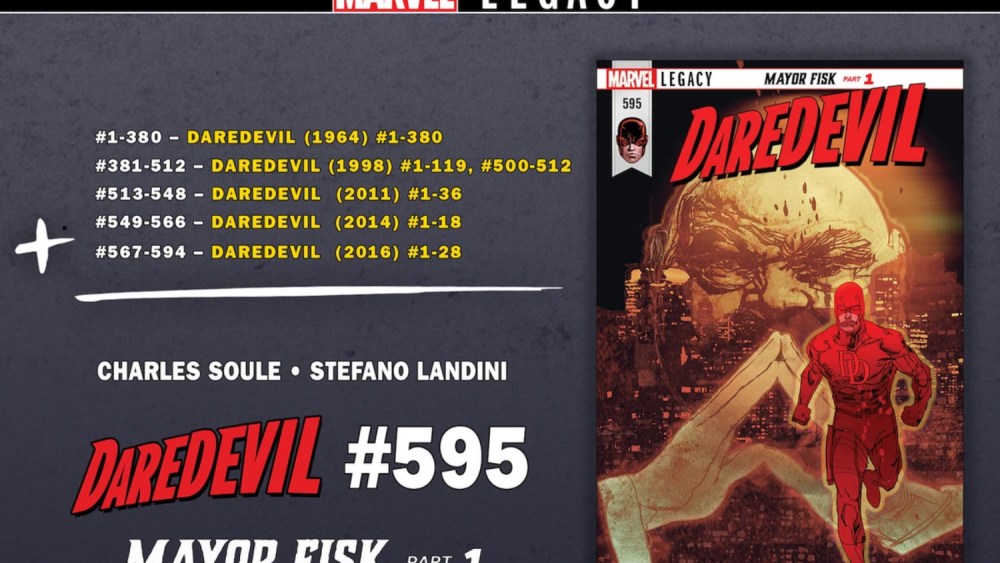
I need to begin by saying that this isn’t Tim Seeley’s fault.
On Thursday, August 20, Seeley made thefollowing post to his Bluesky:
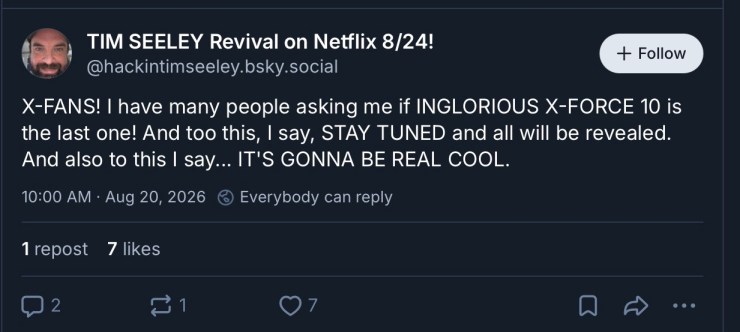
“Another relaunch,” I thought. To be clear, neither myself nor anyone at AIPT has insider knowledge about whether Inglorious X-Force is being canceled or relaunched after the 10th issue (solicited for release on October 21 as of this writing). But a pattern at Marvel has become so familiar that the post made me wonder if we should anticipate an announcement for X-Force or Uncanny X-Forcein a few months.
Let’s call it the “relaunch problem.” For those unfamiliar, the relaunch problem ostensibly looks like this:
- Marvel launches a new series with a new issue #1.
- Sales are initially strong, and the series is able to continue
- Sales taper, and the cost-benefit of keeping the series going leans towards cancellation around issue 10.
- The series is canceled, and a new #1 is announced down the road..
But was this pattern actually real, or had I fallen into an echo chamber that regurgitated complaints ad nauseam? Is this seemingly constant relaunch actually due to sales? I had to do some research. I went to the solicitations to see whether the numbers matched my feelings.
Looking at thesolicitations for September 2026, Marvel is publishing 61 titles (not including reprints, facsimiles, or collected editions). Of those 61 titles, 13 are one-shots (that is, issues that are meant to be treated as standalone stories). Meanwhile, 27 are limited series – and 21 are ongoing monthly titles that could continue indefinitely. Of those 21 ongoing series, nine have an issue number higher than 10.
Thesolicitations for October 2026 bore a similar story. Of 51 titles being 10 are one-shots, 22 are limited series, and 19 are ongoing series. Of those 19 ongoing series, just seven bear an issue number above 10. From there, the most recentsolicitations for November 2026 paints the same picture: with 50 titles, there are seven one-shots; 22 from limited series; and 21 from ongoing series. Of those 21 titles, eight will feature an issue number above 10
While the number of limited series and one-shots may be attributed toMarvel’s publishing arm moving to Los Angeles, a look back at solicitations from last year tells a different story for the ongoing series. Looking at the Marvelsolicitations for September 2025, Marvel had 68 titles: five one-shots, 27 limited series, and 36 ongoing series. Of those 36 ongoing series, 17 bore issue numbers above 10. But this hides the problem. Of the 36 ongoing series solicited in September 2025, just six have made it to September 2026 under the same title and numbering scheme: Black Cat, Captain America, Fantastic Four, Uncanny X-Men, Wolverine, and X-Men. While some series were cancelled out right (notably, the Ultimate line of books), some titles (Avengers, Miles Morales: Spider-Man) have been relaunched with the same title. Others have elected to change their title to justify a new number one – last year’s Moon Knight: Fist of Khonshu gave way to this year’s Marc Spector: Moon Knight.
This is the relaunch problem.
While most people likely don’t know the vast history of Marvel comics (that it started under Martin Goodman as Timely Comics in 1939, rebranded as Atlas Comics in 1951, and finally settled on the Marvel Comics name in 1961), I imagine most people generally recognize that Marvel is, well, quite old. They recognize that characters like Spider-Man, Iron Man, Wolverine, Hulk, etc., have been around for decades. Even newer characters like Miles Morales’ Spider-Man, Kamala Khan’s Ms. Marvel, Robbie Reyes’ Ghost Rider, and Lunella Lafayette’s Moon Girl have now been around for more than a decade. The original Young Avengers crew is old enough in publishing history that they can go get a drink. None of this rich history is reflected in the numbers on the comic book stands.
Yes, when prospective comic book readers enter comic shops in mid-September, they will see The Amazing Spider-Man #1000 on the stands in a myriad of variant covers. But if they want to go back to read the previous 12 issues, they can’t look for The Amazing Spider-Man #988. It doesn’t exist. Instead, they would want to look for The Amazing Spider-Man #24 by Charles Soule, Joe Kelly, and Jesús Saiz. Importantly, this is different from The Amazing Spider-Man #24 by Zeb Wells and John Romita Jr. (that’s actually #918). It’s also different from The Amazing Spider-Man #24 by Nick Spencer and Ryan Ottley (that’s #825). It is also not The Amazing Spider-Man #24 by Dan Slott, Christos Gage, and Giuseppe Camuncoli, nor The Amazing Spider-Man #24 by Howard Mackie and John Romita Jr., nor The Amazing Spider-Man #24 by Stan Lee and Steve Ditko (this last one is actually #24, though).
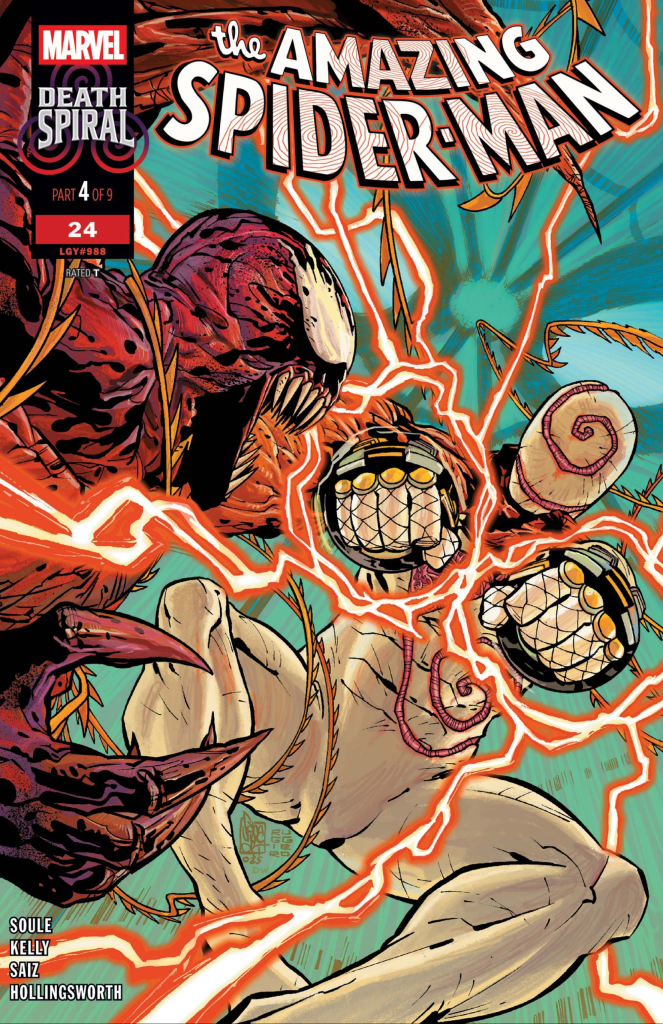
The Amazing Spider-Man #24 (by Giuseppe Camuncoli, Lorenzo Ruggiero, and Dean White). The “LGY 988” signifies that this is actually the 988th issue of The Amazing Spider-Man. Courtesy of Marvel.
Marvel is far from the only publisher that does this. While DC’s Detective Comics will release issue #1115 in November, Batman is somehow solicited for issue #15, while Catwoman bears #93. Christopher Priest has written Vampirella for Dynamite for nearly a decade, but the most recent issue is issue #5.
To be fair to the publishers, there are plenty of reasons to renumber books. When Ta-Nehisi Coates and Brian Stelfreeze began their Black Panther series in 2016, it had been four years since a Black Panther-titled book was on the stands. Selling it under its legacy numbering of #148 wouldn’t have made sense and could have alienated people who were looking to start with Coates’ arrival on the book. When it relaunched in 2018 with Coates writing and Daniel Acuña on art, the book had a decidedly different art style and premise, with T’Challa awakening without his memories in an intergalactic empire, making it a good starting point for new readers. This change in style was used to justify a new #1 issue.
So, when Miles Morales: Spider-Man passes from Cody Ziglar to Bryan Edward Hill, I can understand the justification for Marvel issuing a new #1. It signals the transition from one creative team to another, and thus serves as a starting point for new readers and a jumping-off point for readers who were following a storyteller rather than the character. To Marvel’s credit, they have also been including the “legacy” numbering beneath the issue’s actual number for some time. Dynamite has also followed suit with their Vampirellatitle bearing the legacy numbering alongside the issue number.
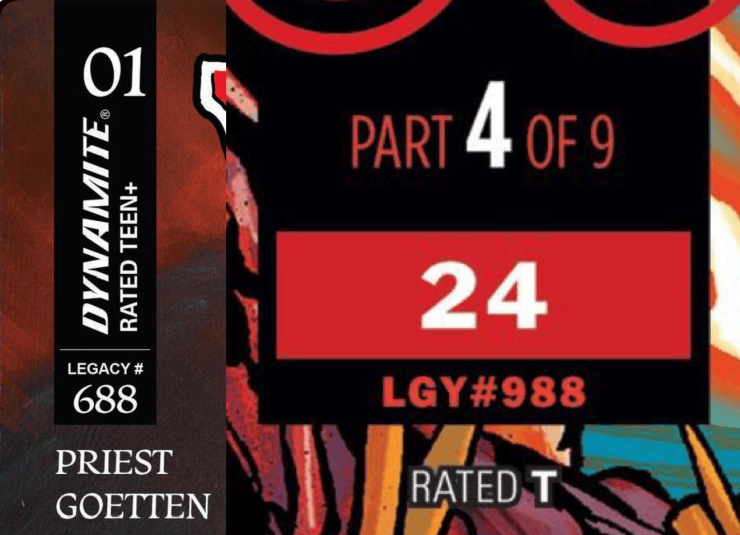
Two approaches to Legacy numbering. On the left, Dynamite’s Vampirella #1 (Legacy #688). On the right, Marvel’s The Amazing Spider-Man #24 (Legacy #988).
The use of the legacy numbering on covers begs a different question – why not simply use the larger number? When Chris Claremont took over X-Men, he began with issue #94, not issue one. The late Peter David’s 12-year run on The Incredible Hulk began with issue #331. Frank Miller’s first issue of Daredevil was #158. These runs have long been the definitive takes on these characters, influencing everyone else’s work thereafter. None of them started with a new #1 on the cover. While it is understandable that Marvel would want to market the change of a creative team, why not let the books themselves use the legacy numbering and simply highlight the start of a new creative team or story arc on the cover?
These frequent relaunches also present a different problem. Many comic readers do not purchase comics monthly, for reasons ranging from cost to storage space to personal preference. Instead, they opt for collected editions. For those readers, the near-annual relaunching of titles can make it harder to know where to begin reading. Take, for instance, a character like Iron Man. The previous run by Spencer Ackerman and Julius Ohta began in October 2024 and ran through issue #10 in July 2025. It makes sense then that the current Iron Man series by Joshua Williamson and Carmen Carnero (from January of this year) would begin with a new #1. Different creative team, gap between issues. But a reader of TPBs looking for “Iron Man Vol. 1” on Amazon will get greeted by both the first TPB for Williamson’s run and the first TPB for Ackerman’s run. Which do they pick?
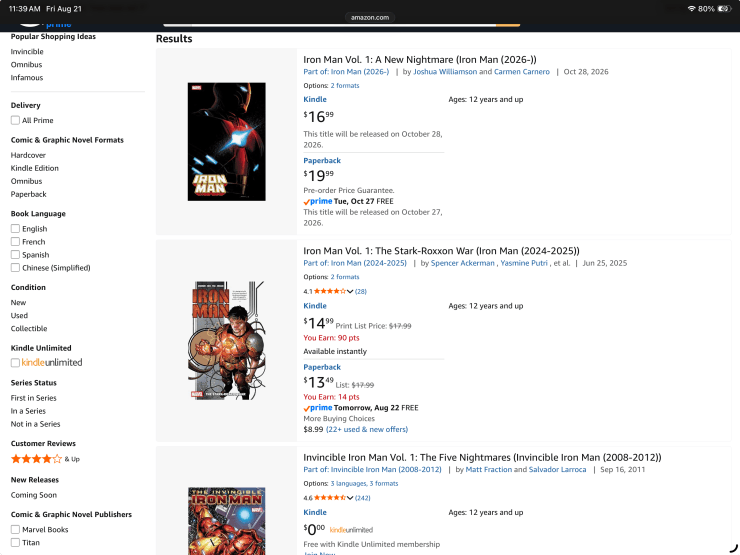
Search results for “Iron Man Vol. 1” on Amazon.
Thankfully, the years are now included in the listing, making it easier to sort them out. In a bookstore, library, or your local comic shop, however, this can be much harder to determine without asking for help or clicking on individual listings to determine which volume you’re looking at. While publishers can’t be held responsible for how stores stock and display their items, the reduction (or even abandonment) of legacy numbering doesn’t help.
I got into comics on New X-Men #114. At the time, I didn’t know creators Grant Morrison, Frank Quitely, or Tim Townsend. I didn’t know that the comic had been titled X-Men for the first 113 issues, nor did I know what happened in those issues. All I knew was that the cover was cool, and I had a vague knowledge of most of the characters presented: Cyclops, Professor X, Wolverine, Jean Grey, and Beast, though there was a platinum-blonde I didn’t recognize (Emma Frost, who would quickly become a personal favorite). Perhaps most important of all, though, was that on the cover next to the title was a subtitle: “E is for extinction”. And below that, “one of three.” That let me know right away that even though this issue was #114, this was the first part of a three-part story.
This was an invitation, not just to a beginning, but a beginning that would require little investment on my part if the story didn’t deliver. Fortunately for me, and unfortunately for my wallet, the story was an all-time classic that continues to influence the X-Men franchise (comics, movies, and cartoons) some 25 years later.
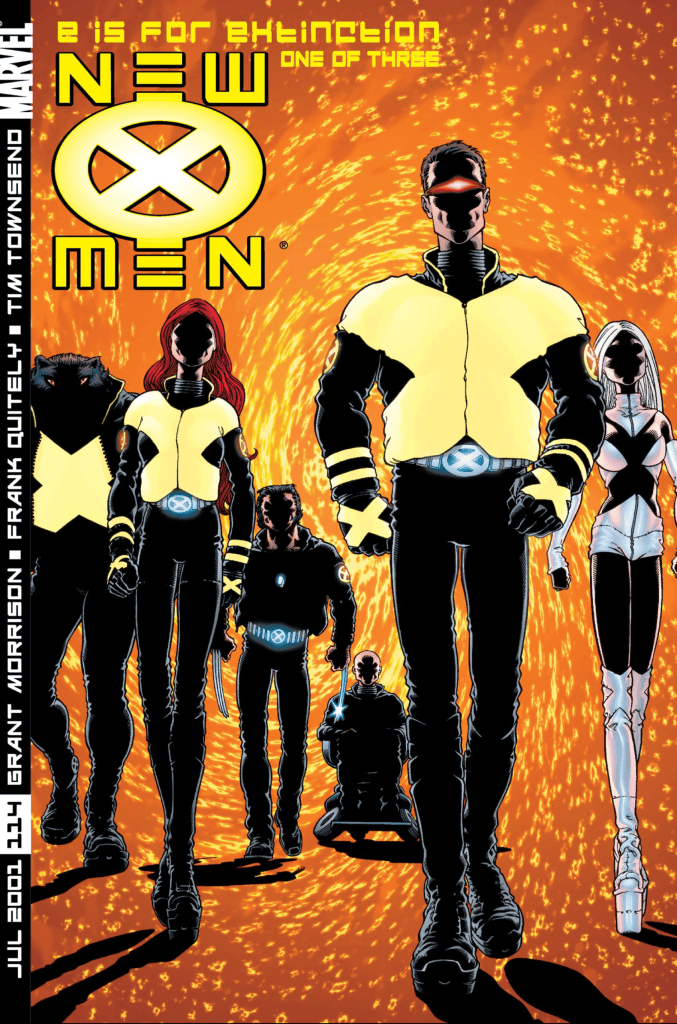
New X-Men #114, art by Frank Quitely, Tim Townsend, and Brian Haberlin. Courtesy of Marvel.
For the historians among you reading this, the irony is not lost on me that my “legacy” introduction to comics was, in fact, a rebrand of a relaunch that had happened a decade earlier in 1991. These frequent relaunches, however, don’t just affect readers and the local comics shops selling the books. In his May 2024 with ICv2, Marvel’s then-president Dan Buckley said that he was “approving some series for 10 issues at a time, not four or five…it’s a lot of work on our editorial staff, too, to restart books all the time.”Earlier this year, it was announced that Buckley would be leaving Marvel as part of a larger leadership change. I do not have answers to the problems that cause Marvel’s relaunches.
What I do know is that legacy is cool. It is fun to discuss stories with other fans and share that fandom with others. It is fun to point prospective X-Men fans to New X-Men #114 or X-Men #94 as starting points. It is fun to tell new Black Panther fans to check out 2008’s Black Panther #38-41 by Jason Aaron and Jefte Palo because it’s one of the most badass stories ever. Rarely do I hear pushback from new readers regarding fears about previous issues. And when it does happen, more often than not experienced fans offer reassurance rather than dismissal.
The legacy numbering also conveys a rich publishing history. Comics is one of the few mediums that contain stories running for thousands of chapters. A reader’s first comic book will always remain special to them, even if they don’t particularly like it. Knowing where that piece fits – and thus where that reader fits – in these long sagas we all love is an important part to engendering fandom. I will never own an original copy of 1962’s Amazing Fantasy #15 or 1963’s X-Men #1; that isn’t my comic book journey. But I enjoy knowing that when I tell more experienced fans that I started with New X-Men #114, they can remember that issue in time and narrative place.
It immediately indicates what I might have read, and what they might want to recommend to me based on when I started. If someone tells me that they started with The Amazing Spider-Man #1, I have to clarify exactly which story they meant to understand what stories they might have read. The relaunches don’t just obfuscate a character’s publishing history – it clouds a reader’s personal journey with these books and with these characters.
This is not a take against relaunches in the absolute. There is a time and a place for them, and real publishing gaps happen that must be addressed. Instead, I simply ask publishers (and the corporations that own them) to display their history with a little more pride than a sub-number or a milestone marker. As a starting point, might I suggest putting the legacy numbering on the back of collected editions so that readers can more easily recognize one V1 from another? Let’s embrace the legacy of these stories and not simply acknowledge that fact.
EXCLUSIVE: David Lapham delivers a horrifying family portrait for ‘Artists From the Abyss’ #1
Batman vs. Absolute Batman: DC reveals its big Batman Day 2026 special

Comic Books
Marvel reveals new ‘Midnight Spider-Man,’ ‘Fantastic Four,’ and ‘X-Men’ preview pages
Comic Books
‘The Legion of Super-Heroes’ #1 is superhero sci-fi firing on all cylinders
Comic Books
X-Men Monday #351 – Steve Orlando Talks ‘Gambit: Gone’
