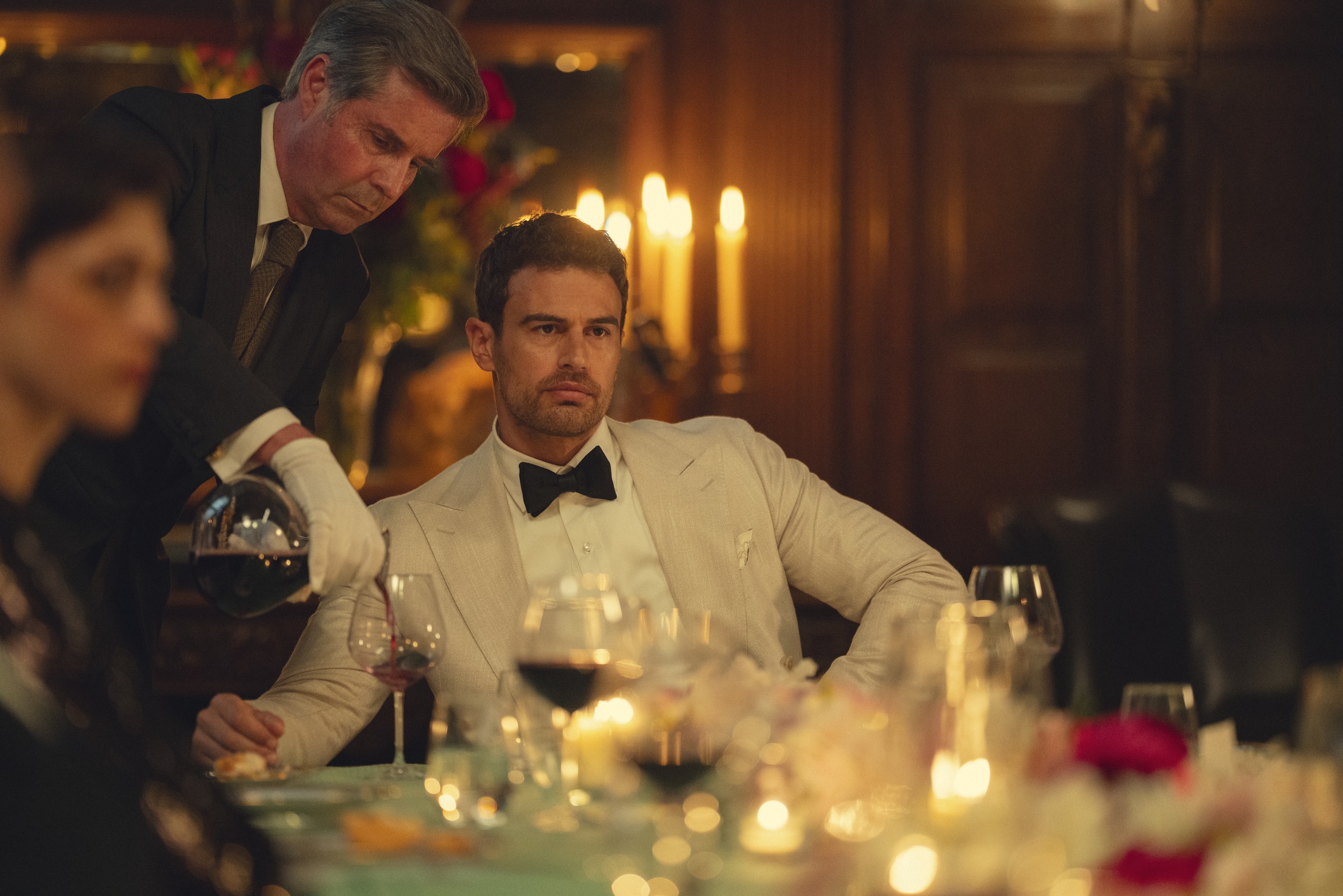
Theo James in The Gentlemen season 2. Photo: Netflix
Guy Ritchie has always shot the English country house as though it were a crime scene waiting to be found. The lawns of Halstead Estate in Season 1 of The Gentlemen — Netflix‘s crime comedy that expanded the universe of Ritchie’s 2019 film into something serialized and considerably more complicated — operated as both setting and subtext: a stately address whose respectability was itself the cover story, and whose value to everyone involved depended on nobody asking what it earned underground. The entire first season was built around a single architectural discovery: beneath a legitimate institution’s exterior lay something thriving, profitable, and hidden for decades. In Season 2, Eddie Horniman already knows what’s under the floor. The question is whether knowing changes what you do next.
Netflix’s eight-episode second season returns Theo James as Eddie alongside Kaya Scodelario’s Susie Glass, now formally partners in the enterprise that Ray Winstone’s Bobby Glass built and has been running with a specific combination of charm and menace. The official Netflix synopsis is precise about what changes: Eddie and Susie have moved operations abroad, expanding the empire in ways Bobby apparently directed. What has changed is Bobby himself. His decisions, Netflix states, are “increasingly unsound” — which is the kind of diplomatically worded assessment that suggests the empire’s architect has become its most significant liability. New cast additions Hugh Bonneville, Michele Morrone, and Benedetta Porcaroli enter the frame on the continental side of operations, adding a European register to a show that, in Season 1, was very deliberately and self-consciously English.
What Season 2’s trailer establishes — and what the season’s premise implies — is a shift in the show’s visual grammar. The country house is still there, the estate presumably still generating the kind of income that requires significant discretion, but the frame opens: European interiors, continental architecture. Ritchie’s stylistic signature — treating crime as a form of elaborate social choreography, where who sits where at what table communicates more than dialogue can — applies differently across the Channel. The premise suggests that Eddie and Susie are moving through spaces whose rules they haven’t fully learned yet, negotiating with a criminal class that doesn’t operate by the English conventions Bobby Glass spent decades establishing.
Hugh Bonneville’s casting is itself an editorial statement. His particular register — an authority that reads as institutional trustworthiness even when the institution being trusted is demonstrably untrustworthy — positions him as something the English criminal world that The Gentlemen depicts rarely encounters: a figure difficult to read because the surface is too convincingly legitimate. Michele Morrone brings a continental threat that doesn’t telegraph itself the way Bobby Glass’s more domestically calibrated menace does. Benedetta Porcaroli, well-known from Italian prestige drama, adds a presence whose alignment — with Eddie, with Susie, with the opposing structure — the trailer declines to clarify. The season’s casting choices function as part of the show’s argument about legibility: whose danger you can read, and whose you cannot.
The Gentlemen has always worked best when read as a parable about the British class system and the particular fiction it maintains about itself. Bobby Glass built something that operates with its own hierarchy, its own protocols, its own inherited obligations — which is to say he built something that functions identically to the aristocracy Eddie Horniman was born into. The comedy of Season 1 was that Eddie discovered the foundations of his inherited legitimacy were literally criminal; the drama of Season 2, by the evidence available, is that maintaining those foundations requires the same decisions any institution requires: loyalty to the system over any individual judgment about whether the system is right. Bobby’s unsound decisions put Eddie in exactly the position that centuries of aristocratic inheritance have always put their recipients — deciding whether to preserve something already compromised before you arrived, or to act on what you actually believe.
Season 2 arrives at a specific moment in the genre’s evolution. Peaky Blinders spent six seasons mapping the arc of a criminal dynasty from insurgent ambition to institutional decline — the final seasons were, structurally, about what happens to the people who built something when that thing outgrows what its builder could control. The Gentlemen draws on that tradition while complicating its protagonist’s position: Eddie didn’t build the empire, he inherited it, which means his crisis is not an empire that has outgrown its builder but an empire whose builder is now the problem. The genre genealogy connects this to succession drama — the same architecture Succession used for a legitimate media conglomerate, The Gentlemen applies to the British criminal class, where the conversation about who runs what next carries identical weight and identical emotional cost.
The show promises, and delivers, Ritchie’s familiar pleasures: dialogue that arrives slightly ahead of where you expected it, violence that has formal elegance, the class comedy of watching people who know exactly what they are behaving as though they were something else. What Season 2 adds — beyond the expanded geography — is a form of moral pressure that Season 1 could park in the background because Eddie was still learning the territory. Now that he knows it, what he does with that knowledge sits differently. The trailer suggests this is not a season about external threat so much as internal reckoning: the empire is not under attack; it is under management, and management requires decisions Season 1’s structure didn’t yet demand.
Netflix’s renewal of the series for a third season — confirmed simultaneously with the Season 2 premiere date — signals how the platform reads the show’s cultural position. The Gentlemen functions as a template for prestige British crime drama built for a global streaming audience: the accent is part of the appeal rather than a barrier, the class comedy translates because class anxiety is not a uniquely British pathology, and the visual grammar is legible across markets. A third-season green-light before Season 2 has premiered suggests Netflix sees the show operating as Peaky Blinders operated mid-run — a property with established audience loyalty and an expanding cultural footprint, which is itself a kind of inheritance the show would probably recognize.
What Season 2 cannot answer — and what The Gentlemen as a series has always refused to settle — is whether Eddie Horniman is capable of holding what Bobby Glass built without becoming, functionally, what Bobby Glass is. Managing an empire built on controlled menace and inherited loyalty requires performing the role of someone who decides what violence looks like and who it serves. The show’s central irony is structural: the man who wanted nothing he inherited is now the only person positioned to hold what someone else built together. Whether that holding constitutes rescue or replication is the question Ritchie leaves permanently open — and it is what makes Season 2, by the evidence of its premise alone, worth returning to.
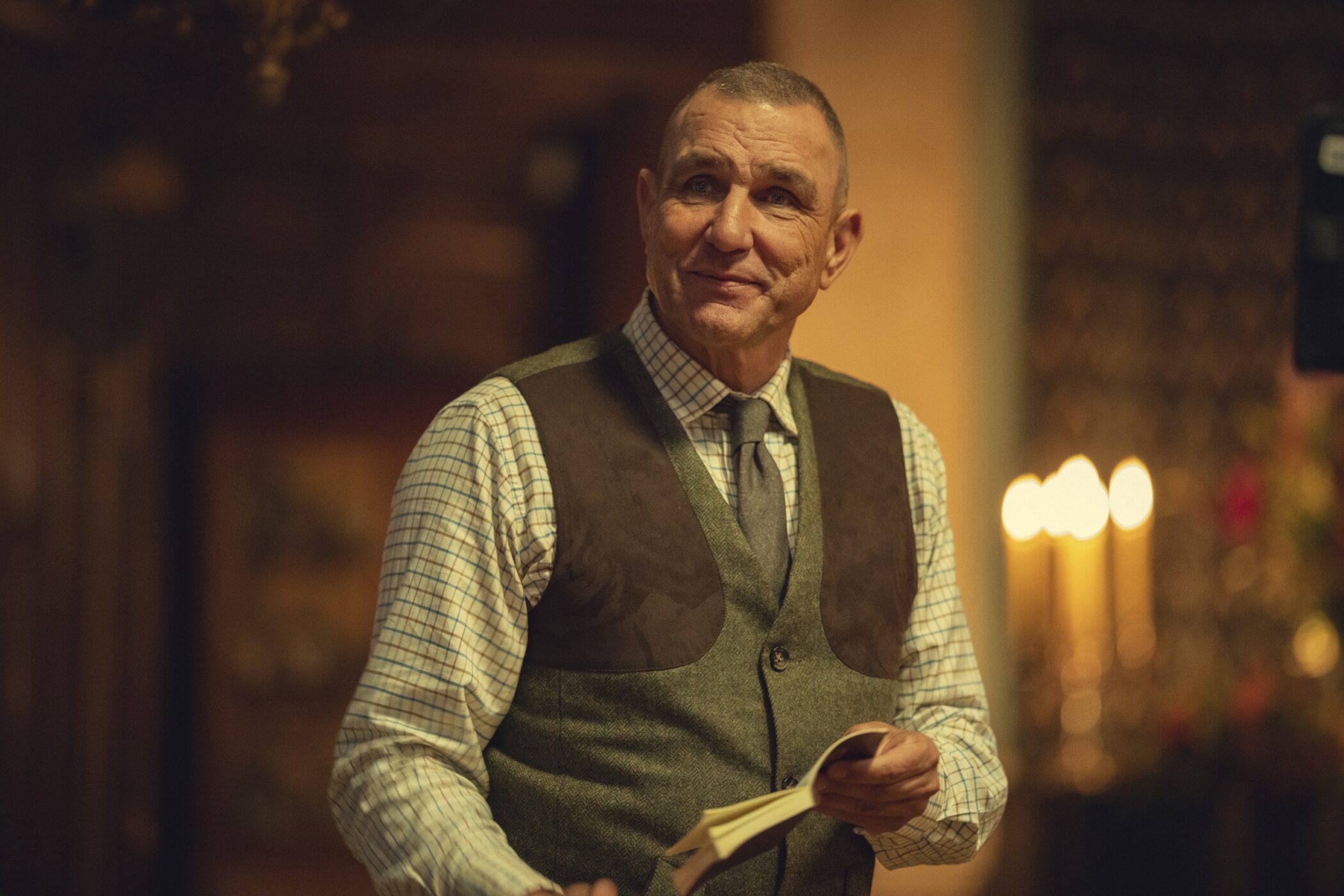
The Gentlemen Season 2 premieres on Netflix on September 3, 2026, with all eight episodes available simultaneously. The series is created and partly directed by Guy Ritchie, who directs alongside Eran Creevy, and is produced by Moonage Pictures and Miramax Television. The returning cast includes Theo James, Kaya Scodelario, Daniel Ings, Ray Winstone, Giancarlo Esposito, Joely Richardson, Vinnie Jones, and Michael Vu, joined by new additions Hugh Bonneville, Michele Morrone, Benedetta Porcaroli, and Chris Eubank Jr. Netflix confirmed the renewal for a third season alongside the Season 2 announcement in August 2026.










Photos: The Movie Database (TMDB)
More Like This

Netflix’s “Woman of the Dead” Returns: The Austrian Thriller Digs Deeper in its Second Season

“Nobody Wants This” on Netflix: A Conventional yet Charming Romantic Comedy

“IC 814: The Kandahar Hijack” Series on Netflix: A Riveting Tale of Aerial Hijacking and Global Espionage

The second season of Barracuda Queens arrives: From suburban heists to high-stakes art thefts on Netflix today

“True Detective: Night Country”, January 14th