

It’s difficult to make a truly great war movie. Of course, war is something that impacts millions of lives every day. There’s a genuine human toll, but as a film, there’s the fear that war will be treated as pure spectacle while ignoring the turmoil behind the madness. Luckily, there’s no shortage of phenomenal war movies that honor those who have lost their lives in battle and hopefully educate those on what really happened in the past (and continues into the present).
But what about the best animated war movies? Animation is still traditionally viewed as a medium for children, even though that’s a total misconception. But in the right hands, animation can be used to portray the horrors of war in a way that simply wouldn’t be possible in live action. Oftentimes, animation is better suited for stories where allegories are used to speak about real wars to make it more palatable for a wider audience.
Don’t get us wrong; some of these movies definitely aren’t suitable for children. But don’t let the medium fool you. These animated war movies do an equal, if not better, job of speaking about war compared to something in live-action. If nothing else, seeing a medium often used for children tell a war story just goes to show that war impacts everyone, including young kids.
5. South Park: Bigger, Longer and Uncut

“South Park: Bigger, Longer and Uncut” may not immediately jump out at you as a war movie, but it brilliantly satirizes war. And despite coming out in 1999, it satirizes the hyper-jingoistic sentiment that would become more commonplace in the United States following the 9/11 attacks just two years later.
The main boys start swearing obsessively after watching a new Terrence and Phillip movie, culminating in Kenny accidentally lighting himself on fire. Rather than take accountability for their own negligence in supervising what movies their children are watching, all the South Park parents blame Canada for their kids’ lack of morals, resulting in World War III.
There’s all of the profane humor one would expect from a “South Park” movie, and it earns its feature-length runtime with an epic plot and assortment of musical numbers. “Blame Canada” remains a brilliant satirical number, and it’s easily one of the best films based on a TV show ever made.
But even among the swearing and songs, there’s a real message about how governments use war to distract the public from more pressing issues. With all of the parents concerned about Canada, they don’t even realize a literal portal to Hell is opening up. Many films based on shows come out long after the series has already begun to decline in quality. But with “South Park,” the movie came right at the height and proved this was a series that was going to stick around.
4. Princess Mononoke
One issue many war films can fall into is presenting one side as completely evil while the other is entirely just in its mission. The real world often isn’t as black and white, and that’s why “Princess Mononoke” is an essential war film that’s gone on to inspire the likes of “Avatar: The Legend of Korra.”
The film’s central figure is Ashitaka (Yōji Matsuda/Billy Crudup), who is cursed and ventures into the unknown seeking a cure. He encounters a conflict between Iron Town, a collective of people who extract iron from the mountain, and the creatures of the woodlands fighting to preserve their natural environment, led by San (Yuriko Ishida/Claire Danes), who was raised by wolves. Man encroaching on nature and nature fighting back is a worthwhile plot to explore, but one thing “Princess Mononoke” does exceptionally well is refusing to cast humans in an inherently negative light.
You can look at films like “Avatar” where most of the humans are unrepentant villains. Everything is very black and white, but “Princess Mononoke” attempts to show that the key to both man and beast being happy is finding a good equilibrium. While Ashitaka attempts to mediate between the two sides, he can’t stop the ensuing onslaught. War breaks out, and it doesn’t spare any detail, as severed limbs get thrown across the battlefield. “Princess Mononoke” shows that the greatest war being fought isn’t between nations but man destroying the very planet he lives on.
3. Persepolis
At least when it comes to American films, there’s a good chance many of the people behind the camera didn’t experience the horrors of war first-hand while making a war movie. This can give way to a greater emphasis on spectacle than is needed. But there’s something deeply human about 2007’s “Persepolis,” based on the graphic novel by Marjane Satrapi. Both the book and film chronicle Satrapi’s personal experiences coming of age during the 1979 Iranian Revolution, giving way to the Iran-Iraq War.
Violence exists in the background, but the film is mostly concerned with how a new rule of law impacts everyday citizens. In one poignant scene, Marjane points out the absurd double standard of enforcing strict dress codes on women while men are allowed to wear whatever they want, even if it’s far more revealing. With a rebellious spirit, she pushes back against the sensibilities of Islamic fundamentalism in small ways, whether it’s dressing more immodestly or listening to heavy metal music.
“Persepolis” avoids overt shots of battles and warfare and instead depicts the very real human toll of upending regimes. We have plenty of war movies focusing on people on the frontlines, but not nearly enough of people forging identities for themselves in areas where they feel like they’re not allowed. And it demonstrates that while war may seem like a foreign concept to many from more privileged backgrounds, it can impact civilian lives in ways you don’t even realize. “Persepolis” remains one of the best animated films ever, albeit one no child should ever see.
2. Howl’s Moving Castle
Hayao Miyazaki never hid the fact that 2004’s “Howl’s Moving Castle” was heavily influenced by the U.S. invasion of Iraq. Miyazaki spoke with Newsweek about weaving the real-world event into his works: “Your country had just started the war against Iraq, and I had a great deal of rage about that … I had just started to make ‘Howl’s Moving Castle,’ so the film is profoundly affected by the war in Iraq.”
It’s not hard to see the inspiration. While the film hones in on a young milliner named Sophie (Chieko Baisho/Emily Mortimer) who gets cursed to look like an old woman, she soon finds herself in the middle of a conflict. She seeks refuge in a giant moving castle overseen by Howl (Takuya Kimura/Christian Bale), who can transform into a giant bird and disrupt various aspects of the war. But each time he turns into a bird, he gets closer to becoming unable to turn back. It’s a clear metaphor for how war dehumanizes all involved.
Like “Princess Mononoke,” “Howl’s Moving Castle” also demonstrates how war deteriorates nature and ruins far more lives than just those of those fighting. Sophie has a pristine life at first, but gradually, the sky darkens, and cities crumble. The ending of “Howl’s Moving Castle” really emphasizes the idea of change, and there’s no greater changing force on Earth than war.
1. Grave of the Fireflies
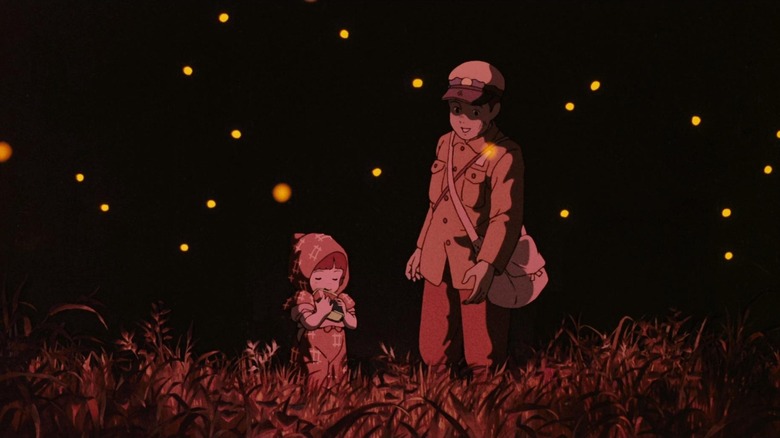
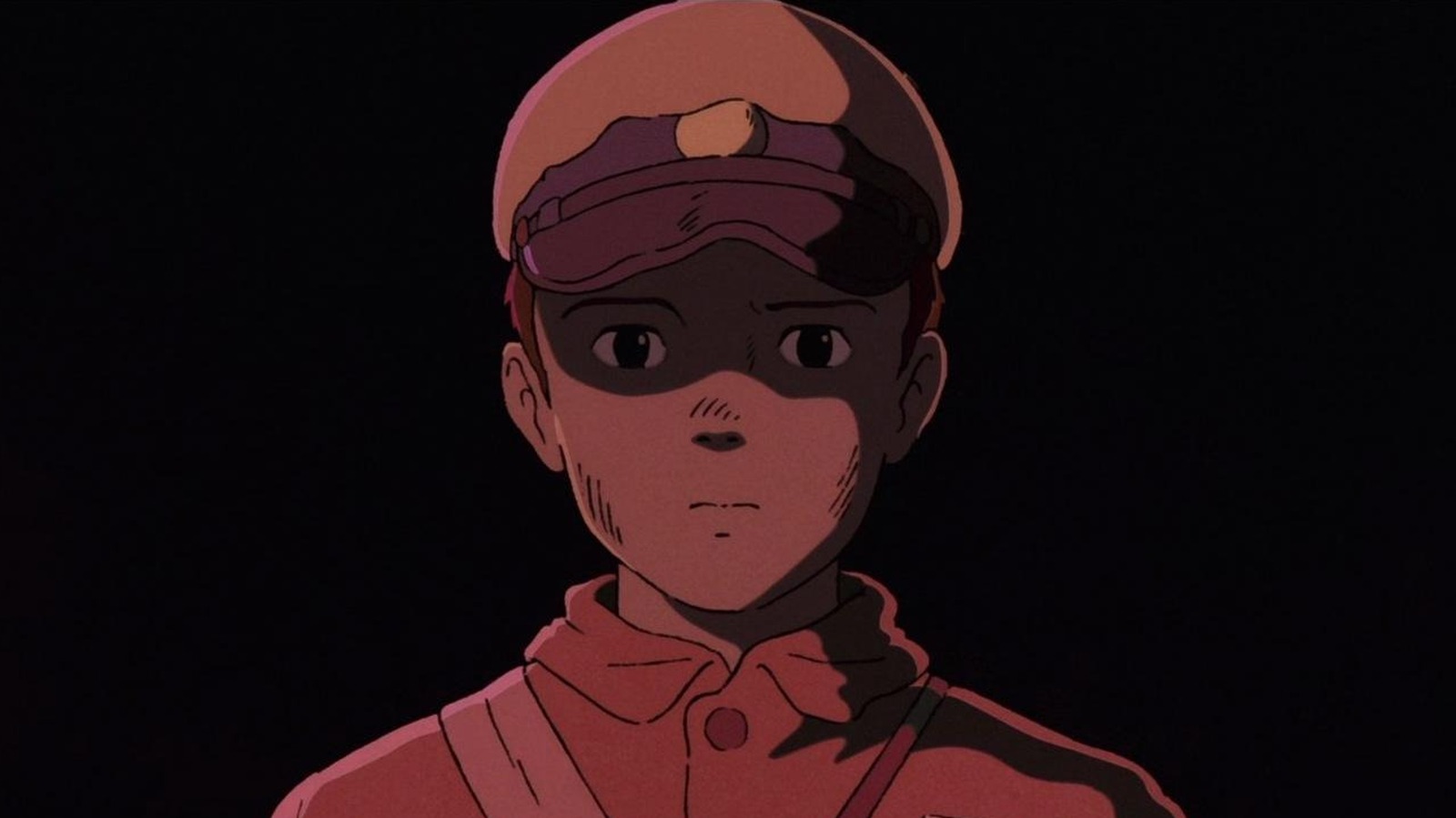
Few films, live-action or animated, have ever shown the horrors of war quite as tragically as “Grave of the Fireflies.” Based on a semi-autobiographical story, “Grave of the Fireflies” focuses on two siblings — Seita (Tsutomu Tatsumi) and Setsuko (Ayano Shiraishi) — who lose their mother during the U.S. bombing of Kobe in 1945. While the film opens with death and destruction, what follows is two siblings trying to survive in a country ravaged by war and running out of supplies.
It’s not just battles where people lose their lives, but in their homes, simply by not having enough food or medicine to go around. And the film doesn’t hide its tragic ending. It opens with the announcement that both Seita and Setsuko will die. As the audience, we’re not left wondering if they’ll make it out okay. We know they won’t, and their deaths don’t come from the barrel of a gun. There just wasn’t enough help to go around, and they’re just two of many innocent casualties of a war they had nothing to do with.
Just like how fireflies quickly live and then die, we see how childhood innocence gets stripped away because politicians in their offices saw fit to wage war with one another. You’d be hard-pressed to find a more devastating film than “Grave of the Fireflies” because no film drives home its message harder than that war truly has no victors.
