The label “unadaptable” has been slapped onto many works of literature over the years, especially in science fiction. Since the birth of the film industry in 1895, studios, producers, and filmmakers have been trying to film the unfilmable, finding creative ways to capture complex worlds and internal struggles with cinematic visuals. Historically, when someone attempts to adapt an “unadaptable” story, detractors, fans, and sometimes even the authors of the original works come out against the project, claiming it can’t be done.
Videos by ComicBook.com
But as the following films prove, telling Hollywood it can’t do something only adds fuel to the fire. Regardless of previous stalled projects or failed attempts, a visionary filmmaker eventually steps up to the plate, ready to take on the challenge. The result, at least in these cases, is a masterful mind-bending tale or sweeping science fiction odyssey that wows audiences in theaters and becomes a home-viewing classic that stands the test of time.
3) Watchmen
Watchmen began as a 12-issue comic series from DC, written by Alan Moore and illustrated by Dave Gibbons. But Moore himself argued that Watchmen wasn’t cinematic, noting that a comic reader can flip back and connect details, while film forces you to watch at 24 frames per second. Another problem was the scope. After Moore declined to write the screenplay, screenwriter Sam Hamm attempted to squeeze the 338-page comic into a 128-page script. When the project moved to Warner Bros., it attached sci-fi master Terry Gilliam, who was unhappy with Hamm’s script, bringing in Charles McKeown to rewrite it using Rorschach’s journal as voice-over. Although it seemed they’d gotten closer, Gilliam’s film also collapsed over budget, and later drafts by David Hayter replaced it.
Warner Bros. eventually hired director Zack Snyder in 2006, and the rest is history. Snyder pulled it off by using the comic itself as his storyboard. He added a title montage to explain the alternate history, and used a simplified ending taken from Hayter. Moore himself ultimately took no credit for the film and gave his share of the income to Gibbons. Gibbons said that watching it on DVD would feel like flipping through the book, since viewers could pause and rewind, and he was right: DVD sales are where Watchmen made its money back. Today, Watchmen is considered a superhero sci-fi classic, and it even launched a Watchmen sequel series from Damon Lindelof.
2) A Scanner Darkly
Philip K. Dick’s A Scanner Darkly entranced readers with the story of an undercover cop in a near-future world who gets involved with a dangerous new drug and begins to lose his identity. However, Dick’s writing is known for being extremely internal, leading readers through the breakdown of the protagonist’s perception from the inside; something nearly impossible to show visually on screen. Director Richard Linklater, who had experimented with rotoscoping on Waking Life, was interested in adapting one of Dick’s novels. He first played around with Ubik, but eventually turned to A Scanner Darkly, deciding to direct it as an intimate animated sci-fi thriller, made for only $8.7 million. His script followed the novel closely, and when he pitched it to Dick’s estate, it was approved.
It was ultimately Linklater’s rotoscoped animation that was key to the film’s success. The technique involved filming live actors (including Keanu Reeves, Robert Downey Jr., Woody Harrelson, and Winona Ryder), then having animators paint over the footage frame by frame. The result is a shifting, dreamlike animation that conveys the character’s fragmented, drug-induced perception while still allowing the actors to give live performances. Instead of turning it into a big-budget action thriller, Linklater leaned into the story’s internal nature, helming what is now considered not only a cult classic, but one of the more successful Dick adaptations and one of Linklater’s most unique films.
1) Dune
Image Courtesy of Warner Bros.
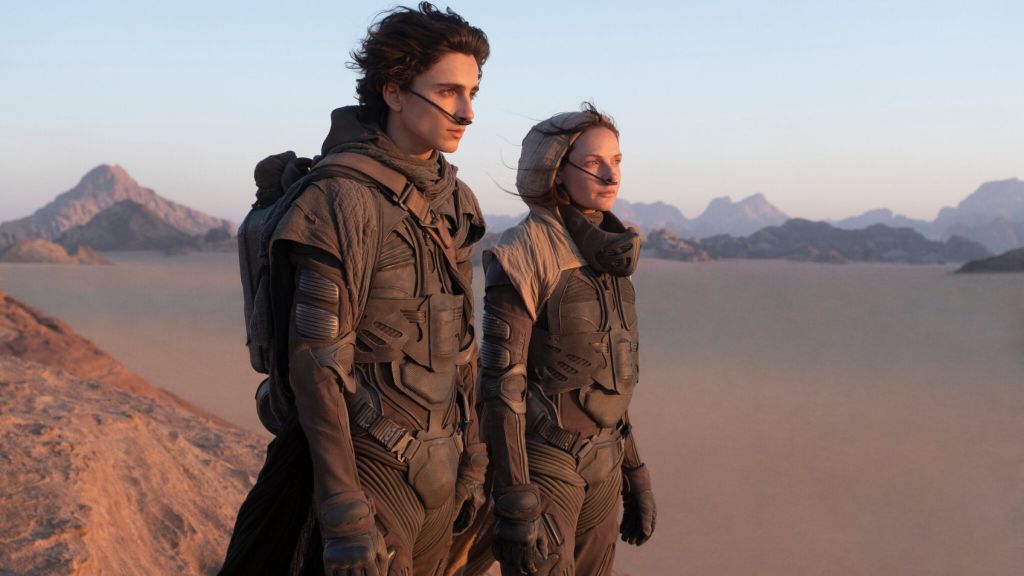
Frank Herbert’s space opera opus Dune built out an entire galaxy’s politics, theology, ecology, and characters. The first notable adaptation attempt came when director Alejandro Jodorowsky began plotting his film, which included music by Pink Floyd and a dream cast of Orson Welles, Salvador Dalí, and Mick Jagger. Trouble was, Jodorowsky’s script would have made a 14-hour movie, and he’d already spent $2 million of the $9 million budget on pre-production. Thus, the project stalled. Next, Ridley Scott was hired to direct and was the first to consider splitting the book into two films. However, Scott’s version focused on an incestuous relationship, which outraged Herbert, and Scott ultimately dropped the project to make Blade Runner. David Lynch then became the first to put the book on screen, though he famously didn’t get final cut, and the result was so disastrous that Lynch disowned the film.
Enter modern-day sci-fi master Denis Villeneuve. Following the idea Scott first floated, he split the story into two films. Using minimal dialogue, he relied on largely practical visual world-building and took a restrained approach to adapting the story and characters, leaving the audience to build out much of the world for themselves without over-explaining the complicated lore and terminology. His adaptations have finally proven a success, making the unfilmable filmable, with Dune: Part Two making over $714 million worldwide. His upcomingDune: Part Three, based on the next novel, Dune Messiah, is set to open in December as the final film in the trilogy.
Are there any sci-fi novels you think are truly unfilmable? Let us know in the comments below.
4 Lesser-Known Sci-Fi Movies That Scored Over 90% With Audiences on Rotten Tomatoes
More Movies
Courtesy of Sony Pictures
Movies
8 hours ago
A Panned Marvel Movie with a 15% RT Score Is Crawling into the Streaming Charts 2 Years After Derailing an Entire Franchise
Movies
9 hours ago
Godzilla x Kong: Supernova Could Introduce A Dangerous Kaiju That Already Destroyed Godzilla Before
<img src="https://comicbook.com/wp-content/uploads/sites/4/2026/08/Avengers-Doomsday-X-Men-Logo-.jpeg?w=300″ alt=”Avengers: Doomsday Just Got Confusing After Marvel Confirms X-Men Deleted Scene Is Canon”>Disney – Marvel
Movies
12 hours ago
Avengers: Doomsday Just Got Confusing After Marvel Confirms X-Men Deleted Scene Is Canon
Movies
14 hours ago
Home Alone Legacy Sequel With Macaulay Culkin Moving Forward With the Perfect Creative Team
Movies
15 hours ago
Marvel Shows Off an Avenger’s 7th Superhero Costume in Doomsday
Image Courtesy of Marvel
Movies
16 hours ago
Did Loki’s Doomsday Scene Create an MCU Plot Hole? Tom Hiddleston Clears Up Marvel Misunderstanding
Movies
17 hours ago
Former James Bond Endorses Robert Pattinson as 007 16 Years After Playing His Dad in a Wild Movie
IMAGE COURTESY OF NETFLIX
Movies
17 hours ago
Is Guillermo del Toro Making a Star Wars Movie? Oscar-Winning Director Responds to Rumors