

Online OriginalsNovember 6, 2026
24 at 25: Howard Gordon on Making Jack Bauer’s Day (Exclusive)
To celebrate the Emmy-winning Fox drama’s 25th anniversary, the writer-producer reveals how he got involved with one of TV’s most unique series and what happened with the proposed 24movie.
At its annual upfront presentation in May 2001, Fox introduced just two new dramas: The family soap Pasadena and a terrorism-themed thriller from creators Robert Cochran and Joel Surnow called24.
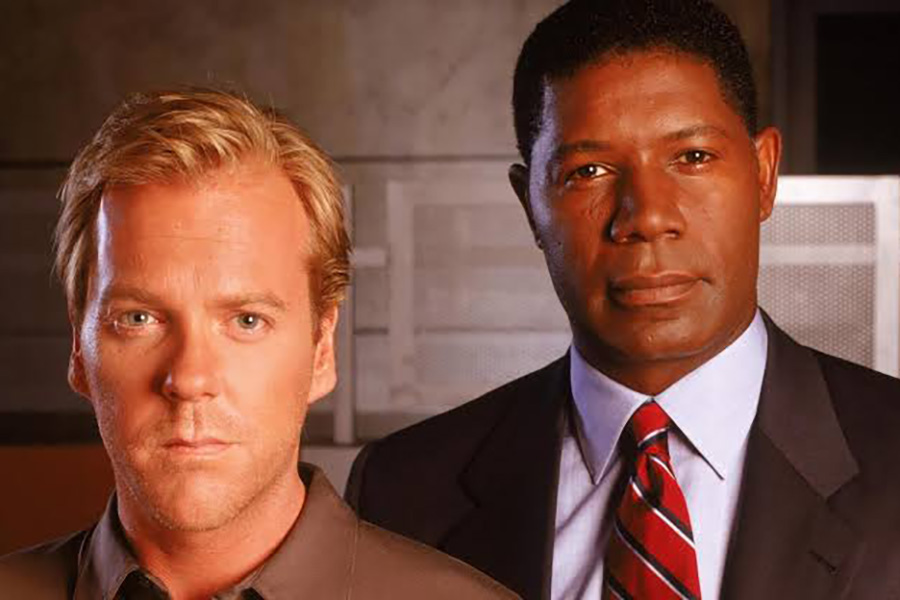
Unfolding in real time over a 24-hour period, 24 followed Los Angeles counterterrorism agent Jack Bauer (Kiefer Sutherland) as he raced to stop an assassination attempt on Democratic presidential candidate David Palmer (Dennis Haysbert). Sounds intriguing, no? Yet it was received with such minimal fanfare that Variety’s big-picture takeaway was that the network “heads into fall as TV’s new king of comedy.”
Then 9/11 happened. And in the immediate aftermath,24 was thrust into the cultural spotlight in a way that nobody anticipated.
“It actively reflected the world we were living in,” says Howard Gordon, the executive producer and showrunner who had previously worked on The X-Files. “We were presenting real issues to our audience.”
Indeed, the premiere episode — which aired November 6, 2001, four days after Fox ended Pasadena’s short run — was delayed a week due to sensitive plot elements. Producers also excised the original pilot’s last scene that featured an American mercenary (Mia Kirshner) detonating a bomb on a commercial airliner. But in a season dominated by comfort TV offerings such as Friendsand Frasier, nearly 12 million viewers tuned in to watch Jack’s adventures as a member of the fictional Counter Terrorism Unit (CTU) — which roped in his teenage daughter, Kim (Elisha Cuthbert). Viewers stayed captivated all the way through Jack’s last agonizing hour on the clock, when he saved the day but couldn’t save his wife (Leslie Hope).
“I think America reacted to the show because of Jack Bauer,” says Gordon. “He was a character who went after the corrupt bureaucracy and would do whatever it takes to defeat terrorists. I think he checked a certain box for the audience because there was a wish-fulfillment element.”
Instead of taking a much-deserved break, Jack kept fighting on. Over nine seasons (plus 2014’s limited series 24: Live Another Day), he tirelessly worked to stop catastrophic terrorist plots, save high-ranking American officials, sniff out moles — damn you, Nina! — and protect innocent lives. At its high-octane creative and critical peak, the show won the Emmy for Outstanding Drama Series in 2006. (Sutherland picked up an acting Emmy that year, too.)
But times change — after 24’s last installment aired in 2010, Gordon moved on to co-develop Showtime’s more cerebral Homeland. “Both shows looked at the war on terror very differently,” he says. “And both shows could have only aired in their respective decade.”
To celebrate 24’s 25th anniversary, Gordon reflected on his time working on the Emmy-winning show and why it featured that infamous cougar in season two.
Television Academy:How did you first get involved with 24?
Howard Gordon: I had a competing pilot at the time. Then I got a call from [then-co-president of Twentieth Century Fox Television] Dana Walden. She said the show [I was working on] was off the schedule and asked me to meet Bob and Joel because [Fox entertainment president] Gail Berman wanted me on the show with them. I watched 24that night, called Gail and said, “You made the [right] choice, because I am so completely blown away by 24.”
The next day, I met with Bob and Joel at Starbucks, and we really vibed. The rest is history. They were incredibly generous with the show in that they really let me be a co-parent. So, even though I didn’t give birth to it, I think I got to raise the child right from the cradle.
What specifically did you love about the pilot?
I just loved its audacity. I thought Kiefer was extraordinary — the whole cast was extraordinary. And the narrative was clearly a high-wire act, which particularly appealed to me. I also felt a connection to Jack Bauer — I was just into my 40s, I was married with a family and I was a workaholic. I wasn’t a counterterrorism agent, but I could relate to Jack at a very human level because I felt the tension between being a father and husband and doing the job.
Did the season one narrative change after 9/11? You had only filmed four episodes at that point.
No, the story didn’t change. It wasn’t until the second season when 9/11 really planted its creative seeds in our minds.
But I don’t think I’m overstating when I say that there was consideration to pull the show. We knew we had to make some edits about the plane blowing up [in the pilot], but the overall thought was that the audience would want either “blue sky shows” or comedy. I’m not sure how far the conversation got, but there was a real concern.
What did Kiefer bring to the character?
You can’t separate Kiefer from Jack. His interpretation of the character — and I mean at the most granular, behavioral level — was incredibly intuitive and spot on. He made even a mundane action like reaching for a glass of water an event. He knew how to fill the space and fill the time. So much of what happened was absurd when you look at the show on its face. But he sold it with conviction. The secret of 24was that it was done with unapologetic conviction.
What was the biggest challenge of locking into that hour-by-hour, real-time narrative?
It was a 24/7, 52-week-a-year enterprise. I’d lie if I said it wasn’t terrifying and challenging. Sometimes you’d have to improvise and vamp when necessary — even if it meant Kim seeing a cougar in the woods.
Was that random cougar in season two intended to be comic relief?
It made me laugh. I mean, it was such an exhausting endeavor. If we gave people something to laugh about, great. I don’t think it was Fonzie jumping the shark; it just may not have been our finest moment. At the same time, we had a narrative requirement to keep Kim off camera for a certain amount of episodes. Everything couldn’t be a perfect 10.
What did you think when viewers or critics would call out the fact that Jack never had a meal or went to the bathroom?
That always made me a little nuts. I would say, “Well, he’s eating when we’re either in another story or when you’re going to commercial.” But, in terms of the distances he traveled, if you really wanted to map reality of how [Jack] got across L.A. in four minutes in rush hour — that would be a fair question. I always said, “Just go with it.”
And then the show earned the Emmy for Outstanding Drama for season five. Looking back, what makes that season stand out for you?
It just was a season when everything fired on all cylinders. As a showrunner, I felt the weight of the real possibility that the show had run its course. But we made the bold move to kill Palmer in the opening — that felt fresh. We also utilized storytelling that made people sit up — and it was helped by some incredible acting. We had the great Gregory Itzin as the new President of the United States and Jean Smart as the First Lady. Their chemistry was terrific. It was like a really magical season. Unfortunately, season six didn’t have the same luck — but that only motivated us to do better in season seven and eight.
What happened with the big-screen movie? How far did you get with it?
We got very close [to making it], but I never really got the straight scoop. As I understand it, the budget they were willing to spend wasn’t sufficient. There was also a conundrum — is the star of the show the real-time narrative or Jack Bauer? One of the charms of the show was this high-wire act of telling a story over 24 hours. So in some ways, a two-hour movie is almost by definition a reductive version of it. So no one was feeling eager to do something that just felt like a piece of business. Because of all those things, the script was put in the dustbin. But it was really good!
This interview has been edited for length and clarity.
24is streaming on Hulu.
