

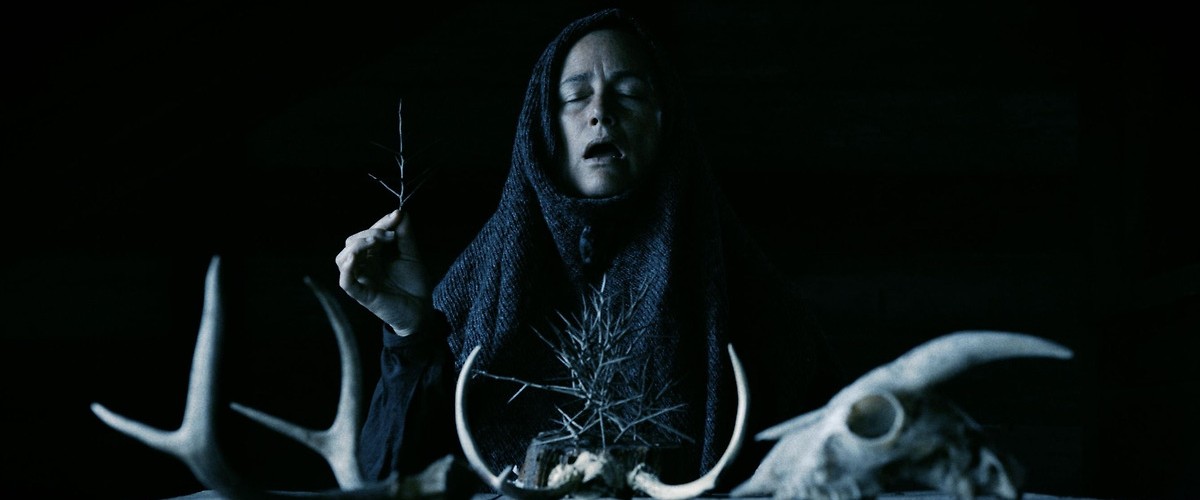
Mother of the Flies, about a father and daughter who tangle with a faith healer in a remote wooded area, is a family film, but not in the way that term is usually used. This is a nightmarish fable about mortality, grief, faith, and the fragility of the body, produced by the Addams-Poser family, one of American cinema’s most fascinating filmmaking teams.
The operation is made up of four people: the actor’s father John Adams, mother Toby Poser, and their daughters Lulu Adams and Zelda Adams. They direct, write, edit, and film as a team while performing in front of the camera. I’ve only seen two of their many movies: “The Deeper You Dig” and “Hellbender.” Both more or less shocked me in the same way as this one. It wasn’t a total jam for me, for reasons that may not matter to others, but it’s clearly the product of talented people who have formed a collective consciousness.
“Mother of Flies” has an opening credits sequence that is both sensual and raunchy. It’s more effective because you don’t fully know what’s going on. There’s blood, viscera, dirt, mucus, and probably other recognizable fluids. The ground is gnarled and irregular, reminiscent of the roots of ancient trees or piles of corpses in a war zone. A naked person’s gore-filled back is seen from above, rising and falling and impaling itself on something beneath. A tightly framed shot of a moaning, writhing woman evokes sexual ecstasy, the last contractions before childbirth, and the body reacting to the first hit of, or painful withdrawal from, a powerful drug. Lovers of oil paintings from the early centuries may remember Hieronymus Bosch, Francisco Goya, Jusepe de Rivera, and other artists known for their depictions of hell.
You won’t understand the point of these images until you understand the story deeply. It tells the story of a young woman named Mickey (Zelda Adams) who goes with her father Jake (John Adams) to a secluded forest home to meet a healer named Solvig (Tony Poser). Solvig is clearly defined to the audience as some kind of mystic, a witch or sorcerer, even before father and daughter meet her. The two hope Solvig can cure Mickey, a terminal cancer patient who has exhausted all treatments modern medicine has to offer.
Solvig speaks in everything but straight sentences. She speaks to herself and recites scriptures and incantations. Often she begins writing what sounds like a parody (intentionally or not) of the “greatest hits” of 19th century English poetry found in textbooks. Sometimes I can barely understand what she’s saying or why she’s saying it that way. Yoda would ask her to take it down a notch.
But she is confident in her power and demands that father and daughter fully submit to her pre-technological process. Their diet consists of mushrooms and leaves. They don’t have toilets at home, so they have to work like their hunter-gatherer ancestors did. It’s like watching a record of the life of a cult with one leader and two members.
The film offers impressive visuals. Solvig’s house is covered with a thick layer of vines. The grounds are so lush with plants that it’s hard to tell where the vines start and the house starts. There is no non-dramatic entrance to Solviegue. She is often silhouetted or glimpsed in half-light, surrounded by doorways or tree trunks. Mickey soon begins to experience visions, including hallucinations and paranormal phenomena. I’m not sure at first. As I lay in bed and looked up at the ceiling, I saw something that looked like pulpy flesh open up. The type of orifice is not fixed because it continues to evolve.
And yes, as the title suggests, there are flies. Lots of flies. If you were to make a definitive list of movies featuring a swarm of flies, you would have to include this one. This movie ranks up there with The Exorcist II: Heretic and the original The Amityville Horror. As the film progresses, more sequences of intense violence appear, including ones reminiscent of the over-the-top stories that circulated during the hysteria over American day care centers in the 1980s and 1990s: ritual abuse, disfigurement, torture, and the cutting of babies from their mothers’ bellies.
Meticulously crafted and lovingly crafted, there isn’t a single shot that isn’t suitable for framing. This is welcome in an era of sloppy filmmaking where the camera was primarily treated as a device to record the actors’ dialogue. But at times, the visuals can be so endearing that it starts to feel like the film’s components are holding back its overall excellence.
I think it’s also a matter of pace and rhythm. It’s not that the film is slow-paced, there’s a lot of lead-in to key moments, and some sequences of abstractly framed shots that are more artistic than useful. It’s that the slowness exists awkwardly in a zone between “too slow” and “too slow,” making the whole thing feel disjointed. Many horror films are objectively slower than Mother of the Flies, but they’re still captivating from start to finish. It’s alluring and frighteningly gorgeous, but it’s not hypnotic. It’s more like a book of scary artwork that you can close at any time and return to later, rather than a nightmare you won’t wake up from.
But with so much to compensate for, it’s very much worth watching for anyone who loves horror, especially the atmospheric and gory horror-based type who isn’t the type who is single-mindedly obsessed with jump-scare presentation. All central performances are special. They haven’t been studied. They feel natural even though every other aspect of the movie is unrealistic and creepy. And the forest is beautiful, dark and deep.
