

Andrew Stanton has had some bad luck making live-action films. The director of two of the greatest animated films of all time, Finding Nemo and Wall-E, tried his hand at live-action with 2012’s John Carter, but that film underwent a legendary grueling shoot, reshoots, and failed release. He finally returned to live-action in “In the Blink of an Eye.” It doesn’t have a messed up story like “Carter,” but it feels like a project that really struggled all the way to Park City for its world premiere. Stanton himself notes in his intro that the show was scheduled to be canceled years ago, but the pandemic derailed the impending production. Filming ultimately began in 2023 and was quietly distributed to Hulu in February 2026 without a theatrical release.
Sadly, time and time again, we see shoddy direction that hinders the film’s ability to function. I’ll be honest and admit that I haven’t read Colby Day’s script. Although this script was once blacklisted, it is a collection of what are considered the best unproduced scripts, so the deep flaws in this final product may have been present from the beginning. But the alternation between half-baked and overcooked ideas makes it feel like something was lost along the way or wasn’t filmed. The final act is particularly rushed, using montage instead of storytelling, emphasizing the relative emptiness of a story that reaches for the stars but finds only dust.
“In the Blink of an Eye” tells three stories set in the past, present, and future. Stanton begins the film with a family scene in 45,000 B.C., said to be the “end of the Neanderthal era.” Although the characters do not speak any intelligible language, on-screen text identifies the father as Thorn (Jorge Vargas), the mother as Hela (Tanaya Beatty), and the daughter as Lark (Skywalker Hughes). Hera is pregnant and has a newborn son named Ebu. The family traipses through gorgeously shot landscapes that at times recall the planetary origins sequence in “Tree of Life,” but this third of the film is woefully underdeveloped on a narrative level. It looks beautiful and Thomas Newman’s score does a lot of the heavy lifting considering the lack of dialogue, but more actual storytelling was needed beyond a few key beats of new life and tragic death.
Now taking up most of Stanton’s film time, it centers on Claire (Rashida Jones), who is working on an anthropology project that seems to involve Thorne and his family. Dusting off bones that are thousands of years old, editor Molly Goldstein travels back 45,000 years to remind us how connected we are as a species over thousands of years. Claire is introduced in bed to a statistics student named Greg (movie MVP Daveed Diggs, who does a great job of getting at least 3rd place in the relatable field), who gradually becomes Claire’s partner. The story slows down because Claire’s mother returns to Vancouver and dies, so the initial stages are a bit emotional and distant.
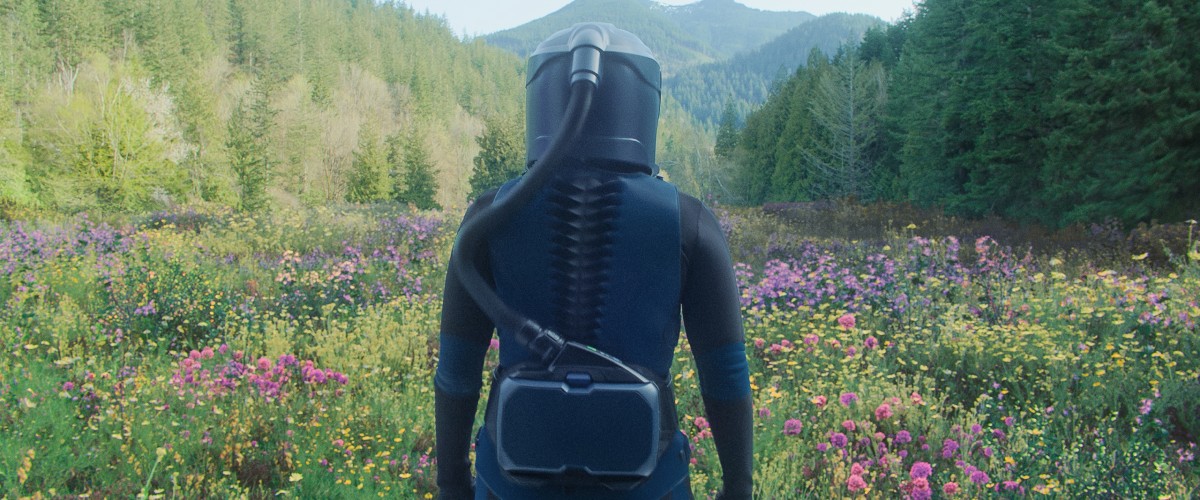
Finally, we meet Coakley (Kate McKinnon, trying out for drama but being taken on). Coakley is a space traveler in the 2400s who brings stem cells, which can quickly become babies, to a colony on a faraway planet. Coakley’s only companion is an AI named ROSCO (voiced by Lorna Rees) who tells his partner that the mission could be destroyed by an infection of the plant colony that supplies the ship with oxygen. In order to get the “baby” to the destination, difficult decisions will have to be made.
“In the Blink of an Eye” is a commentary on the profound changes in human existence, not just the shallow literal connections between these eras. The age of the Neanderthals is revealed from the start, but the remaining two-thirds of the film also contains plot elements that I won’t spoil, but which tie these threads together under the banner of human evolution driven by emotion, dedication, and curiosity.
If that sounds ambitious, it’s not wrong, but that ambition mostly holds back a movie that never develops its characters beyond the basic idea. Although only about 90 minutes long, it often feels like a Cliffs Notes version of a 500-page novel. As a film critic who also covers television, I’m no stranger to the prevalence of miniseries that should be movies, but this is the rare film that was able to use an episodic structure to really build characters, themes, and ideas. As it stands, it feels too throwaway for a film that, at least on some level, attempts to depict the entirety of human history and the future of humanity. And while Newman’s score is beautiful, it’s asked to do too much, too often, to fill in the gaps that feel like they weren’t filmed, even if they existed on the page.
There are so many humanist ideas in “In the Blink of an Eye” that it’s tempting to pass it on that alone. How we connect our past and future as a species is fertile ground for science fiction filmmaking. Whether due to the pandemic, rushed production, Searchlight’s financial upheaval, or something else entirely, the land simply didn’t have enough water to power the production.
This review was submitted from the world premiere at the Sundance Film Festival. It will first air on Hulu on February 27th.
