

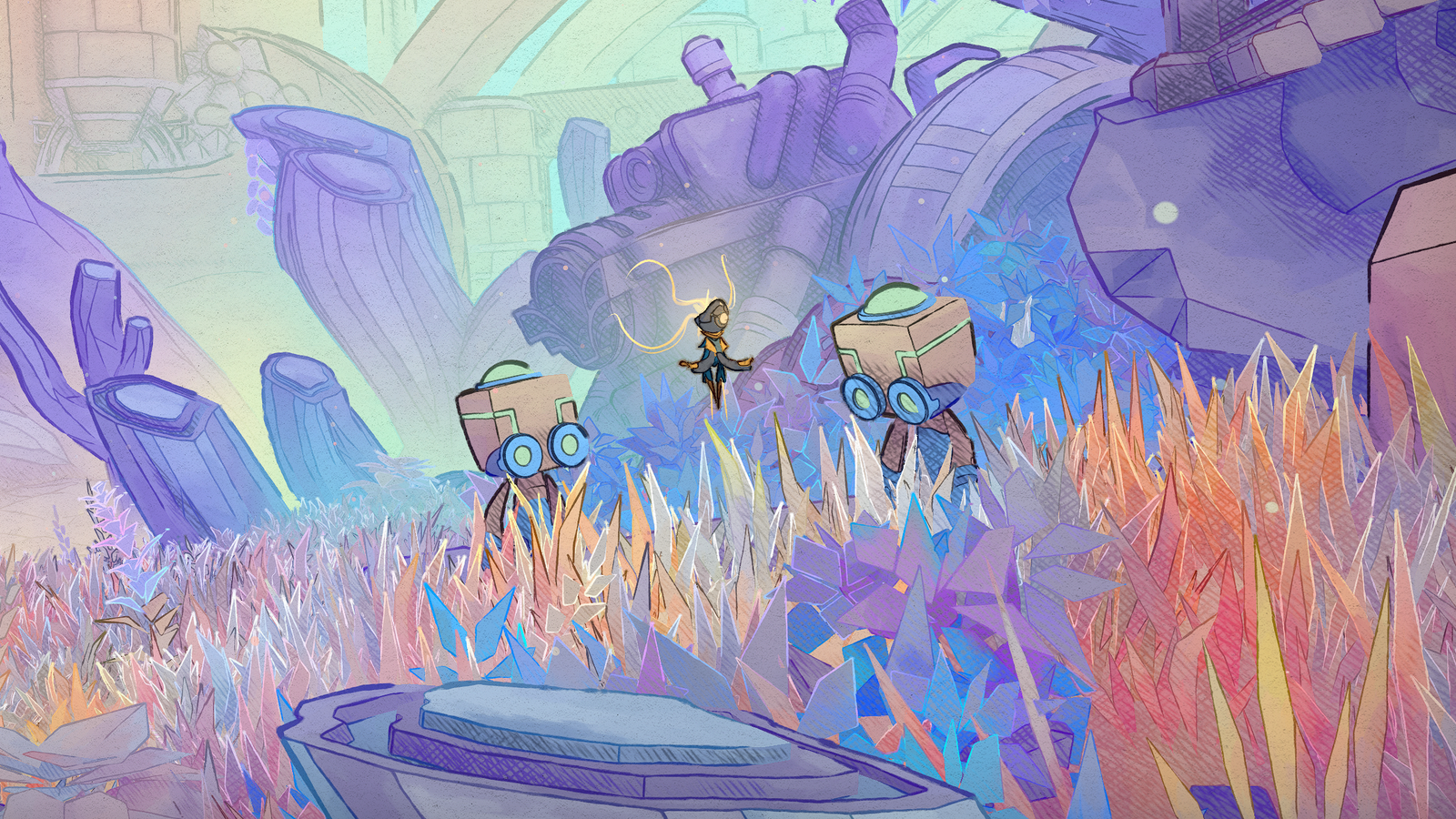
Video game development is a race against time. Studios are racing against deadlines, rushing to hit milestones and complete features in order to stay on time (and on budget) for their next game’s release date. Sometimes staff lose the fight and delays become unavoidable. It’s not necessarily a sign of defeat. For Mio: Memories in Orbit developer Douze Dixièmes, it was practically divine intervention.
“To be honest, we’re a little late,” Douze Dixièmes co-founder Sarah Hourcade told Polygon in a video interview ahead of Mio’s January 20 launch. “This is the second release date we have discussed with the publisher. The first release date, which was never announced or told to the public, was actually the exact same day as Silksong.”
There was no way Douze Dixièmes could plan the hype for Hollow Knight: Silksong since Team Cherry had just announced a September 4th release date a few weeks ago. Whether it was fate or not, narrowly avoiding a collision with one of the biggest games of 2025 is just one example of time working in the studio’s favor. (Other developers weren’t so lucky, suffering last-minute delays.) Douze Dixièmes spent every minute of the development cycle on his stylish new Metroidvania right down to the final months of development, which were allowed by miraculous internal delays. It wouldn’t be the same game without calendar management.
Development on Mio: Memories in Orbit began five years ago. The team at Douze Dixièmes had just completed their previous puzzle platformer, Shady Part of Me, and wanted to try something new. As if they were in charge of their own destiny, the team began thinking about the game itself, which would have ruined their original launch plans if they hadn’t pivoted.
“For the first few weeks, we wanted to create a Metroidvania in a sci-fi setting,” Hourcade says. “At the time, half the team was playing Hollow Knight, and we thought Silksong was going to take that long. When we made Shady Part of Me, it was a very linear platform game, and by the end we were really tired of playing it. Next up, we wanted to make a game that would still be fun to play five years later.”
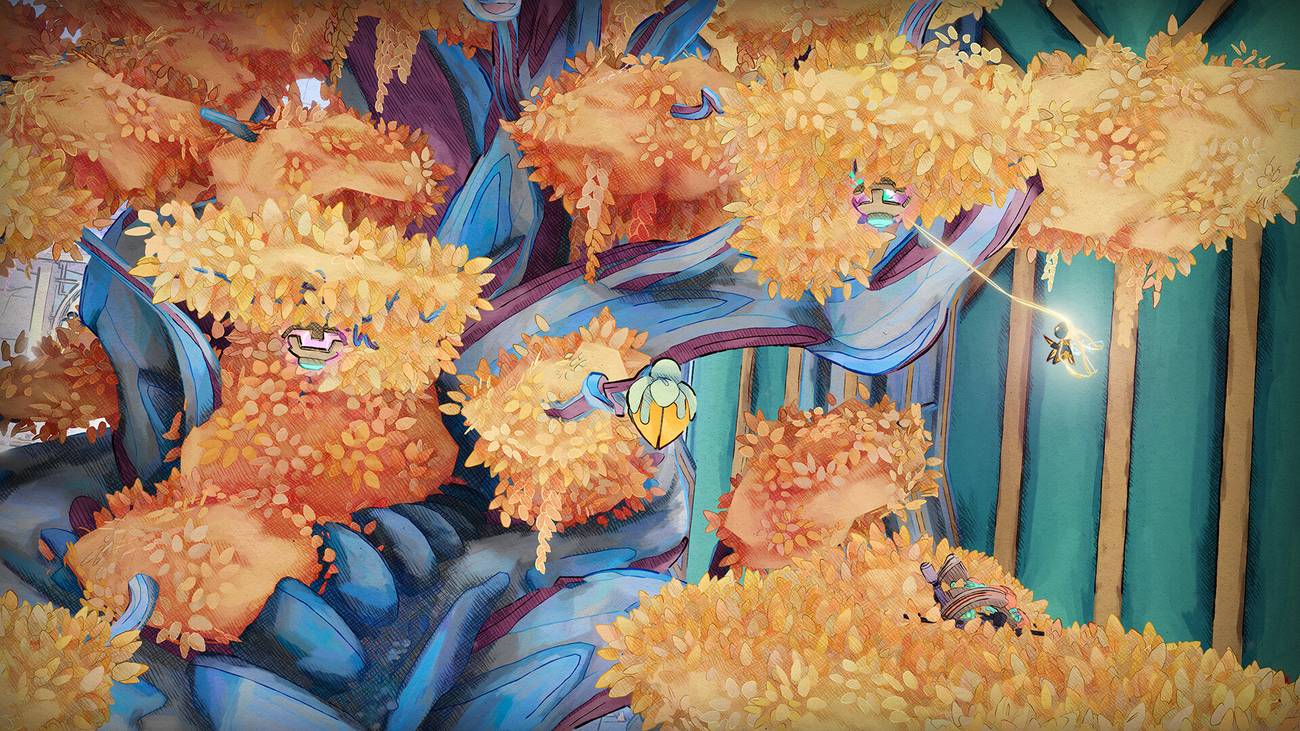
A small team worked on creating something inspired by several games. Hollow Knight was the North Star, but the team also considered Ori and the Blind Forest for art direction, and Chants of Sennaar and Tunic for games that didn’t tell you everything explicitly. It was an ambitious undertaking for a studio that had previously made short, relatively simple puzzle platformers, and the reality of it began to add up after five years of development.
“There were a lot of things we changed significantly because we didn’t want any inconsistencies,” Hourcade says. “And every time we found it, we thought, ‘Oh no.’ We lost so much time.”
Everything changed in two months.
As a great example, Hourcade describes the game’s map design. Mio takes place entirely on a spaceship called “The Vessel.” It’s structured a bit like a human body, and everything converges into a central chamber called The Spine. At one point, the team wanted to go all-in on the idea and include just one checkpoint in the room. This complex idea was scrapped after the team accepted that it could not be realized without working toward that goal from the beginning. (The final game had approximately 18 checkpoints, reduced from 50 earlier in the project’s lifecycle.)
Although the team was unable to realize some ideas, other important features were completed in record time. For those who were shocked by Mio’s art style, which makes every frame look like it was hand-painted in watercolor, know that it looked very different until some simple work gave the game a unique look.
“One of the main things we decided to do to create this hand-drawn environment was to change it mid-production,” Hourcade says. “It started out like any other game. An artist would create something, and then you’d do the rendering and all the other post-processing. After three years of production, they decided to change everything. All the rendering, all the material systems, all the lighting, everything changed in two months.”
The change comes from what Hourcade describes as a Photoshop-like post-processing method that allows developers to apply a consistent hand-drawn look to every frame. The move also meant a big change in the team’s approach to lighting. In the original art style, scenes were typically lit by multiple lights. In the final version, most scenes have only one light source.
Other major features were integrated much later in the development cycle. In fact, some say if Mio had stuck to its original release date plan, they might not have made the game at all. For example, Hourcade said the game’s final ending was only written during the last eight months of production. Other choices were even more important, including features so fresh that even Hourcade wasn’t sure how players would feel about them.
“We had to make a choice and we knew that from the beginning,” she said. “You can’t be innovative in all areas. You can’t change everything. So some small changes will be unique because they serve a purpose. Some things were done at the end of the project, and I don’t know if it’s such a good idea yet, but we’ll see how it goes. For example, the mechanism for permanently losing lives…I think it arrived six months before release.”
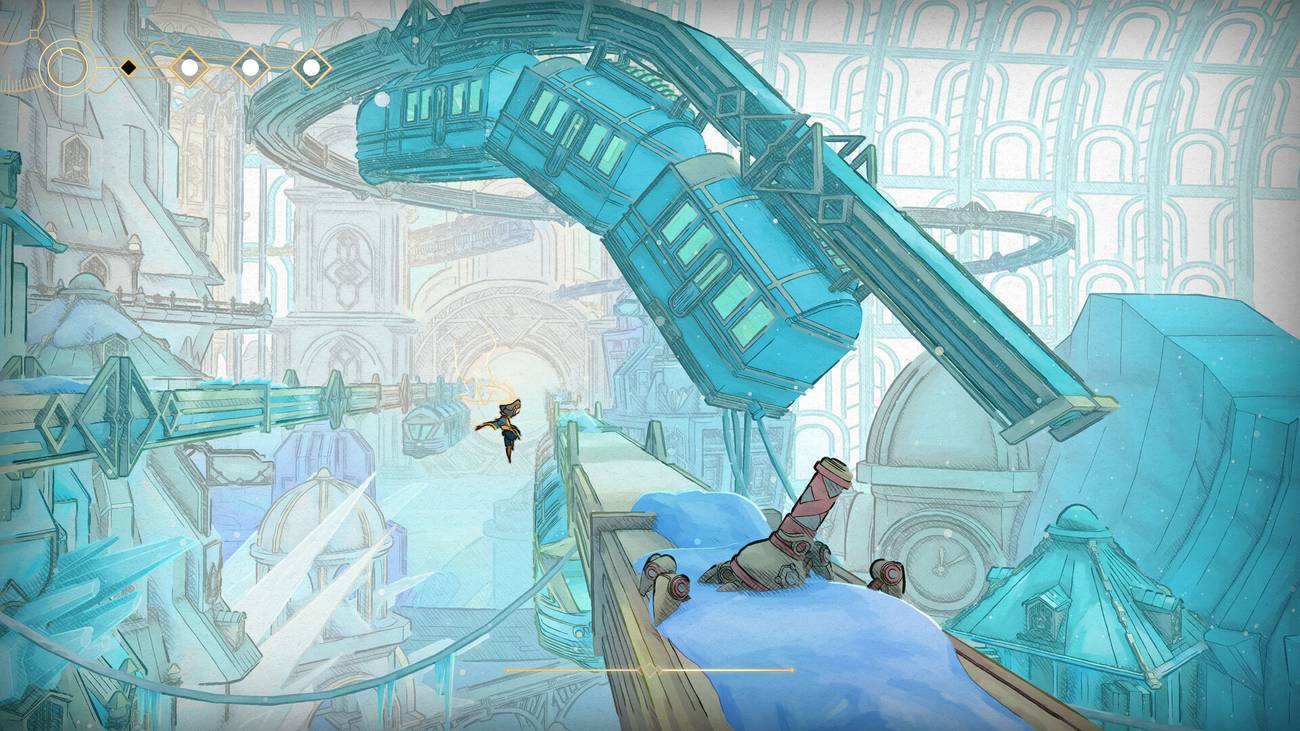
Image: Twelve Tenths/Focus Entertainment
Not only has Mio changed a lot over the past five years. So was the world around me. The game tells the story of an abandoned spaceship run by an AI caretaker. The robots are misbehaving, and it’s up to Mio, the game’s diminutive hero, to set them right. Thanks to the rise of generative AI in recent years, that story will carry more weight in 2026 than it did in 2021, which is a powder keg problem for the video game industry. Naturally, this theme wasn’t on the studio’s mind when they wrote hundreds of pages of background for the game’s world, but some of their fears about AI have now translated into a timely story.
“We can’t live in cages and not see what’s going on in the world,” Hourcard said. “So, we thought about it. But it’s very strange coming from a video game studio, but we’re not very involved in technology. I don’t think anyone in the studio has an Instagram account or anything like that. We don’t have social media. We don’t use AI. Of course. We know what’s going on in the world by reading the news, but we’re also getting into our own world a little bit. But I think that inspired some of the stories because, of course, we read the news and it feeds us into writing. ”
Douze Dixièmes’s knack for timing is paying off once again, as it launches in a quieter January rather than a crowded September. Mio is the first major Metroidvania to be released after Silksong, and it comes at a time when more people than ever are hungry for the genre. This is a pleasant surprise for the studio, but it’s also a double-edged sword. Due to its closeness to Silk Song, there will be many people who dislike it and consider it a cash rip-off. Awakade said he had already seen some comments to that effect on the trailer.
If Hollow Knight didn’t exist, Mio wouldn’t be what she is now.
Mio has some obvious Hollow Knight inspirations, but it’s very much its own game. This is a more traditional Metroidvania, with more emphasis on movement and mystery than combat. While Hollow Knight is harsh and whimsical, Mio is meditative and philosophical. Over time, this work has formed its own entry into the canon of the genre. Despite some trepidation at one point, Hourcade is confident that his team’s work will pay off.
“People will compare it to Silk Song, and some will say we made a copy of Silk Song and we already know that,” she said. “During production, we were very worried that we would take too much inspiration from one game. But in the end, we had about 20 people working on this game, and they all put their stories, their emotions, everything. It’s really nice to have a great game to draw inspiration from. And Silksong is a masterpiece! It’s such a great game, so I’m so glad it exists. We can play it right now, and you never know what would happen without it. But Mio That wasn’t the case. I think we’re all working together to figure out what would happen if Hollow Knight didn’t exist.”
If you’re hoping for a sequel to be made in less time than it took Team Cherry to make Silksong, don’t get too excited. Awakade said the team hasn’t talked much about turning Mio into a broader series. Douze Dixièmes will have to wait, even if the team wants to. Mio’s director is taking a year off to follow the project. Now it seems like I can use my time effectively.
