

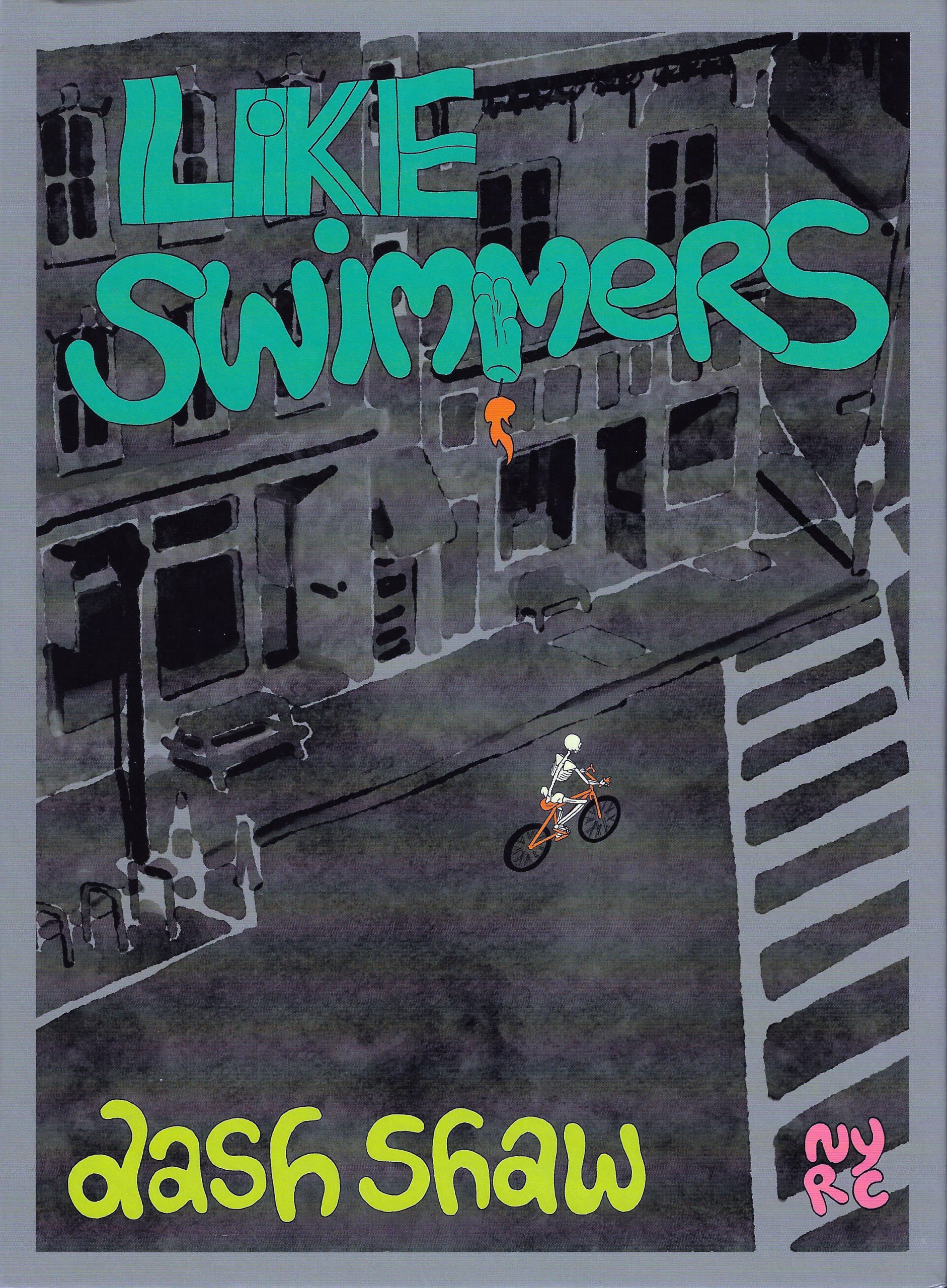
“I have seen the future of comics and its name is Dash Shaw.”-David Mazzucchelli
In 2010, in a blurb for BodyWorld, David Mazzucchelli described Dash Shaw as “the future of comics.” With the release of Like Swimmers, his latest graphic novel from New York Review Comics, that “future” is now.1
Even before Mazzucchelli’s enthusiastic endorsement, Shaw was already exploring the boundaries of the medium. After earning his BFA in Illustration from the School of Visual Arts in 2005, Shaw published several ‘zines and mini-comics, as well as the out-of-print graphic novella,The Mother’s Mouth(2006). His breakthrough graphic novel,Bottomless Belly Button(2008), was an ambitious family drama that sits comfortably on the bookshelf between Craig Thompson’sBlanketsand Don DeLillo’sUnderworld, while his follow-up,BodyWorld(2010), a Philip K. Dick-inspired science fiction epic, was stylistically closer to animation. Designed for the web and first serialized online,BodyWorld‘s vertical-scroll format and digital painting were a revelation. Published just two years apart, these very different, yet equally innovative books announced the arrival of a major new creative voice in alternative comics.
In the sixteen years sinceBodyWorld‘s release, Shaw has produced an eclectic body of work that spans graphic novels, animation, and film. More than most of his contemporaries, he is an artistic chameleon who’s explored everything from historical fiction (Discipline) and mystery (Clue: Candlestick), to metaphysical fantasy (Doctors) and satire (Cosplayers), adapting his visual style to fit each subject.2 His most recent graphic novel,Blurry(2024), a 480-page mosaic of intersecting slice-of-life vignettes, landed him on year-end best-of lists of theNew York Times, theWashington Post, andForbes.
Marketed as “a pandemic murder mystery,”Like Swimmerscontains far more depth than its genre label suggests. Set in Shaw’s hometown of Richmond, Virginia, during the early months of COVID-19 (the cover and endpapers set the stage as death stalks the empty streets), it recounts the lead-up to and aftermath of the murder of Howie, a 24-year-old bike courier, tattoo artist, and occasional cartoonist. Rather than follow typical police procedure, however, Shaw filters the mystery through Howie’s older sister, Mackenzie, an unreliable narrator who undertakes her own investigation that is colored by grief, suspicion, and self-doubt.
But whileLike Swimmersborrows the machinery of detective fiction, one of its primary concerns is the divide between fine art and popular art. Howie and Isa, whose unlikely affair forms the book’s emotional core, embody this divide. Howie, who still has an “innocent glow” to Kenzie, teaches cartooning to kids and hangs out at playgrounds playing four-square, whereas Isa, twelve years his senior, is married to a wealthy department chair and works at the contemporary art museum where Howie is a fish out of water.
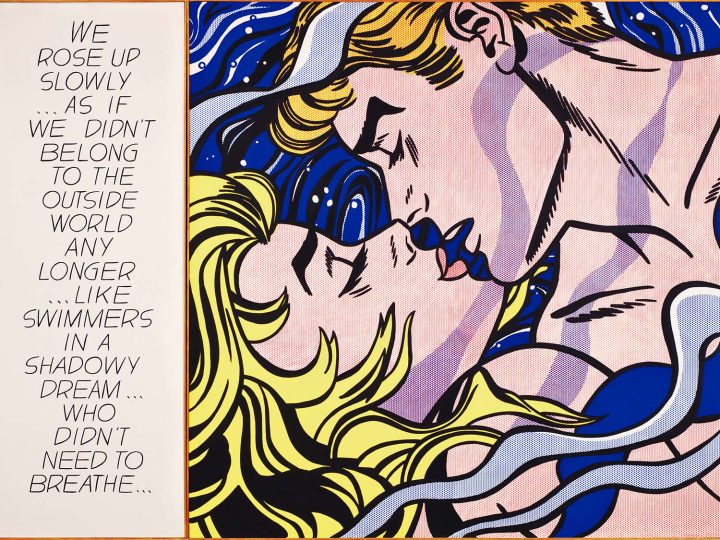

Throughout the book, Shaw explores how cultural differences affect our perceptions of art through the lens of Roy Lichtenstein. The book’s title is taken from the text embedded in Lichtenstein’s painting,We Rose Up Slowly(1964), which Shaw reproduces on his yellow-and-black title page. The painting was adapted from a panel drawn by John Romita Sr. inGirls’ Romances#81 (1962). 3
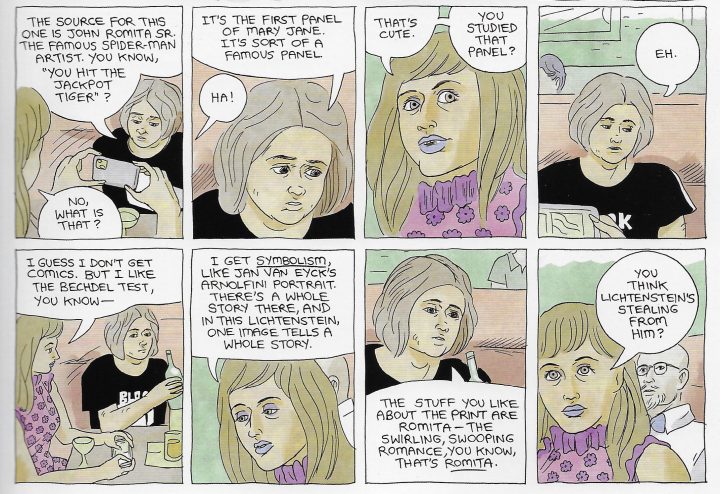
In one of the book’s most memorable scenes, Howie and Isa debate the merit of Lichtenstein’s painting. Howie dismisses Lichtenstein as little more than a “projectionist” who copied and “enlarged” other people’s art and presented it as his own. Isa, on the other hand, believes that “context” transforms meaning. By excavating a single panel and hanging it in a museum, she argues, Lichtenstein created a separate original work of art. Shaw pushes this debate further by having a signed print ofWe Rose Up Slowlyrepeatedly stolen back and forth between Howie, Isa, and her husband, transforming the painting from a controversial symbol of the cultural divide into a physical object over which both sides stake competing claims.
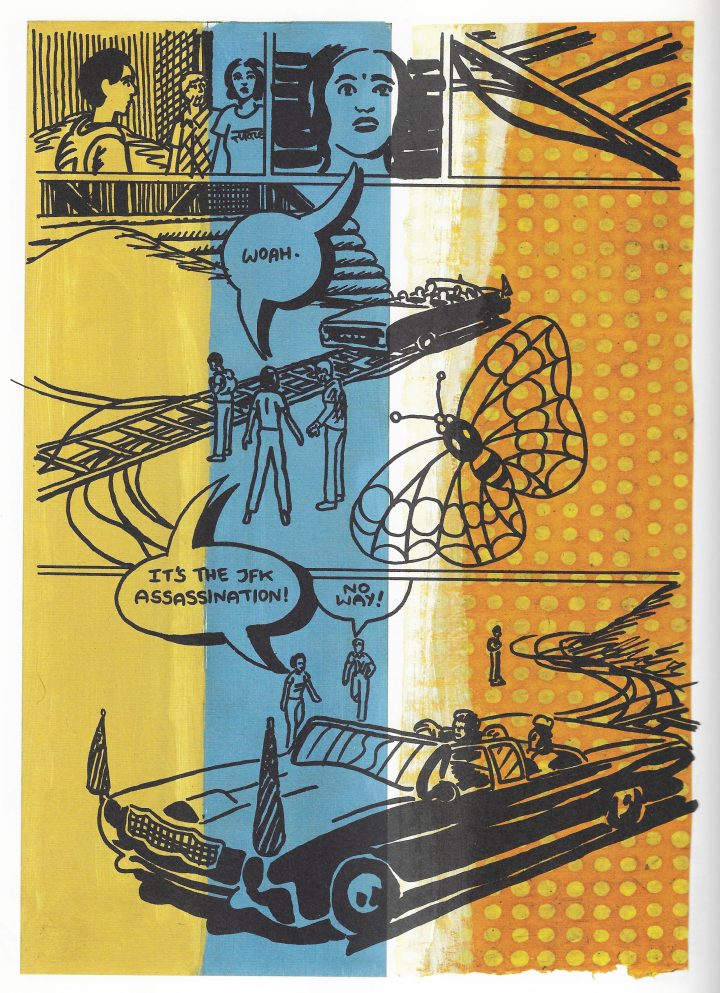
This imaginary line between comics and fine art is a theme Shaw has explored throughout his career. InNew School(2013), he blended black-and-white comics with abstract paintings and photo collages. The book was an attempt to erase this artificial boundary by combining the two – “high art and pop art” – on the same page. “I don’t think about a separation between high art and pop art,” he said.(Clough2008)WhileNew Schoolmade that argument visually,Like Swimmersexplores it through character and conflict.
Shaw’s drawings inLike Swimmersretainthe elegant minimalism that traces fromBlurryall the way back toBottomless Belly Button. His characters are deceptively simple, but his command of posture and expression put him on par with Jaime Hernandez. The manga-style pacing, a departure from the static four-panel format ofBlurry, mixes dense four-tier grids full of dialogue with long silent sequences, giving the story balance and momentum.
Shaw’s expressive coloring, an especially fascinating tool in his arsenal ever sinceBodyWorld, is much more subtle inLike Swimmers. WhileBodyWorldflooded its pages with psychedelic digital colors,4Like Swimmersemploys a softer, more muted palette. Scenes are awash in soft pinks, pale greens, and bruised purples. InBodyWorld, the colors carried significant storytelling responsibility; inLike Swimmersthey function more like the score of a film, blending into the background while shaping the emotional atmosphere.
In the end, it’s clear that Shaw is less interested in solving a murder than in questioning whether people, like works of art, can be reduced to a single identity. Just as the same image in Lichtenstein’s painting acquires different meanings depending on who is looking at it, so do the people in our lives. By the end of her investigation, Kenzie realizes, too late, that “there are at least two sides to every person,” and that there was much more to Howie than she, from her limited perspective as his older sister, ever knew.
Ultimately, the brilliance ofLike Swimmersis that Shaw respects his readers enough not to spoon feed them answers, allowing multiple interpretations of the story to coexist. Though the younger Shaw who Mazzucchelli hailed as “the future of comics” is no longer as driven by formal innovation as he was in 2010, he has matured into a formidable storyteller.
- Mazzucchelli is an Eisner and Harvey Award-winning artist who also famously reinvented himself in the ‘90s, leaving behind superhero comics to blaze his own trail into independent self-publishing. For years, he has been a mentor to Shaw. Shaw was his student at SVA, and the two recorded a fascinating conversation about craft and storytelling in The Comics Journal #300 (2009).
- As Greg Hunter, author of New Realities: The Comics of Dash Shaw, noted, “More so than many of his contemporaries, Dash Shaw has varied his visual approach from book to book, shifting from the spare line work of Bottomless Belly Button to the blunt lines and colorful near-chaos of New School to the comics normcore of Cosplayers.” (Hunter 2023)
- Unsurprisingly, Lichtenstein’s appropriations have never sat well with the cartoonists on the losing end of them. Hy Eisman, for example, whose own romance-comics work was later repurposed by Lichtenstein for a different painting, put it bluntly decades afterward. “I worked like a dog on this stupid page and this guy has $20m to show for it. If it wasn’t so tragic, it would be [funny].” (Eisman, qtd. in Lambiek Comiclopedia, n.d.). (Hunter 2023)
- Shaw explained that, for BodyWorld’s coloring, he “combined animation techniques with comic coloring techniques, with the line art on acetate sheets (like an animation cell) and painting behind it or on a separate layer, and doing color separations, like pre-Photoshop comics coloring.” (Conklin 2011)

3 Comments
Pingback: Does It Look Desperate When Brands Use Pop Culture to Be Relevant? - Comic Vibe
Pingback: Kylie Jenner Details Becoming a Die-Hard Knicks Fan Since Dating Timothee Chalamet - Comic Vibe
Pingback: GUESS THE WRESTLER BY THE ROBLOX CHARACTER - Comic Vibe