

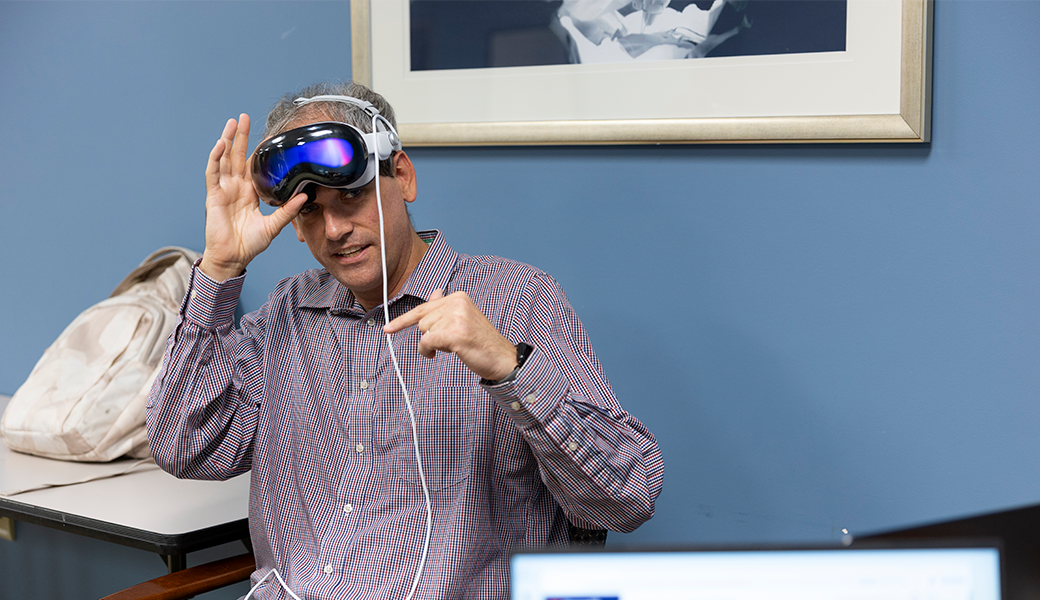
Kyle Johnsen, a professor in the University of Georgia College of Engineering, will receive the 2026 Innovation Award from Georgia Life Sciences, the state’s largest life sciences advocacy and business leadership organization, at the 2026 Golden Helix awards.
Johnsen helped develop Targeted Brain Rehabilitation (TBR), a gaze-controlled virtual reality (VR) therapy designed to treat phantom limb pain in amputees. The technology guides patients through four progressive phases, moving from simple hand recognition to guided meditation, mirror therapy, and finally a VR simulation that projects an intact limb the amputee can manipulate.
“Johnsen’s Innovation Award highlights UGA’s commitment to translating research discoveries into life-changing solutions,” said Derek Eberhart, associate vice president for research and executive director of Innovation Gateway, UGA’s technology commercialization and startup support program. “This recognition illustrates the vital synergy between academic ingenuity and industry partnerships, a key driver of UGA’s No. 1 ranking among U.S. universities for bringing new discoveries to the marketplace.”
Johnsen will be honored as part of the 2026 Golden Helix awards, which recognize the individuals, organizations, partnerships, and investments advancing innovation, improving patient care, strengthening Georgia’s economy, and shaping the future of the state’s life sciences ecosystem. The Innovation Award specifically recognizes those thinking outside traditional paradigms to create unique technology.
“Winning the Innovation Award means a lot, honestly,” said Johnsen. “Georgia has a deep and very serious life sciences community and to have that community recognize the innovation in our research is such a strong signal to us that we are on the right path.”

The TBR approach, rooted in Johnsen’s research on retraining neural pathways, aims to restore patients’ sense of control over a missing limb and reduce pain signals associated with its loss.
“We keep having breakthroughs in our work, and it happens every time we have patients use our systems,” said Johnsen. “Each person’s amputation is fundamentally different, and those differences require new innovations to address their needs and the ones that came before them. We’re constantly working to better understand how the technology, the virtual and clinical environments, and the therapies all play a role in reducing and ultimately preventing phantom limb pain.”
This VR therapy is currently licensed by Axolo Health. Registered as a Class II Software as a Medical Device (SaMD), TBR is proving to be a promising nonpharmacological alternative for amputees managing chronic pain.
Johnsen also directs UGA’s Virtual Experiences Laboratory and leads the Georgia Informatics Institutes for Research and Education. His research focuses on emerging human-computer interaction technologies—including virtual reality and multimodal 3D user interfaces—with applications spanning health, education, and the environment.
Johnsen will be recognized alongside this year’s other Golden Helix honorees during the Georgia Life Sciences Summit Welcome Reception and Golden Helix Awards Ceremony on Tuesday, Aug. 25, at the Sandy Springs Performing Arts Center.
