

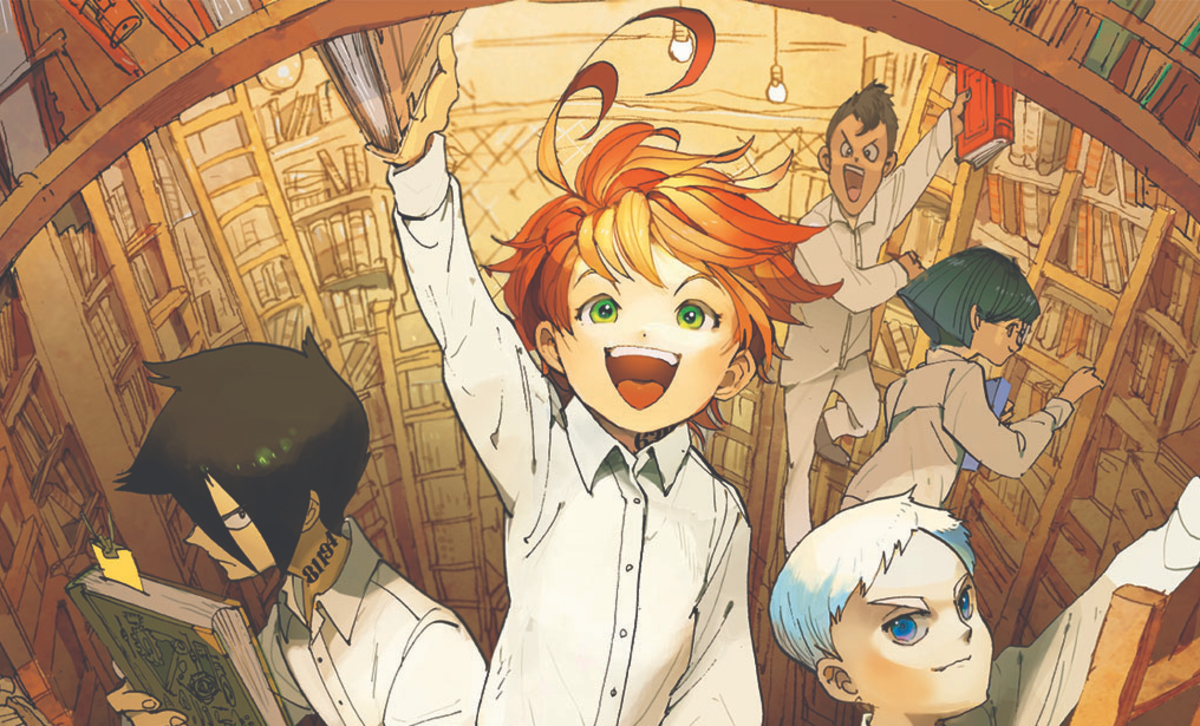
The manga that defined psychological thriller shōnen at its peak returned to Weekly Shonen Jump today with “War vs. Peace,” a 36-page canonical sequel set in the year 2050 — the first story to advance the timeline of The Promised Neverland‘s universe since the original series concluded in June 2020. Written by Kaiu Shirai and illustrated by Posuka Demizu, the one-shot publishes in WSJ Issue 39 as part of the franchise’s 10th anniversary campaign, and it arrives in the same month that Weekly Shonen Jump’s print circulation fell below one million copies for the first time since the Japan Magazine Publishers Association began its current reporting system in 2008.
The coincidence is not incidental. For a franchise with more than 43 million copies in global circulation, the return of The Promised Neverland to the magazine that launched it matters more this week than it would have at any other point in the last decade — because the magazine itself is at a crossroads, and Shueisha knows it.
The one-shot, set in the year 2050, centers on Ayshe as the central character of the post-ending narrative. ComicBook.com’s reporting on the released chapter confirms she still carries hatred toward Norman and the group for killing her father during the events of the original series, even as she has bonded with the human community around her. Emma — who sacrificed all her memories of her family and past as the price for negotiating the New Promise — plays a central role in helping Ayshe find a path toward resolution.
War vs. Peace: What the Chapter Addresses
“War vs. Peace,” published today in Japan in WSJ Issue 39, centers on Ayshe, a character whose arc from the original manga carried one of its most unresolved emotional weights. The chapter, set roughly two to three years after the original ending’s timeline of November 2047, depicts Ayshe still carrying the grief and hatred that followed from Norman and the others killing her father during the campaign to liberate humanity. She has bonded with the human community around her, but the hatred has not dissolved — it has simply coexisted alongside the bond, the way grief tends to.
The chapter brings Emma into that conflict. Emma, who gave up all her memories of her family and past as the price for negotiating a new Promise that freed all the orphans and eliminated the Farm system, now lives in 2050 without knowledge of who she once was or what she once did. She has found a new life, a new identity, and — per the original manga’s volume-edition addendum — something like happiness. What Ayshe discovers, in conversation with this Emma who cannot remember being the person who saved everyone, is apparently the seed of the resolution she has been unable to reach through rage alone.
Shueisha announced the one-shot in April when the chapter was first revealed, releasing storyboard pages showing the year 2050, a photograph of Emma riding a giraffe — a callback to the dream she named in the original series — and Gilda calling for Ayshe. What the chapter delivers, per ComicBook.com reporting based on the released chapter, is a story about how hope travels through a body that no longer carries the memory of why it once fought for it.
That is not a small thing to dramatize in 36 pages. It is also, by the standard of what the franchise’s fanbase has been waiting for, exactly the right story to tell first.
Why “War vs. Peace” Is the Right Title
The original Promised Neverland premise — children raised in a beautiful orphanage who are secretly livestock for demons — was always about what people will accept in exchange for comfort. The Farm system was not maintained by brutality alone; it was maintained by the willingness of its participants, on both sides, to not look too closely at what the system required.
The title “War vs. Peace” names the ideological conflict that the post-Promise world inherits. Defeating the Farm system militarily did not resolve the question of whether two fundamentally different kinds of beings — humans and demons — could share a world without one consuming the other. It only removed the institutional mechanism that had formalized the consumption. What remains is the harder problem: whether coexistence is possible when the history of exploitation has not been equally distributed, and when the surviving individuals carry different wounds from the same war.
Ayshe’s story is that problem made personal. Norman’s faction killed her father. Norman and the others are the reason the demons’ world was transformed. They are also the reason the orphans are alive and free. Ayshe is asked to hold those two facts simultaneously and find a way to live among people she has genuine reason to hate — which is, more precisely, what every post-conflict reconciliation process in human history has asked of its participants.
What Partition Theory Reveals About the Promise
The political architecture of the original Promised Neverland draws directly on a tradition that political scientists have spent decades studying: partition as conflict resolution. Approximately a thousand years before the events of the manga, a representative of the human world — Julius Ratri — negotiated with the demon god to physically separate the two worlds into distinct domains, accessible only through controlled gates. The arrangement was enforced supernaturally; both sides were bound by an entity whose authority transcended political allegiance.
Real-world partition has followed a similar logic throughout the 20th century: Ireland (1920), the Indian subcontinent (1947), Korea and Germany (1945). Scholars of partition theory have observed that partitions typically freeze rather than resolve the underlying conditions of conflict. The two sides no longer have immediate access to each other, which reduces proximate violence — but the conditions that made violence probable in the first place remain intact beneath the institutional settlement.
The original Promise followed exactly this failure pattern. It separated the worlds and removed the opportunity for immediate conflict, but it institutionalized the Farm system as its ongoing mechanism of appeasement — meaning the partition was only sustainable as long as the humans continued to be “produced” for demon consumption. The moment the production system was disrupted (by Emma and the escaped orphans), the partition’s structural logic collapsed.
What Emma’s New Promise attempts is categorically different. By eliminating the demons’ biological dependence on human flesh — through the propagation of Mujika’s blood, which functions in the narrative as a permanent metabolic override — the new arrangement eliminates the underlying condition that made partition necessary in the first place. This is not a better partition; it is an attempt at the prerequisites for genuine coexistence. Whether it holds in “War vs. Peace” is the chapter’s central dramatic question.
Emma’s Amnesia Through Parfit’s Lens
The philosophical weight of Emma’s sacrifice at the end of the original series has attracted genuine academic interest, though not in manga scholarship specifically. The structure of her situation maps with unusual precision onto the thought experiments of philosopher Derek Parfit’s 1984 workReasons and Persons, which argued that personal identity consists in psychological continuity and connectedness — what he called “Relation R” — rather than the physical persistence of a body.
Parfit’s central claim was that “identity is not what matters.” What matters is the chain of psychological connections — memories, intentions, beliefs, relationships — that link present self to past self. His fission thought experiments, in which a person’s brain is divided and each half transplanted into a different body, asked: if psychological continuity is what constitutes personal identity, what are we to say about a case where the thread is severed but the body survives?
Emma’s situation is a precise fictional enactment of that question. Her body persists. Her behavioral dispositions — her empathy, her instinct toward others’ wellbeing — appear to persist as well; the original ending showed her drawn toward the children of Grace Field despite having no memory of them. But the specific relational matrix that constituted her as Emma — the memories of Norman, Ray, Isabella, the years of planning and fighting and losing — is gone. Is the woman in 2050 who helps Ayshe find peace the same person who negotiated the New Promise?
Parfit’s answer would be: the question is less important than we think. What matters is not identity but continuity — and some form of psychological continuity, it appears, survived Emma’s sacrifice even as the memories did not.
The Idyllic Institution and Its Literary Lineage
The Promised Neverland participates in a tradition of speculative fiction that uses palatability as its primary weapon. Grace Field House is, deliberately, beautiful. The children are raised in apparent luxury precisely because a comfortable, educated child is a higher-quality “product.” The horror is not in the surface; it is in what the surface conceals.
This structural choice connects TPN to several significant works. Kazuo Ishiguro’s Never Let Me Go (2005) uses a nearly identical architecture — an idyllic boarding school called Hailsham whose students are clones raised for organ donation. The comparison has been noted by critics directly: CBR described Never Let Me Go as the literary version of The Promised Neverland. The key structural distinction is one of disposition: Ishiguro’s Kathy, Ruth, and Tommy accept their fate with heartbreaking passivity; Emma and her family reject theirs with every cognitive and social resource they possess. Both works are interested in what systems ask of the people they contain. One explores complicity; the other explores resistance.
Ursula K. Le Guin’s “The Ones Who Walk Away from Omelas” (1973) poses the same moral problem in starker form: a utopia whose perfection depends on the suffering of one child kept in a basement. Le Guin’s citizens know. Most choose to live with knowing. Some walk away — but Le Guin does not tell us where they go, or whether they find something better. TPN answers the question Le Guin left open: Emma goes back into the basement, confronts the child’s captors, and attempts to rebuild the city without the child in the basement at all.
Shirley Jackson’s “The Lottery” (1948) uses the same technique of the beloved institution masking its violence until the last moment possible. What distinguishes TPN from all of these is its insistence on addressing the reconstruction problem — not just the exposure of the horror, but the attempt at what comes after.
What the WSJ Circulation Moment Means for This One-Shot
Weekly Shonen Jump’s print circulation averaged 985,000 copies per week between April and June 2026, according to the Japan Magazine Publishers Association. This was the first time the magazine had fallen below one million copies since the JMPA began its current reporting system in 2008 — it also means Japan no longer has any print magazine with a certified circulation above one million. WSJ’s all-time peak was 6.53 million copies per week in December 1994, when it was serializing Dragon Ball and Slam Dunk simultaneously.
The decline is driven primarily by the migration of readers to digital platforms. Shonen Jump+, Shueisha’s mobile app, surpassed 30 million cumulative downloads as of October 2025. Digital manga sales grew substantially over the preceding decade as print declined. The structural shift is not a contraction of the manga audience; it is a redistribution of it.
But the symbolic weight of the sub-1M moment is real, and Shueisha is not unaware of it. The timing of the Promised Neverland one-shot — in the same month that the circulation milestone was reported, in the same issue that Japanese readers are holding as the magazine crosses below a threshold it has not breached in their lifetimes — is not accidental. Legacy franchises serve a different function in a declining print environment than they do in an expanding one: they remind readers why the physical magazine mattered to them, which is the only argument for its continued existence that price and convenience alone cannot win.
How the Anime Failure Shapes What This One-Shot Means
It is impossible to discuss “War vs. Peace” without discussing Season 2, because Season 2 is the reason so many of the franchise’s fans feel the creative team owes them something.
Season 1 of the Promised Neverland anime, produced by CloverWorks and broadcast from January to March 2019, adapted the first 37 chapters across 12 episodes and was widely regarded as one of the finest thriller anime productions of the decade. It generated the international audience that gave TPN its claim to blockbuster franchise status. Season 2, which premiered in January 2021, compressed more than 100 chapters into 11 episodes, omitted the fan-favorite Goldy Pond arc (chapters 64–95) in its entirety, and concluded with a slideshow ending that bore little structural relationship to how the manga actually ended — including omitting Emma’s memory sacrifice entirely.
The Goldy Pond arc alone is 31 chapters that anime viewers never saw animated — chapters that featured Emma’s first major solo narrative, introduced significant new characters, and expanded the demon world’s mythology in ways essential to understanding what the Promise system was protecting against. ComicBook.com described Season 2 as having butchered nearly 65% of the manga’s story.
Against this context, “War vs. Peace” is not only a creative act. It is a statement of authorial authority. The definitive version of The Promised Neverland lives in the manga — not in the adaptation that contracted it, not in the English-language live-action series Amazon Studios has been developing (no confirmed release date as of this writing) — and the original creative team has more story to tell in it. For a fanbase that experienced Season 2 as an institutional abandonment of source material, that claim of authority means something.
How to Read “War vs. Peace” Today
Weekly Shonen Jump Issue 39 is on sale in Japan as of August 24, 2026. Shueisha has made the first 10 volumes available free of The Promised Neverland to read on Shonen Jump+ and Zebrack through August 31. An official English-language release for “War vs. Peace” itself had not been confirmed as of August 10; VIZ Media, which publishes the franchise in North America both physically and digitally, has not announced a simultaneous release date. Given VIZ’s track record with high-profile Shonen Jump content, an official English release is expected but has not been formally scheduled.
The anniversary ecosystem extends beyond the one-shot: a full-scale stage musical is scheduled to run in Tokyo in Q4 2026, full-color digital editions of the original 20 volumes are in production, and an online lottery campaign launched in July 2026 tied to anniversary merchandise. Whether any of these projects advances the conversation about a Season 2 remake — the single most consistent demand from the English-speaking TPN fanbase — remains to be seen.
What Remains Unfinished
The question “War vs. Peace” cannot answer is whether a 36-page one-shot constitutes genuine closure for a franchise whose most meaningful remaining wound is not narrative but structural. The Goldy Pond arc, the King of Paradise arc, the full thematic complexity of the demon-world transformation — none of this exists in animated form. The story that Shirai and Demizu told across 181 chapters, collected into 20 volumes, won the 63rd Shogakukan Manga Award, is largely inaccessible to the majority of the franchise’s global audience, who came to it through the anime and stayed only as long as the anime’s fidelity held.
“War vs. Peace” offers Ayshe’s resolution and an encounter between her grief and Emma’s involuntary serenity. That is a meaningful story. It does not restore the two seasons of animated content that do not exist. It does not retroactively make the adaptation’s decisions coherent. What it does is remind readers — and potentially a new generation of them, arriving through the free-volume campaign — that this world has more dimensions than what they saw on screen.
Whether that reminder leads somewhere larger is, for now, a promise rather than a plot.
Frequently Asked Questions
What happens in the Promised Neverland “War vs. Peace” one-shot?
“War vs. Peace,” published in Weekly Shonen Jump Issue 39 on August 24, 2026, centers on Ayshe, a character who bonded with Emma and the others but still carries hatred toward Norman and the group for killing her father during the events of the original series. Set in the year 2050, the chapter depicts her confronting that unresolved grief, with Emma — who sacrificed all her memories of her family and past as the price for negotiating the New Promise — playing a central role in helping her find a path toward resolution. The chapter is 36 pages and was confirmed by ComicBook.com’s reporting on the released content.
Where can I read “War vs. Peace” in English?
As of August 10, an official English-language release for the one-shot had not been announced. The chapter is available in Japanese in Weekly Shonen Jump Issue 39. Shueisha has made the first 10 volumes of the original manga free on Shonen Jump+ and the Zebrack app through August 31, 2026, which is available in English. VIZ Media, which publishes The Promised Neverland in North America, has not confirmed a simultaneous English release date for the one-shot; one is expected given the franchise’s profile but has not been formally scheduled.
Will there be a Promised Neverland Season 2 remake?
No Season 2 remake has been confirmed as of August 2026. Fan demand for a remake has been consistent since Season 2’s heavily compressed and altered broadcast in 2021, which omitted the Goldy Pond arc (chapters 64–95) and other major story elements. The 10th anniversary projects include a stage musical, full-color digital manga, pop-up stores, and the “War vs. Peace” one-shot — but no announcement about a new anime adaptation.
What does the Promised Neverland’s ending actually mean for Emma’s identity?
Emma’s sacrifice at the end of the original series — offering all her memories of her family and her past as the price for the New Promise that freed the orphans and eliminated the Farm system — poses one of fiction’s cleanest versions of the personal identity question philosopher Derek Parfit explored in Reasons and Persons (1984). Parfit argued that personal identity rests on psychological continuity and connectedness — memory chains linking present self to past self. Emma’s body survives her sacrifice; her empathy and fundamental disposition appear to survive as well. But the specific relational matrix that constituted her as the person who led the resistance — her memories of Norman, Ray, and the others — does not. Whether the Emma of 2050 is “the same person” is less settled than it might appear. What “War vs. Peace” asks, implicitly, is whether that continuity was perhaps never the most essential part of who she was.
ⓒ 2026 TECHTIMES.com All rights reserved. Do not reproduce without permission.
