

- Auburn University mathematician Eric Harshbarger solves a 15-year-old mathematical problem involving dice to determine turn order in board games.
- The solution involves using four 12-sided dice to ensure no ties and equal odds for every player, with a later improvement using five 60-sided dice.
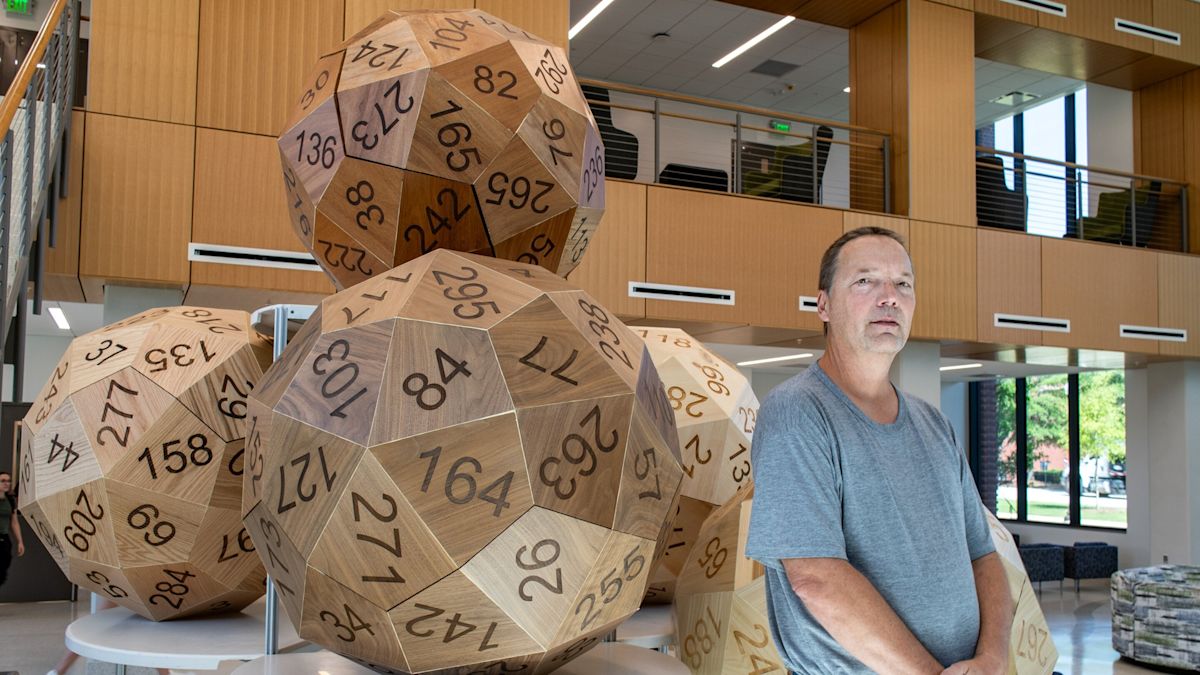
- Harshbarger commemorates the achievement by creating a wooden sculpture of the dice, which will be displayed at Auburn University’s new STEM + Agricultural Sciences Complex.
A dinner conversation at a gaming convention turned into a 15-year mathematical odyssey, all over one of the simplest questions in any board game: who goes first? Auburn University mathematician Eric Harshbarger has finally closed the case, and celebrated by carving the answer into five giant wooden dice.
Harshbarger, a senior lecturer in Auburn’s College of Sciences and Mathematics, was asked by a board game designer friend whether dice could settle turn order without ties. That casual question spiraled into a global research effort involving up to 20 contributors across multiple countries.
A deceptively hard question
Standard tie-breaking works by rolling again whenever two players land on the same number. Harshbarger’s friend wanted to skip that step entirely, asking for a set of dice where the highest roller always wins outright, with no repeat rolls needed.
The catch made the problem far harder than it sounds. Every player also needed an identical chance of rolling the highest number, whether all the dice were in play or only a smaller subset of them. Harshbarger and longtime collaborator Robert Ford solved the three-player case fairly quickly using standard numbered dice.
Then came a wall
Four six-sided dice turned out to be mathematically impossible, according to a program Harshbarger wrote to test every possible arrangement. The fix came from abandoning cubes altogether. Four 12-sided dice, numbered 1 through 48, finally produced a working solution with no ties and equal odds for every player.
That breakthrough drew international attention, including press coverage back in 2012, and interest in owning a set kept arriving from around the world. Harshbarger began cutting dice on his own laser cutter before a manufacturer eventually picked up production.
Searching a numeric universe
Extending the solution to five players required searching number spaces so large that Harshbarger compared them to counting atoms in the universe. One researcher ran a supercomputer for an entire summer and only ruled out a sliver of the possibilities.
Early five-player solutions worked but required dice too complex to manufacture practically. A version using five identical 120-sided dice eventually succeeded, and a handful were even machined from aluminum. Canadian researcher Paul Meyer later improved on that result around 2023, delivering a solution using five 60-sided dice instead, simpler to produce and just as mathematically fair.
Now a permanent sculpture
To mark the milestone, Harshbarger built five 60-sided dice as a wooden sculpture. Each measures nearly 3.5 ft (107 cm) across and was carved from different woods, including walnut and mahogany. Every die took roughly a month to complete by hand.
The sculpture will find a permanent home inside Auburn’s new STEM + Agricultural Sciences Complex, the future headquarters for the College of Sciences and Mathematics. Harshbarger said he hopes the towering dice make passersby pause, take notice, and start asking their own questions about the math hidden inside a simple roll.
