

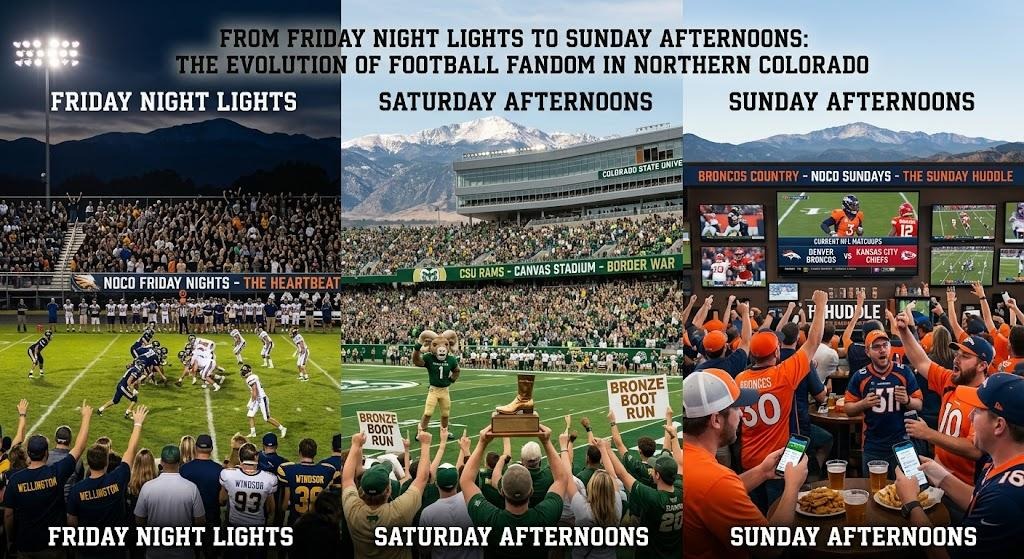
Northern Colorado sits at a strange crossroads. You have deep farming roots smashing right into explosive suburban sprawl, creating a massive regional obsession with athletics. Autumn rewires the entire calendar across Weld and Larimer counties. Residents essentially abandon normal timeframes to live on a strict football schedule. This sport dictates every single movement from Friday evening to Sunday night. The hyper-local community rituals of high school games in Wellington establish the baseline. Saturday collegiate tailgates in Fort Collins ramp up the regional tribalism. By Sunday, everyone morphs into a hyper-connected consumer of national broadcasts.
To observe how a community engages with the gridiron across a single weekend is to watch identity formation in real time. We see an incredible escalation in cultural scale. Friday nights reflect localized civic pride. Saturdays become a heavy banner of regional hatred. Sunday strips away the sentimentality, dropping the residents of Northern Colorado directly into a massive, heavily financed national market.
Friday Night Dirt and the Beet Field Resurrections
Wellington sits on the absolute edge of the Wyoming border. Agricultural survival historically defined this enclave, not modern suburban comforts. The reality is, youth athletics here were completely inseparable from the brutal labor of the sugar beet harvest for most of the twentieth century. Kids ripped crops from the freezing dirt just to keep their families solvent. Byron “Whizzer” White remains the patron saint of this grueling, hyper-localized ethos. Byron banked a buck-fifty a day pulling those crops. Then the guy somehow turns into a Heisman contender down in Boulder. You look at his resume and it makes zero sense. The man inked a massive rookie deal in the NFL. Oxford called him up for a Rhodes Scholarship right after that. Eventually, Washington put him on the Supreme Court. He actually despised the fame and flatly rejected interview requests when he returned to Colorado. Wellington clung to his legendary shadow for decades while their actual high school football program rotted away. Guys at the local diner used to laugh about the varsity field, claiming the dirt was vastly superior for raising root vegetables than actual football players.
Everything finally flipped in the modern era. Wellington violently snapped a humiliating 72-year championship drought during the 2025 campaign. The real turning point actually happened in the semifinals against Eaton. A skinny freshman named Brayton Meglen fielded a kickoff and burned the coverage for an 85-yard touchdown. The kid honestly had the build of a sprinter. That specific 85-yard run just shattered the other team’s morale entirely. Pueblo hosted the finals a few weeks down the road. Elizabeth High School showed up to play, but Wellington completely suffocated them. The scoreboard read 35-0 by the end of the massacre to secure the 2A crown. The entire municipality lost its collective mind. Agrarian grit clearly still pays massive dividends.
Start your morning with Northern Colorado news.
The Daily Update delivers local stories, weather, and events each morning at 5 a.m.
Drive thirty minutes south, and the historical athletic baggage gets even stranger. Windsor High School operates as a heavy, institutionalized football factory today. Their identity, however, was forged through a bizarre 1920s teenage rebellion. A draconian former Army officer named Joe Ryan took over the school’s sports programs to stop local boys from fighting Russian immigrant farmhands in the streets. He forced his athletes to choke down prune juice daily, mandated a miserable diet of stale bread, and outright banned swearing with ruthless efficiency. That oppressive friction birthed an unbelievably resilient basketball squad that traveled by train to Chicago in 1924, routed a South Dakota team in front of thousands, and earned the moniker “Wizards” from a bewildered local press. Today, the town translates that hardwood magic directly to the turf. Booster money floods into the Windsor bleachers these days. Those fans expect nothing less than absolute perfection on the turf. The squad actually ripped off a dozen straight victories during the 2025 run. Pomona finally derailed them in a brutal 17-14 dogfight for the 3A trophy. You do not just passively attend these matchups; you buy into a century-old municipal timeline.
That localized fever breaks permanently at sunrise. The residents of Weld and Larimer counties strip off their letterman jackets, abandon the freezing metal bleachers, and funnel directly toward the geographic epicenter of Fort Collins to finance a completely different beast.
A Quarter-Ton of Stolen Bronze and Saturday Tribalism
Colorado State University used to exile its football operations to Hughes Stadium, a concrete bowl parked several miles away near the foothills. Let’s be real, that remote setup absolutely murdered the organic college game day energy. The spatial dynamics shifted violently back to the heart of Fort Collins in 2017. Canvas Stadium cost $220 million to build, and it essentially dropped a massive concrete megaphone right into the center of the academic buildings. City streets and student pathways violently collide here. The setup forces local residents to physically confront the sheer size of the university every Saturday. Take the Old Main Bell as the perfect indicator of this cultural revival. Frat boys stole the 450-pound artifact back in 1919 and buried it on a local farm because they lacked an actual getaway plan. It sat silently in the dirt for half a century, bounced between basements in the 1970s, and then mysteriously appeared in a driveway just in time for the new stadium’s opening. Now, it rings out over 41,000 screaming fans every single time the Rams score.
The real financial and emotional capital, however, gets burned on the Border War. Wyoming sits a mere 65 miles north up U.S. Route 287. Laramie operates on a completely different cultural wavelength than the rapidly gentrifying cosmopolitan sprawl of Fort Collins. The Bronze Boot—an authentic combat boot worn in the jungles of Vietnam by a CSU ROTC instructor—serves as the hardware for this 125-year-old hatred. The logistics behind this trophy are insane. Cadets from Laramie physically run the game ball 27 miles down the highway until they hit the state border. A hyper-formal handoff occurs in the middle of nowhere, allowing a squad of CSU cadets to sprint the remaining 38 miles south. Recent history heavily favors the Cowboys, unfortunately. They absolutely embarrassed the Rams last year with a 28-0 blowout up north. You might think CSU jumping to the Pac-12 soon would kill this tradition, but television executives know better. Money dictates the schedule, and this specific collision of frontier isolationism and suburban expansionism is far too lucrative to abandon.
Once the final whistle echoes across the campus on Saturday night, the regional tribalism evaporates immediately. It gives way to the cold, hard mathematics of the American hospitality sector.
Satellite Dishes, Spreadsheets, and the Sunday Casino
The Denver Broncos cast an inescapable, billion-dollar shadow over the entirety of the Rocky Mountain region. Look closer, though, and you will see that the true engines of Sunday football in Northern Colorado are the wing joints and dive bars scattered around Campus West and Old Town. Establishments like Jim’s Wings and Mo Jeaux’s Bar and Grill do not just sell alcohol; they deal in highly orchestrated sensory overload. Seven to ten massive screens broadcast every possible camera angle of the league simultaneously. The patrons occupying these barstools are absolutely not the same sentimental neighbors who shivered through a Windsor high school game two days prior. They are completely rewired, data-driven consumers.
The legalization of sports wagering and the absolute explosion of daily fantasy apps have transformed the average Fort Collins resident into a ruthless amateur oddsmaker. The Colorado Division of Gaming tracks millions in betting revenue every single month, and you can practically smell that quiet, frantic financial desperation in the bars. A guy eating a plate of Cajun food at Mo Jeaux’s is deeply, financially invested in a meaningless third-quarter drive between the Jaguars and the Titans. The conversation pivots instantly from passively analyzing current NFL matchups to calculating volatile point spreads, shifting weather conditions, and agonizing last-minute injury reports on a cracked smartphone screen. Geographic loyalty completely vanishes in this space. The internet has successfully atomized the weekend, turning wholesome civic pride into a purely transactional, high-stakes dopamine hit.
The Final Whistle Cash-Out
The catch? None of this hyper-commercialized evolution erases the past. The agrarian toughness of Wellington, the bizarre prune juice history of the Windsor Wizards, and the exhausting ROTC highway runs for a Vietnam boot all survive perfectly intact. They just share the exact same geographical space with a billion-dollar digital gambling ecosystem. Northern Colorado figured out exactly how to package its dirt-road history and sell it right alongside a massive, synchronized Sunday wager. The fandom here does not slowly fade as the weekend comes to a close. It simply cashes out, reloads the bankroll, and resets the board for next Friday.
