

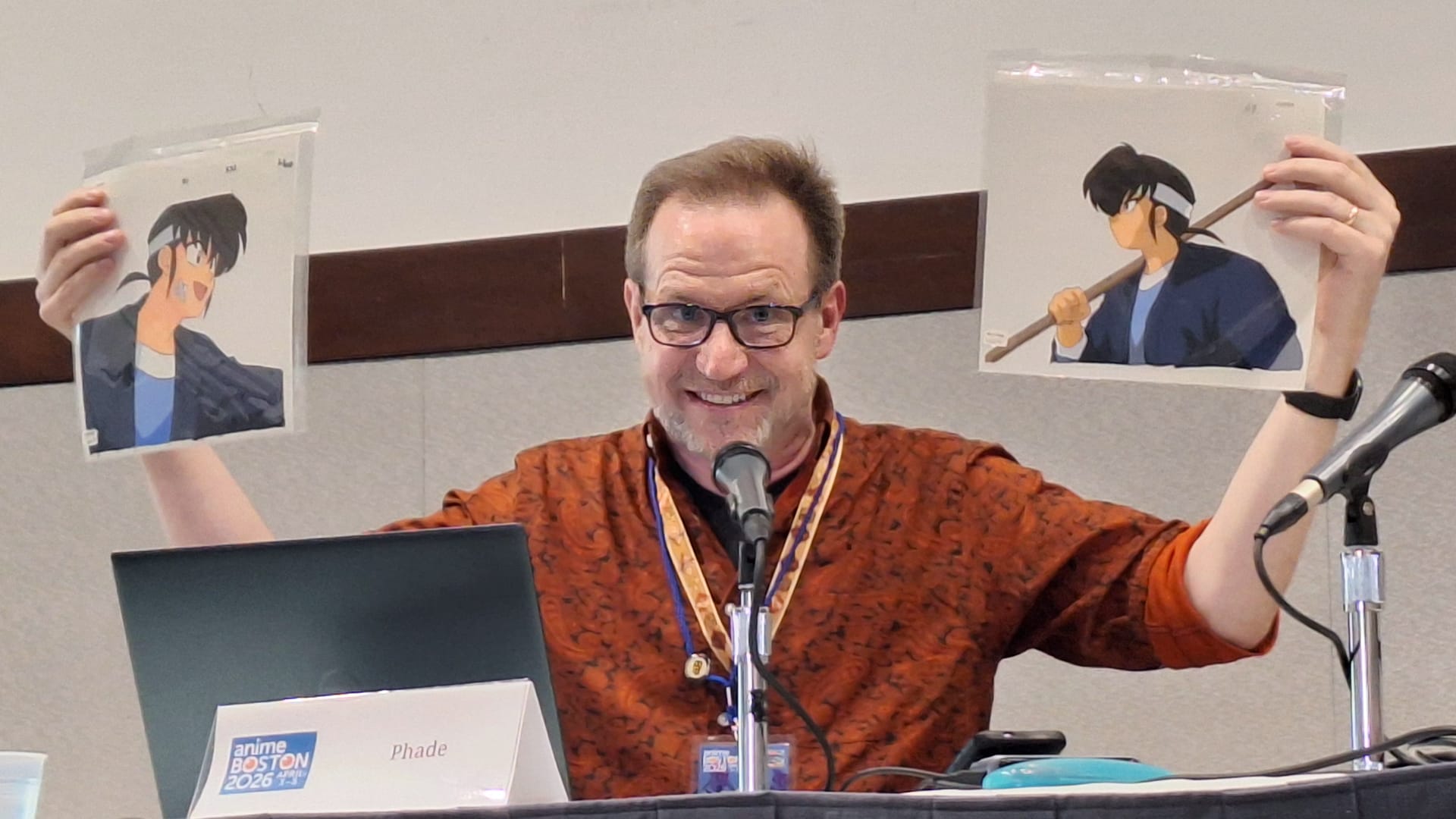
Title: The AMV.org History Panel with Phade
Preview Text: AnimeMusicVideos.org founder Phade hosted an unexpectedly tactile panel about the past, present, and future about his landmark AMV site at Anime Boston this year.
Table of contents
Anime music videos—or AMVs—are one of the most quintessential expressions of fandom. Ever since the late James Kaposztas set Star Blazers to The Beatles’ “All You Need is Love” in 1982, AMVs have, against all odds (more on that later), become a foundational part of anime fandom culture. Since that first, now-lost AMV was made more than forty years ago, AMV contests have become a convention staple. And, honestly, who amongst us hasn’t discovered a cool new anime or song through AMVs?
Introduction
No one has been more dedicated to giving AMVs and their community a home than Kris “Phade” McCormic, who runs AnimeMusicVideos.org (henceforth AMVorg), which he launched all the way back in 2000. To put that in AMV terms, that’s the same year Linkin Park released “Hybrid Theory.” This year, the lucky attendees of Anime Boston got the opportunity to learn about Phade’s and the site’s past, present, and future directly from the man himself.
But Phade uses an image of Shinnosuke from the Ranma ½ OVA as his avatar—how were we, the audience, to know that this was the real Phade? Who’s to say this wasn’t an imposter? Thankfully, to put our collective minds at ease, the man alleging to be Phade showed us that he has the animation cels that he uses as his online avatars. When combined with how much he would prove to know about the site, well, I suppose I guess it’s safe to believe that this was, in phact, Phade. In any case, bringing the famous cels with him was a really cool, unexpected thing for him to do, that I think we can all be forgiven for not expecting in a panel about an AMV website—a medium that has roots in physical media (more on that later), yes, but is still largely a digital operation. We the audience didn’t know it at the time, but this was only the tip of the iceberg. Phade had brought a veritable museum’s worth of objects with him, making the panel experience an unexpectedly tactile one.
But as for the meat of the panel, Phade had it divided into six chapters: General information about the site, the site’s genesis, the physics of the site, what keeps the site running, the future of the site, and then questions. Starting with the general information, he shared some pretty impressive stats about AMVOrg: In the twenty-six years it’s been online, it’s garnered nearly a million members and a little over 200,000 video entries, just over half of which are downloadable. As of the panel, there have been more than 28 million downloads from AMVorg.
It was as he moved on to talking about the humble beginnings of AMVorg, that Phade whipped out another prop: His badge from Katsucon 2000. More specifically, his love of anime goes back even further—he cited loving shows like Robotech and Transformers as a kid. Fast forward to just after his college years, when some of his coworkers introduced him to the wonderful and wacky world ofRanma ½, which got him hooked. Those same coworkers urged him to go to Katsucon, which was taking place that very weekend. He only went for the Sunday of the con, but despite being what’s usually regarded as the smallest day for most shows, it was still more than enough to irrevocably alter the course of his life when he walked into a dark room and saw AMVs playing. Phade recalls seeing them and thinking they were the coolest things he’d ever seen. He wondered if anyone had ever made a Ranma AMV to Madonna’s “Material Girl,” and it was his inability to readily find such a thing (largely via mailing lists) on the pre-YouTube internet that soon led to the creation of the site (and later, his making such an AMV—one of only two that he’s ever made, to this day).
Physical Media
After seeing some early screenshots of AMVorg (which you can also see here), Phade moved on to the physics of the site—or rather, tangible items “that make the magic.” As he explained, back in The Day—and especially when dial-up internet was prominent—it could take forever to download even a singular AMV. So burning them onto discs and sharing/exchanging them with other AMV-makers (especially at conventions) was a pretty common practice once upon a time. Phade brought a number of such discs with him, and showed pictures of others. Some of them looked like straight-out-the-box blank CDs with little more than a marker label of what was on it. Others managed to get some visuals on them (one, for example, had a collage of anime images on it). Particularly notable among the discs mentioned were The AMV Hell Perfect Collection, containing AMV Hells 0, 1, 2, and 3.
Still, it wasn’t just discs that Phade had. Before discs, AMV makers used tapes—which, yes, he also had on-hand. He explained that in addition to sharing AMVs with other AMV makers, physical media like these discs and tapes were also necessary for AMV contests at conventions before widespread internet access was available. Phade explained that AMV-makers would have to physically mail discs/tapes with their AMVs to enter them.
Next on the docket was AMVorg’s community. Phade kicked things off by taking us all back to Anime Weekend Atlanta 2005, where he was hanging out with a bunch of AMV creators. Suddenly, someone handed him a sheet of paper with a drawing of a guy holding a sword, and a bunch of signatures. The person went on to explain that it was a drawing of Phade, signed by fifty-six AMV creators who were at Anime Weekend Atlanta that year. He didn’t have the drawing with him physically (it was at home, “encased in glass”), but he nonetheless shared a photo of it. A murmur of “awwww”s could be heard in the audience.
That’s already adorable enough as it is, right? Brace yourself, it somehow gets even sweeter. Phade then passed around a booklet that showed a scanning of the drawing, and the pages each zoomed in on each individual signature, and listed information alongside it clarifying the name of the person (on the site, and if Phade knew it, the real name), the day they joined the site, and their AMVorg ID. Holding this in one’s hands, one couldn’t help but feel the immense weight of sentimentality this must hold. “Heartwarming” doesn’t even begin to describe it.
The Growth of the Site
From here, we moved on to the hosting timeline of AMVorg, and the more technical ins and outs of maintaining the site in general. It’s easy to forget—or at least not appreciate the gravity—of how, especially on a pre-YouTube internet, hosting video online was an expensive ordeal, both in terms of money and resources. Even though the site was founded in 2000, it wouldn’t be until 2002 that the idea to host video on the site emerged. Even so, the site needed $4,000 to get the correct server (the site’s first server, which Phade still has at home, used two Celeron 300A processors. “I’m pretty sure the base Apple Watch is more powerful than this machine here,” he would say) to make it happen (roughly $7,363 adjusted for inflation), so donations for this began in January 2003. Downloads went live the following month, and in July, the server would be filled for the first of what would eventually prove to be multiple times.
As the site has grown, it’s continued to run off of donations. And these donations very demonstrably mean a lot to Phade. Prior to electronic payment becoming normalized and widely accessible, these donations were often mailed directly to him. And if the envelopes were handwritten, Phade couldn’t find it in himself to throw it away. And thus, he amassed a box weighing seventeen pounds full of such envelopes from around the world—some even containing art from an envelope art contest he held in 2005. He remembered he offered a prize, but he couldn’t remember what it was.
So the members and donations are the beating heart of the site, that much is clear. But what about the skeletal structure that keeps everything intact—what about the actual hardware and technology that keeps the site afloat and operational? Phade spoke at great length (and a surprising amount of specific detail) about the specs the site has run on in the past, and is currently. These details included (but obviously weren’t limited to) the names for certain pieces (ex: The original firewall’s name was “Goku,” the new one is “Lain”) which, personally, I find hilarious. Personally, I think every site owner should name their servers and firewalls.
I can’t emphasize enough the granular level of detail Phade went into here. Unfortunately, a lot of it was lost on someone like me who’s never run a website and knows virtually nothing about the tech it takes to do so, but it was still cool to see him so visibly excited to talk about it. Especially if there were any techies in the audience, I also imagine it was especially cool for them, since people don’t usually talk so openly about this side of operating a website—at least, not at anime convention panels. Even if a lot of the jargon went over my head, I could still appreciate a unique experience when I was so clearly in the midst of it.
The Future of the Site
At the end of the tech talk, we’d talked about the site’s past and present, so obviously, it was finally time to talk about the future of AMVorg. Namely, to use Phade’s phrasing, a “major site refresh” which will happen in two phases: Site functionality, and then the extra bells and whistles. Among the most exciting of the new features he described are a new design (which, notably, will work better on mobile devices), auto-population (if you’ve been uploading to YouTube and not AMVorg, these features will streamline what could otherwise be a long, extended process of making entries for them on AMVorg), auto-detection (for which anime is in an AMV; this might also detect which AMVs have series spoilers, and which AMVs contain strobing lights), and event coordination. Some of these had more specific details about how they’re going to happen than others. Still, all roads led back to the site’s community. The community has, obviously, been at the heart of AMVorg since day one. And they are, similarly, at the heart of AMVorg’s future. Phade described rolling out these updates by way of Stone Soup—community contributions.
The panel ended with a few minutes of Q&A—most of which were more technical questions, but there was also one from yours truly about a certain incident that occurred in 2005 which has been a bit of a longtime fascination of mine. To recap: AMVs have always existed under a dark, looming cloud of copyright—whether it’s that of the music, or the anime itself. Especially in the earlier days of AMVs, it was something that creators were constantly afraid of. And in 2005, for a brief moment, those fears seemed realized when Phade posted that he’d received a cease and desist with regards to AMVs using music by Evanescence, Seether, and Creed—which were thus abruptly removed from the site. At the time, Anime News Network would report that this accounted for, “close to 2000 AMVs.”
While I don’t want to completely trivialize Seether and Creed, it’s immediately obvious to anyone who turned on a radio at any point between 2002–07 which of these bands had the biggest impact. Evanescence’s hit album “Fallen” (which had mega hits like “Bring Me To Life,” “My Immortal,” among others) had only come out just two years prior—it was still fresh at the time. “Call Me When You’re Sober” wasn’t far on the horizon. So my question for Phade was, did this whole thing ever get resolved? Are AMVs with music by Evanescence, Seether, or Creed allowed on the site once more?
After recapping the rest of the audience on what happened (he referred to the call where he heard about this as, “the most nerve-racking phone call I’ve ever had.” Further adding salt in the wound, is that he was/is an Evanescence fan himself), he shared that “a couple months later,” he got an email from a law student who linked him up with a law professor, Lawrence Lessig—a big enough deal in the legal world that he has his own Wikipedia page. Suffice it to say, he’s no stranger to copyright and fair use laws. And according to Phade, Lessig told him, in so many words, that AMVs fell under fair use, and gave him his number, and told Phade to give him a call if this ever happened again (Phade hasn’t needed to do this).
Thus, today, users can add AMVs to AMVorg with music by Evanescence, Seether, or Creed to their heart’s content—they just can’t be downloaded. Phade hasn’t heard a peep from the bands or anyone claiming to represent them saying otherwise in the twenty-plus years since this odd little episode. But for whatever reason, most users simply aren’t. There’s plenty of speculation as to why that could be the case: Declined popularity for the groups and their songs, Evanescence being perceived as overused, and perhaps, some people not knowing that the ban is lifted. Either way, the bottom line is that it’s okay now. So, there’s hopefully some good news for anyone who’s been holding off on posting their beloved, old-enough-to-legally-drink-alcohol-in-the-US AMV set to “Bring Me To Life.”
Closing Thoughts
A running theme of the panel was an interest in preservation. While it was usually framed by Phade as mostly an interest in preserving AMVs on the site, it was through the abundance of physical objects that Phade not only still has around, but went so far as to actually bring with him that one could tell that his interest runs deeper than that. Not unlike we here at Anime Herald, one could easily tell that Phade’s interest in fandom history might be even deeper than even he realizes. It seriously can’t be emphasized enough: It’s amazing enough to realize that he still had many of these objects—many of which were older than a good slice of Anime Boston’s attendance—at all. And it’s through preserving this history that Phade has also preserved and helped us understand more about AMVorg’s history and the culture surrounding it and AMVs overall, than I ever expected walking into the panel—and my hopes were already pretty high. If I left that panel sure about anything, it’s that Phade has a lot of love for what he does and the community he’s developed over the years.
