

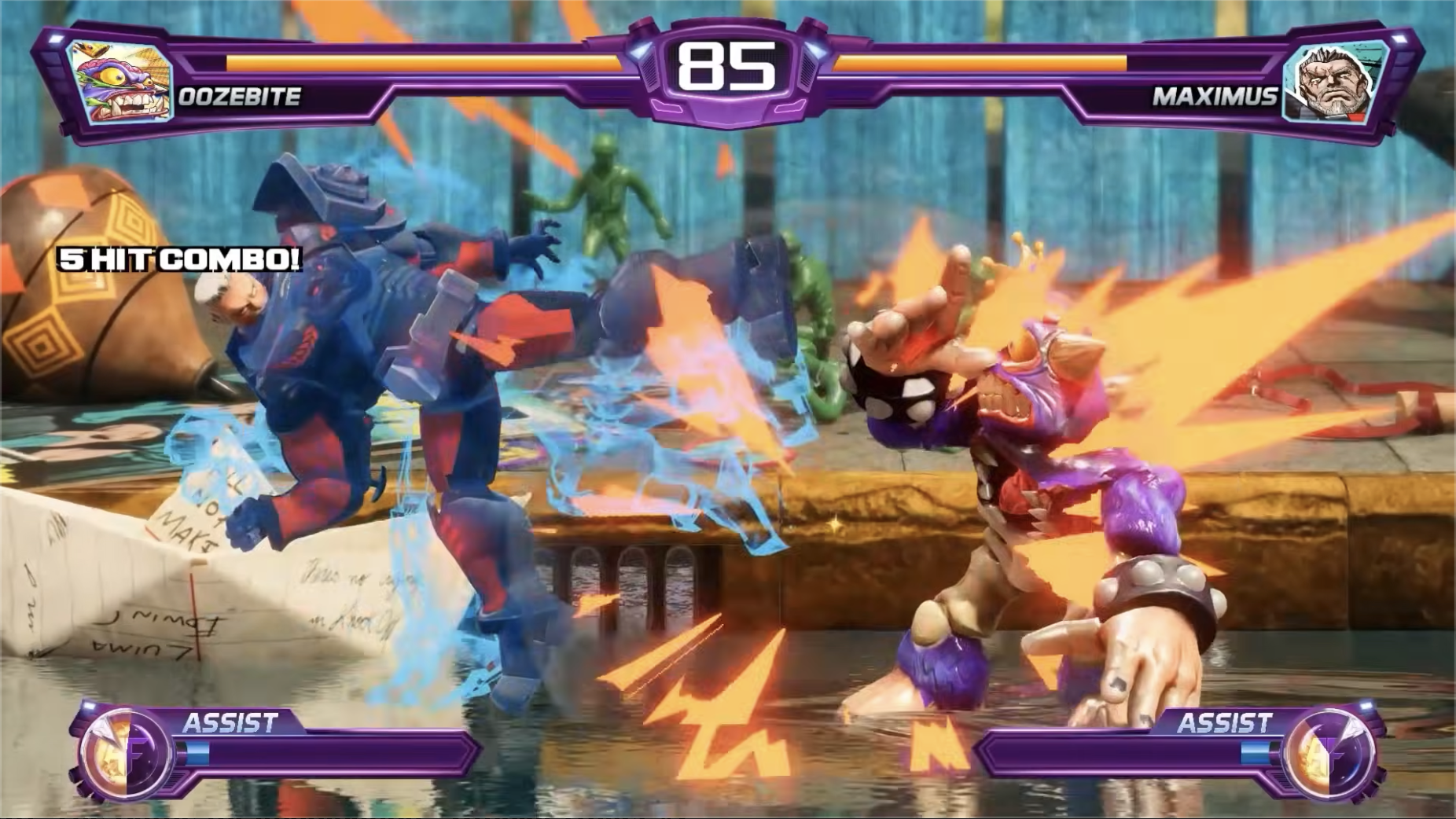
Detroit-based publisher Bit Bot Media announced on August 12, 2026, that it is teaming up with developer Mecanimal Games to release Knock Off: The Battle for Imagination, a competitive 2D fighting game built entirely around the cultural experience of growing up with dollar-store knockoff action figures — and that the game will arrive on PlayStation 5, Xbox Series X|S, and PC
The premise is specific: every child of the 1980s and 1990s who ever opened a birthday present expecting He-Man and found a vaguely similar plastic warrior named “Space Power Warrior” knows what Knock Off is about before reading a word of its description. That’s a more resonant cultural hook than any licensed IP, and it’s the thing that distinguishes this game from every other fighter currently competing for space on the 2026 release calendar.
Who Controls Johnny’s Toy Box Now?
Johnny’s action figure collection was never exactly stocked from Toys “R” Us. His warriors were “bootleg bargains” — cheaper, off-model, and unnamed on the package — but in Johnny’s imagination, they were legends. When Maximus, his first official brand-name action figure, arrives and immediately upends the hierarchy, Johnny’s beloved knockoffs must prove that off-brand does not mean outmatched. The full game premise is detailed on the Steam wishlist page.
The roster of playable fighters captures the specific flavor of that off-brand era with real specificity. Kronan is a sword-and-sorcery warrior from the realm of Elderholme — the kind of He-Man adjacent figure that probably came in a blister pack labeled “Sword Masters of Destiny” — waging an endless battle against the corrupted villain-king Grimrot and his Legion of Blight. Wolfgang leads the Young Mutated Lizard Warriors against the sinister Palm Clan, trained by Sensei Sawdust alongside brothers Bach and Ludwig, which is an unmistakable nod to a certain group of ninja turtles without being any of them. Oozebite, the self-proclaimed King of Slime from Grossopolis, wields toxic sludge with unstoppable enthusiasm. Rayzenger is Earth’s super robot, built by Professor Akio Iwabuchi from the alloy Luxantium and piloted by his son Kenji through a psychic link — a Voltron/Gundam composite whose name was probably “Defender Robot X” on the actual blister card. Lockjaw is a stunt rider-turned-barracuda-human hybrid who rides into battle alongside teammates Wrecker and Blitz. Each character’s full fictional backstory appears on the official game website.
Each fighter brings a handcrafted playstyle, its own assist sidekicks, and full fictional toy-line lore. The world-building does something that licensed fighters cannot: it earns its nostalgia through invention rather than recognition. Readers who have never heard of these specific characters will still understand exactly what kind of thing they are.
“Knock Off is the game we dreamed about as kids, where our favorite toys came to life and settled everything with a fight,” said Joshua Viola, co-owner of Bit Bot Media. “We wanted to capture that feeling of dumping your toys on the floor and creating an entire universe in your head. It’s nostalgic and packed with personality,” Viola said in the announcement.
Why Rollback Netcode Is the Most Important Line in the Feature List
The game’s combat system and feature list runs on a classic six-button layout with air combos, launchers, EX moves, assist characters, and super attacks. The Steam listing promises that matchups will be strategic and skill-based, with fighters rewarding deep learning rather than button-mashing. A complete arcade mode with a fully voiced narrative is confirmed, alongside online multiplayer with global ranking systems and local shared/split-screen play. Planned post-launch content — additional fighters, stages, and music — is already on the roadmap.
But the feature that matters most to whether this game builds a sustaining competitive player base is a single phrase near the bottom of that list: rollback netcode.
Fighting games have historically used delay-based netcode, which works by intentionally slowing down both players’ inputs until the network can confirm both have arrived before simulating the next frame. In a genre where a handful of frames determines whether a combo connects, that added delay is immediately perceptible and deeply frustrating. Rollback netcode takes the opposite approach: the game simulates the next frame immediately using a predicted opponent input (typically “they’ll continue doing what they were last doing”), then corrects invisibly if the prediction was wrong when the actual input arrives over the network. The correction — the “rollback” — happens under the hood in a fraction of a frame at typical latency levels. The result is that online play feels close to offline play, because from the local player’s perspective, there is no input delay at all.
The foundational implementation of this system is GGPO (Good Game, Peace Out), an open-source library created by Tony Cannon — of Street Fighter fame — around 2007 that made rollback accessible to independent developers for the first time. Before GGPO, delay-based was the default not because it was better but because rollback was prohibitively complex to implement from scratch. In 2026, Street Fighter 6, Guilty Gear -Strive-, Tekken 8, Granblue Fantasy Versus: Rising, and Rivals of Aether 2 all use rollback netcode. It is not a differentiator among the top tier of competitive fighters — it is the entry requirement. A game without it is routinely excluded from serious tournament consideration by the fighting game community (FGC).
Announcing rollback netcode is therefore not just a feature checkbox. It is a signal that the team is building Knock Off for the FGC, not just for the casual nostalgia audience. The nostalgia premise draws players in; the rollback infrastructure is what would keep them there.
Who Is Building This, and What Gives Them Credibility?
Bit Bot Media is a multimedia company co-founded by writer Joshua Viola and musician Klayton, better known under his Celldweller project. The company has licensed properties including Cyberpunk 2077, Legacy of Kain, Jim Henson’s The Dark Crystal, The Terminator, and Evil Dead — a slate that indicates genuine IP-deal credibility — and operates across games, film, television, comics, and collectibles.
The Creative Director is Frank O’Connor, who spent nearly two decades on the Halo franchise — starting at Bungie during the development of Halo 2 and remaining through Halo Infinite at 343 Industries. His experience at Halo covered franchise development, worldbuilding, and transmedia expansion into novels, comics, animation, and live-action television. He also contributed to the Perfect Dark reboot project at Crystal Dynamics before joining Bit Bot in May 2026.
“Everything about Knock Off’s era of tactile nostalgia and deep yet simple VS combat speaks to me as a gamer and the kid I once was,” O’Connor said in the announcement. “Action figures, toys and video games have always been about kindling and energizing imagination — not replacing it — and that notion is absolutely incandescent in Knock Off’s DNA.”
The soundtrack is being composed by Klayton in his Celldweller and Scandroid musical projects — a detail that matters more than it sounds. Klayton has game composition credits that include Dead Rising 2 (2010) and the Killer Instinct reboot (2013), putting him in direct contact with the competitive fighting game genre’s sonic identity before this project. Knock Off is something more personal than either of those.
“It would have blown my little mind if I had known that as an adult, I’d have the chance to write a theme song and full soundtrack for a game that perfectly captured those moments of my youth,” Klayton said in the announcement.
The development studio is Mecanimal Games, which operates as Bit Bot’s in-house studio. The game has already been in development long enough to have a confirmed character roster with fully developed lore and the Steam listing already live with confirmed minimum system requirements (an Nvidia RTX 2070 and AMD Ryzen 7 3700X).
What Does 2027 Look Like for an Indie Fighter?
The 2026 fighting game market is the deepest the genre has looked in over a decade — Street Fighter 6 hit a new Steam peak of 72,067 concurrent players in March 2026, nearly three years after launch, and Fatal Fury: City of the Wolves, 2XKO, and multiple indie fighters are all competing for FGC attention. Q2 2027 may relieve some of that crowding, giving Knock Off room to establish itself before the next wave of major releases.
No other game currently in the 2026-27 pipeline is built around the specific cultural experience of the off-brand toy. That’s a meaningful absence. Most licensed fighters compete on IP recognition; most original fighters compete on mechanical innovation. Knock Off is competing on something else entirely — a specific childhood memory that millions of people share and that no other game has yet claimed as its identity. Whether that premise can carry a competitive-grade fighting game through post-launch content cycles and FGC adoption is a question Q2 2027 will answer.
The Steam wishlist page is live now at the link below. Nintendo Switch support has not been officially announced.
Frequently Asked Questions
What is Knock Off: The Battle for Imagination?
Knock Off: The Battle for Imagination is a competitive 2D fighting game from developer Mecanimal Games and publisher Bit Bot Media, planned for Q2 2027 on PlayStation 5, Xbox Series X|S, and PC via Steam. The game is built around a fictional world of knockoff and bootleg action figures — characters inspired by off-brand versions of 1980s and 1990s toy archetypes — who must battle to prove that being off-brand does not mean being outmatched. It features rollback netcode for online play, a classic six-button layout, air combos, EX moves, assist characters, super attacks, and a complete arcade mode with a fully voiced narrative. The full feature list is on Steam.
What does rollback netcode mean, and why does it matter for this game?
Rollback netcode is a networking architecture that allows online fighting game matches to feel close to offline play. Instead of waiting for both players’ inputs before simulating each frame — which introduces perceptible input delay — rollback predicts opponent inputs and simulates immediately, correcting invisibly if the prediction was wrong. It is now the competitive standard in major fighting games including Street Fighter 6, Guilty Gear -Strive-, and Tekken 8. For an indie fighter like Knock Off, committing to rollback is a signal to the fighting game community that the game is built for serious competitive play rather than casual nostalgia appeal alone.
How is Knock Off different from other fighting games in 2026-27?
No other game currently announced or in development uses the off-brand, dollar-store knockoff toy experience as its primary identity. Licensed fighters compete on IP recognition (names and characters you already know); original fighters compete on mechanical novelty. Knock Off claims a specific cultural memory — the child who received the not-quite-right plastic figure and made it legendary anyway — that no other game in the genre revival has touched. Whether that premise sustains a competitive FGC community alongside the nostalgia audience is the open question the Q2 2027 launch will answer.
Who are the confirmed playable fighters in Knock Off?
Six fighters are confirmed on the official website: Kronan, a fantasy warrior from Elderholme; Wolfgang, leader of the Young Mutated Lizard Warriors; Grimrot, the corrupted villain-king; Oozebite, the King of Slime from Grossopolis; Rayzenger, a super robot piloted by Kenji Iwabuchi; and Lockjaw, a barracuda-human hybrid stunt rider. Each is a clear homage to a specific 1980s-90s toy archetype without reproducing any specific licensed property. Post-launch roster expansions with additional fighters and guest characters are already confirmed in the roadmap. Full character profiles are available on the official game website.
ⓒ 2026 TECHTIMES.com All rights reserved. Do not reproduce without permission.
