![Kentaro Hagiwara’s manga adaptation “Wind Breaker” transforms shōnen entertainment into a theatrical Blue Sky experience. [Fantasia]](https://comicvibe.com/wp-content/uploads/2026/08/5_DSC03336_rtd01.png "Kentaro Hagiwara’s manga adaptation “Wind Breaker” transforms shōnen entertainment into a theatrical Blue Sky experience. [Fantasia]")
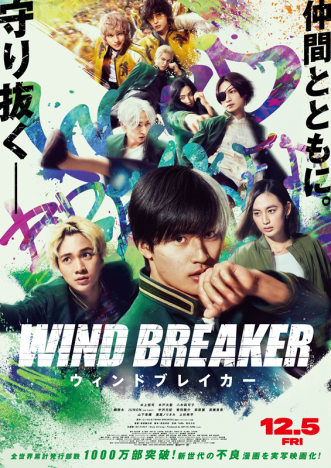
What does it mean to be strong? What does it mean to hold power? Is it the means to defeat a thousand foes and to draw fear from opposition *or* is it to be able to protect all who matter to you spiritually and physically? Questions like these get batted around a lot in shōnen stories whether in the classic origin before the 19th century or in the modern sense applied to tales like One Piece or My Hero Academia. One such tale is Satoru Nii’s Wind Breaker, a manga about an upstart ruffian looking to prove himself that first published in January 2021 and spawned an anime in 2024. Now, directed by Kentaro Hagiwara (Tokyo Ghoul) and having its international premiere in the Horizon 2026 section of Fantasia International Film Festival 2026, the live-action version of Wind Breaker brings all the martial arts action, heartfelt comradery, and exploration of meaning that courses through much shōnen entertainment.
L-R: Taisei Kido as Akihiko Nirei and Koshi Mizukami as Haruka Sakura in WIND BREAKER. Photo courtesy of Fantasia International Film Festival/Sony Pictures/Crunchyroll.
Typically treated as an outsider due to his bifurcated hair and heterochromia, high schooler Haruka Sakura (Koshi Mizukami) seeks to be the strongest there is in order to prove that he doesn’t need anyone. Enrolling at Furin High School, rumored to be overrun with the toughest people in his region, his plan is to establish dominance quickly by taking out the top fighter. However, upon arriving in town, he quickly learns that Furin High School underwent a change two years prior and now is home to the Bofurin, the protectors of the town lead by Umemiya (Shuhei Uesugi). Not only that, the nearby gang, Shishitoren, led by Choji Tomiyama (Kôki Yamashita), wants to expand to absorb the Bofurin into their organization, meaning that Sakura has just stepped right into the middle of a cold war that is set to explode any moment and he’s ready to dominate. But can the usually lone fighter realize in time that he can’t take on this much trouble alone?
L-R: Noritaka Hamao as Togame Jo and Kôki Yamashita as Choji Tomiyama in WIND BREAKER. Photo courtesy of Fantasia International Film Festival/Sony Pictures/Crunchyroll.
Having not read the manga or watched the anime, there will be no comparison between the source and initial adaptation to the film. What can be said right out of the gate is that Hagiwara immediately conveys the tone and style of Wind Breaker between the method of introduction and the art direction of the set. Two things, the narration and an animated figure, quickly introduce that the film is going to possess whimsy amid its blustering, establishing that, for all of its great force, silliness is going to occur. The title, Wind Breaker, relates to where the story takes place as frequent, high-powered winds cut straight through the town. The camera moves along an animated figure as it gets blown from its own advertisement for a business and travels through other signs down a street until the camera stops at a significant location.
However, don’t mistake the comparison here to suggest that Wind Breaker is going to involve blood-letting and horror. This is where the art direction comes in as the town is a mixture of bright affable colors and pastels with plenty of sunshine and blue sky — this does not signal trauma (rather a safe place to explore), but for renewal and coming together. The design of Furin High School may be grey on the outside, but it’s got a massive green flag as the base for its logo, is adorned with spreading ivy, and has a tree upon its roof. Likewise, even the more scummy and trash-ridden territory of the Shishitoren, operated with a focus on what can be taken from others and disregard for the useless, is peppered with yellow (highlighting their club colors) and remains lively, rather than a more dystopian feel one might expect from their operational style. Because of this, the whole of Wind Breaker comes off as a piece of “Blue Sky” entertainment wherein danger can exist but goodness is going to prevail. With that sensation permeating the film, one can allow the action and drama to pour over you without any real concern for the outcome.
Keeping in mind that Mizukami is headlining the new Crime City film, TOKYO BURST, the actor is quite capable of bringing the pain in a believable way. Not only that, but there are numerous stunt sequences throughout the film, most of which feature Mizukami’s Sakura getting into it with someone, anyone really, as the character goes through the expected arc of stalwart isolationist to team player. We’ve seen this type of story play out so frequently as a trope in both shōnen and international stories that there’s little within the film’s narrative that will surprise. That’s why it’s so important that the action feels propulsive to the narrative and concussive to the audience. Without spoiling who says what and when, a character refers to fighting as a dialogue without words, which is what any individual well-versed in action cinema will tell you, suggestive that screenwriter Yosuke Masaike (Anime Supremacy!) or original writer Nii understand this, as well. To that end, the action in Wind Breaker may be nothing like that of TOKYO BURST with the kind of fisticuffs Crime City fans expect (and Mizukami is nearly unrecognizable from this project to that), but that doesn’t mean one doesn’t feel the intensity of the action. In a strange way, Wind Breaker is less of a battle shōnen (Naruto; My Hero Academia) and more akin to BLUE LOCK or Haikyu!!in that each physical altercation is more about wins and loses than about how badly one gets beat. Punches, kicks, and grapples are received like pass breaks, driving a ball down a field, or some other immediate competitive descriptor. So, whether it’s the initial sequence that establishes general ruffians with ties to the Shishitoren disrupting business at a café that serves as Sakura’s intro, Sakura meeting his Furin classmates and immediately challenging one, or an all-out brawl in which all the main characters get a featured moment, the violence is shot and staged for maximum impact and excitement, but not necessarily damage. This matters because the audience needs to understand that actions in a fight have weight, but they can’t have so much weight that we grow too fearful for the safety of our characters. Choji is no All for One and Umemiya is no All Might (though Sakura is basically Bakugo mixed with Todaroki), so the stakes for the whole story are quite low. This isn’t a film about the fate of the world, but what it means to exist in society and what value our existence brings.
L-R: Noritaka Hamao as Togame Jo and Koshi Mizukami as Haruka Sakura in WIND BREAKER. Photo courtesy of Fantasia International Film Festival/Sony Pictures/Crunchyroll.
This is where the film is both its most interesting and least. Where it works, it really nails home the notion that, for instance, Sakura really only wants to prove his power because his physical appearance turns most people away. He’s never experienced a place like the one within Bofurin territory where people are valued merely because they exist, not for what they can do or what they offer. The presentation of this ideological transformation, no matter how expected, is thoughtful and effective in part to Mizukami’s performance as it is the ways in which Hagiwara makes real the parts Mizukami can’t through performance alone. The downside, however, is that things often feel too neat and clean where they shouldn’t. This can be a by-product of the specific type of storytelling that tries to maintain a positive outlook regardless of what led up to the conclusion. Optimistic, sure, and can be deeply satisfying across several volumes of story or 10 episodes (which the live action seems to encompass of the anime), but, within a two-hour film, tends to feel rushed and unearned no matter how much we enjoy the performances from the cast or find the themes within resonant.
L-R: Keito Tsuna as Junfei Su, Koshi Mizukami as Haruka Sakura, Taisei Kido as Akihiko Nirei, Motoki Nakazawa as Toma Hiiragi, Shuhei Uesugi as Umemiya, Rikako Yagi as Kotoha, and JUNON as Kyotaro in WIND BREAKER. Photo courtesy of Fantasia International Film Festival/Sony Pictures/Crunchyroll.
The live-action Wind Breaker is, frankly, more a showcase for the cast and what they’re capable of, as well as a means of sparking interest in checking out the story in either its print or animated side. It’s not that there’s something wrong with the film; on the whole, it’s fine, it’s just that there’s clearly more going on than the runtime allows us to see. The shift to live action always happens with stories that resonate, whether it’s a tale that starts as a book, a comic, or even a poem. If someone thinks they can make it cinematic, regardless of whether the new medium can produce anything as evocative as its original format (or even animation), they are going to try. That’s why Sakamoto Days received a live adaptation and My Hero Academia reportedly continues to have one in development — what folks love in one format, someone will try to push to another. As long as no one tries to do this with Jujutsu Kaisen, we may be ok because there’s almost no way to tell any of that story in a satisfactory way that isn’t a series. And maybe that’s why Wind Breaker, fun as it is, feels like a warm hug rather than a satisfying adventure — it’s just not the right format for the energy within to be shared.
Screening during Fantasia International Film Festival 2026.
For more information, head to the official Wind BreakerFantasia International Film Festival webpage or the theatrical webpage.
Final Score: 3.5 out of 5.