

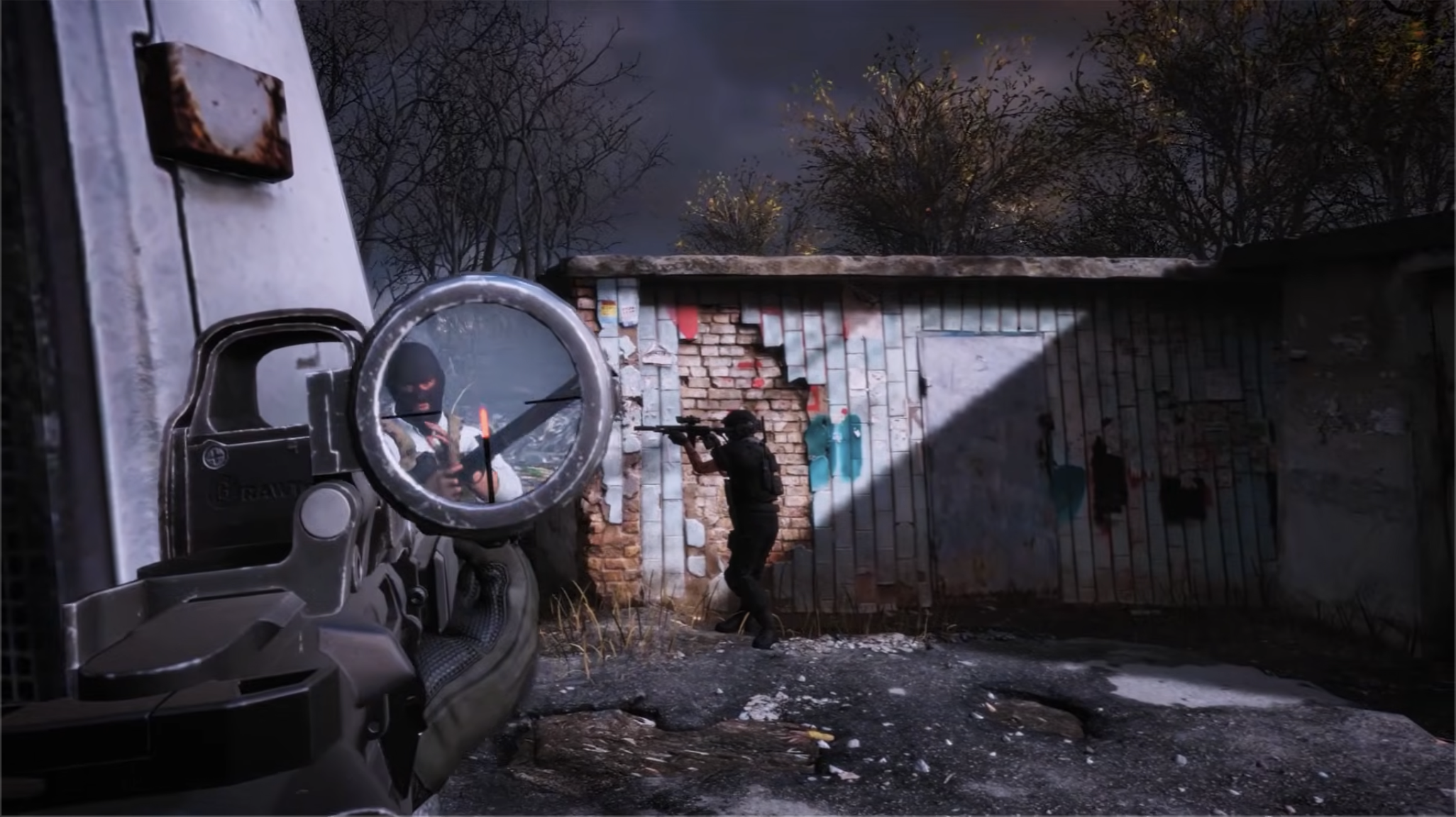
The VR military simulation genre has operated with a conspicuous vacancy since June 2025, when Meta ended Onward development by shuttering Downpour Interactive’s dedicated development team and merging its staff into Camouflaj — the studio behind Batman: Arkham Shadow. Onward remains available on Meta Quest and Steam but receives only critical bug fixes: no new content, maps, or features. At the August 2026 VR Games Showcase, XREAL Games — the Budapest-based studio behind the Zero Caliber series — released the first teaser trailer for COVR and confirmed what milsim players have been waiting to hear: the game is coming to both Meta Quest and SteamVR before the end of 2026. COVR can be wishlisted now on the Meta Horizon Store.
What separates COVR from the genre’s current alternatives is the ambition of its engineering commitment. The studio is not positioning COVR as a spiritual successor built around Onward’s feature set. It is positioning it as a harder game — one built at the realism end of the spectrum that Onward’s own arc, shaped by its acquisition by Meta and the cross-platform compromises that followed, ultimately moved away from. When first announcing the game in April 2026, the studio wrote: “Zero Caliber sits between arcade and realism. This does not.”
What Close-Quarters Battle Actually Demands of Standalone Hardware
COVR’s stated design center is close-quarters battle — the specific category of military tactical doctrine focused on building-entry, room-clearing, and threat neutralization in confined spaces. CQB is the milsim genre’s most demanding design context, and not primarily for visual reasons. Its core challenge is behavioral: authentic CQB requires enemy AI that can react to breach sequences, update pathfinding as players move through connected spaces, and assess threat lines within corridors and doorways in real time. These are CPU-bound workloads.
The Meta Quest 3 runs on Qualcomm’s Snapdragon XR2 Gen 2, an integrated SoC that handles both rendering and simulation compute without the thermal overhead of a dedicated gaming PC. A PC VR build running on an Nvidia RTX GPU can offload simulation work to a desktop-class CPU while the GPU handles rendering independently. On standalone hardware, both workloads compete for the same processor and battery budget. XREAL Games uses Unreal Engine, and their stated commitment to “pushing each platform as far as possible” signals a scalable approach — the same engine build with per-platform tuning — rather than a full separate standalone code path.
Whether the Snapdragon XR2 Gen 2 can sustain the AI behavior density that COVR’s CQB ambitions require without compromising the atmospheric fidelity the studio is also prioritizing is the genuinely interesting engineering question the teaser leaves open. The answer won’t be visible until the game releases or enters public testing.
From Zero Caliber to Something Harder
XREAL Games has been one of the most consistent VR-native studios since it was founded in Budapest in 2016. Their first title, A-Tech Cybernetic, arrived in 2017. Zero Caliber VR followed in 2018 and became a benchmark for co-op VR shooter campaigns on Steam. Zero Caliber 2 PS VR2 arrives in October 2026, following the Meta Quest launch in August 2024 and a PC VR remastered edition in October 2025.
That staggered multi-platform record matters for COVR because it demonstrates a development discipline that is not common at the studio’s scale. Cross-platform VR development at roughly 30 employees requires careful scope management — a lesson XREAL has applied across at least three title generations. COVR follows the same pattern: announced April 2026 with an explicit acknowledgment of early-development status, confirmed for both major platforms at the August showcase, with no specific launch date yet attached.
The studio’s language in the August 2026 VR Games Showcase listing is precise in what it reveals about COVR’s design scope: “next-gen visuals, realism, tension, and stealth gameplay.” The addition of “stealth” is new and notable — it implies gameplay scenarios where noise discipline, avoidance, and non-engagement are viable tactical options alongside direct assault. That places COVR in a design space closer to Escape from Tarkov’s deliberate pace than to Breachers’ competitive 5v5 format or Contractors’ more arcade-adjacent shooting galleries.
Where COVR Sits in the Current VR Tactical Landscape
After Onward’s development ended, the VR tactical milsim category became, by most accounts, thin. Tactical Assault VR, still in Early Access with mixed-to-positive Steam reviews, has served as the most prominent remaining option for players specifically looking for squad-based CQB. Breachers occupies the competitive tactical space — closer to a VR-native Counter-Strike than to a milsim — and Contractors Showdown is free-to-play and positions itself as accessible rather than hardcore. Pavlov operates in the same mid-spectrum zone as Zero Caliber: more demanding than a pure shooter, less demanding than Onward at its peak.
COVR’s announced design intentionally addresses the hard end of that spectrum. The COVR full developer description confirms: “combat that rewards situational awareness over reckless play,” “demanding close-quarters engagements,” and “deploy alone or work together in co-op missions where communication, coordination, and tactical execution can make the difference between success and failure.” That is a design brief built for the community Onward left behind — players who treat VR milsim as a skills-based practice rather than an entertainment activity.
Will Standalone Do the Experience Justice?
XREAL Games has been explicit that Meta Quest is not a second-class target for COVR. The studio says it is focused on pushing each platform “as far as possible” and aims for “highly detailed and atmospheric presentation designed to reinforce the intensity of the gameplay” across all versions. This is a more committed statement than the common “Quest version will be comparable to PC VR” phrasing studios use when a standalone port is in fact a compromise. It implies active per-platform optimization rather than a single build accepted on both.
What that means in practice depends on decisions XREAL has not yet disclosed: whether COVR uses dynamic resolution scaling, what LOD budget it allocates for indoor environments, whether the AI behavior systems scale down to simpler pathfinding states on standalone, or whether the Quest build is architecturally equivalent and simply runs at lower visual presets. These are the implementation details that determine whether COVR on Meta Quest feels like the same game as COVR on PC VR, or like a meaningful but reduced version of it. No hands-on impressions exist yet.
What the Teaser Actually Shows
The August 2026 teaser is approximately 48 seconds. It establishes a visual aesthetic — tight indoor environments, gritty surface materials, atmospheric lighting — that is consistent with the studio’s description of “grounded and intense” presentation. The environments shown appear to be building interiors: corridors, doorways, rooms with limited sightlines. This is consistent with CQB design; the maps are not large open spaces. The tone is closer to Escape from Tarkov or the tactical sequences in Ready or Not than to the bombastic spectacle of mainstream military shooters.
No gameplay is shown — the teaser is key art and environmental reveals, not a demonstration of AI behavior, weapon handling, or co-op systems. The decision to lead a platform-confirmation announcement with a visual teaser rather than gameplay footage is a meaningful signal about where development priority has been over the past four months since the initial April announcement. XREAL appears to be working to establish a visual identity for the game before it commits publicly to demonstrating systems that may still be in earlier development.
What COVR Still Needs to Prove
The gap Onward left is not only a genre vacancy — it is a community vacancy. Onward’s longevity was sustained by a player culture of radio etiquette, coordinated squad tactics, and shared standards for conduct that existed because the game’s design enforced them. Milsim community culture does not transfer automatically from one game to the next; it has to be rebuilt.
COVR has the genre positioning, the studio pedigree, the platform targets, and now a visual identity established in the teaser. What it does not yet have is confirmation of the design specifics — the mechanics that produce the culture — or a launch date. A playtest sign-up form linked from the original April announcement suggests XREAL intends community testing before release, which is the right approach for a game targeting a community with strong expectations. Whether the resulting game closes the gap for milsim players or occupies a slightly different point on the spectrum than Onward will depend entirely on implementation choices that are not yet public.
COVR is expected to launch on Meta Quest and SteamVR in 2026. It can be wishlisted on the Meta Horizon Store now.
Frequently Asked Questions
What happened to Onward VR, and why does that matter for COVR?
Meta acquired Onward developer Downpour Interactive in 2021 and closed the studio’s dedicated development team in June 2025, shortly after the major Onward 2.0 update. Downpour’s staff were merged into Camouflaj, the studio behind Batman: Arkham Shadow. Onward remains available on Meta Quest and Steam but receives only critical bug fixes — no new content, maps, or features. That closure left the VR hardcore milsim space without a developer actively building for it, which is the market gap COVR is targeting.
How is COVR different from Zero Caliber?
XREAL Games, which makes both games, has been direct about the distinction: Zero Caliber occupies a middle ground between arcade and simulation, offering a campaign-driven co-op shooter experience that is accessible without sacrificing weapon handling depth. COVR is explicitly positioned at the harder end of the realism spectrum — closer to Onward’s pace-and-consequence design than to Zero Caliber’s more cinematic shooting. The studio’s own language is “Zero Caliber sits between arcade and realism. This does not.”
Can Meta Quest standalone hardware run an authentic CQB milsim?
This is the central technical question COVR’s development must answer. The Meta Quest 3’s Qualcomm Snapdragon XR2 Gen 2 processor handles both rendering and simulation compute, unlike a PC VR setup where a dedicated GPU handles graphics while a desktop CPU manages AI and physics. CQB milsim places significant demands on enemy AI behavior — pathfinding updates in real time as players breach rooms, threat assessment in connected corridor environments — and these are CPU-bound workloads. XREAL Games has committed to “pushing each platform as far as possible” and to avoiding a downscaled standalone port, but the implementation details that would confirm whether that commitment translates to equivalent simulation depth have not yet been publicly disclosed.
What platforms and when can I play COVR?
COVR is confirmed for Meta Quest (standalone) and SteamVR (PC VR). A release window of 2026 has been confirmed, with no specific date announced as of the August 2026 VR Games Showcase. The game is available to wishlist now on the Meta Horizon Store.
ⓒ 2026 TECHTIMES.com All rights reserved. Do not reproduce without permission.
