

J.Y. Park, a singer, producer, and pioneer of the K-pop industry, has once again demonstrated the weight of his influence.
As the head of JYP Entertainment and a prominent music producer, he is expanding his reach from “Artist J.Y. Park” to “Cultural Planner J.Y. Park” by leading national-level cultural exchange projects.
However, the way he chose to approach this role was unexpected. Despite the position allowing for minister-level treatment, he has declined all official benefits, including a salary and a vehicle, opting to participate in a non-standing capacity.
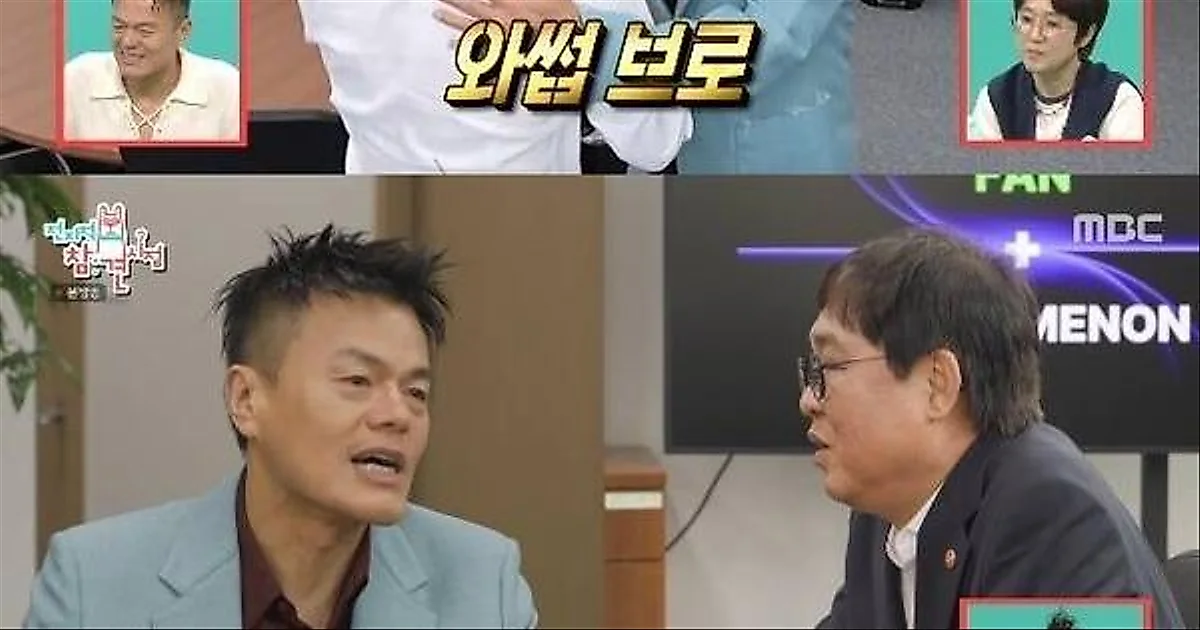
On the MBC entertainment program “The Manager,” which aired on the 1st, Park revealed the motivations behind his appointment as Co-Chair of the Popular Culture Exchange Committee, which operates directly under the President.
The broadcast showcased his daily life as the CCO and Chief Producer of JYP Entertainment, alongside footage of him attending cultural policy meetings at the Blue House.
The cast members expressed surprise at his appearance in the meeting room. In particular, his ability to exchange casual jokes with Presidential Chief of Staff Kang Hoon-sik highlighted a comfortable, professional communication style distinct from his previous public image.
Regarding his appointment, Park confessed, “I refused repeatedly for the first three months.” However, he explained that he eventually felt a sense of responsibility after long discussions with the officials who persuaded him.
His stance on compensation drew significant attention.
When Song Eun-i asked, “Since it is a minister-level position, doesn’t the state provide a salary and protocol?” Park replied, “If it were a standing position, there would be a salary and many benefits, but I requested to serve as a non-standing member,” adding, “I am not receiving a salary either.”
He further noted, “It is actually nonsensical to serve in a non-standing capacity at a ministerial rank, but I found a way to make it work.”
His reasoning was clear: he is focused on the expansion of the K-pop industry and Korean culture rather than personal honor or authority.
“I am not the progressive faction or the conservative faction; I am J.Y. Park,” he emphasized, cautioning against political interpretations. He intends to serve within his professional expertise of music and culture rather than representing a specific ideology.
This commitment aligns with his career trajectory. Since debuting as a solo singer in the 1990s, he established JYP Entertainment and spearheaded the systematization of the idol industry. He has shaped the structure of Korean popular music by producing numerous artists, including god, Bi, Wonder Girls, 2PM, TWICE, Stray Kids, ITZY, and NMIXX.
To him, K-pop is more than a music genre; it is a cultural platform connecting Korea to the world.
His work with the Popular Culture Exchange Committee follows this vision. Through the recent “2027 FANOMENON” plan, Park is envisioning a global cultural festival that integrates K-pop performances, fandom culture, and the content industry.
As the name suggests—a portmanteau of “Fan” and “Phenomenon”—he aims to create a new type of festival where fandom and the cultural industry move in unison, moving beyond traditional concerts.
During the broadcast, Park also mentioned the process of recruiting famous overseas artists, noting, “Fans reacted by asking if the artists themselves would skip the event when the fans are receiving awards.” His strategy is to build a global platform by leveraging the powerful cultural asset of fandom.
The broadcast also revealed another side of Park. He invests billions of won annually in JYP’s in-house cafeteria to support the health of his trainees and employees.
Recalling how heartbroken he was to see trainees eating convenience store food in the past, he explained his insistence on an organic diet: “As long as they are with the company, I consider them my children.”
Ultimately, a single keyword defines Park’s path: “People.”
Nurturing artists, caring for employees, and promoting Korean culture to the world may seem like different fields, but they are all connected through his dedication to culture.
Having shaped the music scene for nearly 30 years, J.Y. Park is evolving from a singer into an architect of the Korean cultural ecosystem. All eyes are now on whether his new challenge will serve as the catalyst for the next era of K-culture.
