

Crunchyroll.com
AnimEigo and its parent company MediaOCD announced five new North American Blu-ray licenses at their Otakon 2026 industry panel on Friday, July 31 — bringing the most significant batch of licensing news the boutique distributor has delivered since MediaOCD acquired the 38-year-old label in February 2024. The five titles span three decades of anime history and share one quality: every one of them was either out of print, unavailable on Blu-ray in North America, or receiving its first North American home-video release of any kind.
The headline acquisition is ReLIFE, the 2016 sci-fi rehabilitation drama whose combined TV series and OVA finale became physically inaccessible after Funimation shuttered its streaming service and discontinued support for its digital-copy library on April 2, 2024. AnimEigo’s comprehensive new edition will bundle all 13 television episodes with the four-episode OVA that concluded the story — both subtitled and dubbed — in a single release scheduled for 2027.
All five titles are scheduled for 2027, with Otakon 2026 still underway in Washington, D.C., through Sunday, August 2.
Why ReLIFE Becoming Out-of-Print Matters More Than It Sounds
ReLIFE — directed by Satoru Kosaka, produced by TMS Entertainment — was ahead of its time in one technical respect: its entire 13-episode run was released simultaneously on the Comico digital platform in June 2016, making it one of the earliest anime to adopt a full-season drop model years before Western streaming services normalized the format. The TV broadcast followed the next month; Crunchyroll simulcast the subtitled version same-day; Funimation produced the English dub.
That dub’s existence is now the problem. Funimation’s physical releases and digital-copy library went offline when Sony shuttered the platform in April 2024, folding subscribers into Crunchyroll without transferring purchased digital copies. Dub-only viewers who never purchased the DVD — and hadn’t anticipated the platform’s closure — lost access. AnimEigo’s 2027 Blu-ray is the first re-issue of the dubbed version, and the first English-language physical release to include both the TV series and the 2018 Japanese OVA finale in the same package.
The series follows 27-year-old Arata Kaizaki, an unemployed and socially withdrawn man who accepts a single experimental pill from a shadowy “ReLife Research Institute” that physically reverts his appearance to 17. He then lives covertly as a high-school student for a year — a government-backed social-rehabilitation study — with his memories of everyone he meets scheduled to be erased at the end of the program. The premise is fantastical, but it maps onto real scientific territory more closely than most viewers realize: the field of epigenetic reprogramming, which studies whether aging is an accumulated program written into DNA methylation and histone modification patterns, not an irreversible cellular process. Researchers working with the four Yamanaka transcription factors — the same mechanism behind 2012’s Nobel Prize in Physiology or Medicine — have demonstrated that reversing these epigenetic marks in aged cells can restore youthful gene-expression profiles. Whether that ever translates to the overnight phenotypic shift ReLIFE depicts is a different question, but the conceptual distance is shorter than it once appeared.
What AnimEigo and MediaOCD Actually Are — and Why That Matters for These Releases
AnimEigo is not a new company having a lucky licensing run. Founded in 1988 in Ithaca, New York, by Robert Woodhead and Roe R. Adams III, it is one of the original North American anime distributors — the kind of institution that subtitled and distributed Urusei Yatsura and Bubblegum Crisis when the market for that content was small enough to count in the thousands. Its acquisition by MediaOCD in February 2024 is the structural reason the Otakon 2026 batch is possible.
MediaOCD is a Los Angeles-based post-production company founded in 2011 that has specialized in high-quality video restoration, mastering, and disc authoring — the company has produced more than 1,300,000 discs for clients including Discotek Media, IFC Films, and Bandai Namco Holdings. What the acquisition created is, essentially, a boutique anime label with a restoration studio built in — an arrangement that makes the Dog of Flanders: The Movie 4K restoration a credible promise rather than a marketing stretch.
Dog of Flanders: The Movie Gets a 4K Restoration — and That Is Harder Than It Sounds
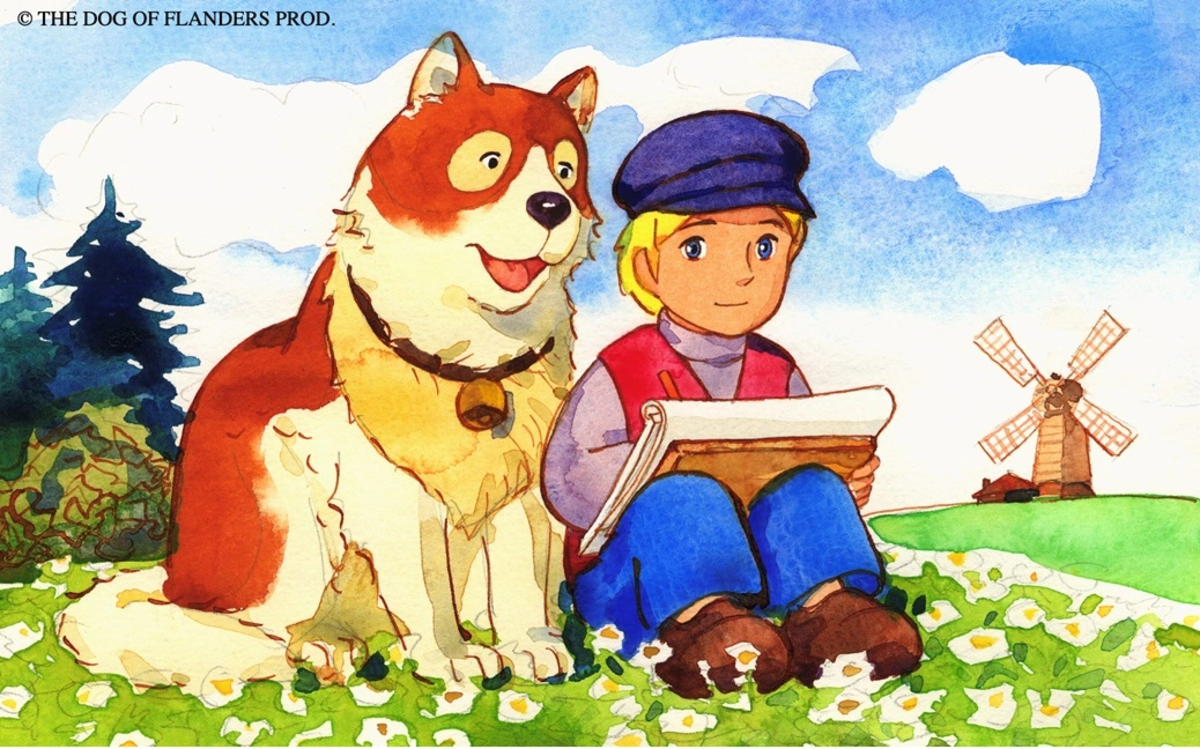
Dog of Flanders: The Movie, the 1997 Nippon Animation feature based on Marie Louise de la Ramée’s 1872 novel A Dog of Flanders, is the batch’s most technically involved release: AnimEigo’s late 2027 Blu-ray will include a 4K restoration of both the uncut Japanese original and the edited Pioneer English dub — the version that featured Robert Loggia as the voice of Grandfather Jehan Daas.
Applying 4K restoration to 1990s cel animation is not the same operation as restoring a live-action film. Scanning 35mm film at 4K captures approximately 6,000 lines of effective resolution from the original photochemical grain, but for hand-drawn cel animation, high-resolution scanning also amplifies registration jitter — the subtle frame-to-frame positional variation in painted cels introduced by imprecision in the rostrum camera process. That jitter, largely invisible at DVD resolution, becomes a technical problem at 4K. The MediaOCD approach — the same techniques applied to their Discotek Media restoration work — involves optical flow algorithms that perform digital stabilization across frames, the same category of motion-estimation software used in video-processing pipelines and originally developed in computer vision research. The tradeoff is not zero: aggressive stabilization risks making hand-drawn animation’s inherent movement feel “corrected” rather than authentic, and the target is a restoration that improves legibility without erasing the artifact’s character. MediaOCD’s track record in this space, across more than a million discs, is the reason the 4K promise reads as a production commitment rather than a marketing claim.
Antique Bakery and Welcome to Irabu’s Office — Two Titles From Anime’s Most Unconventional Broadcast Context
Two of the five licensed titles share a specific institutional origin that distinguishes them from the broader anime market: both aired on Fuji TV’s noitaminA programming block.
noitaminA — the name is “Animation” spelled backwards — launched in April 2005 with an explicit and documented purpose: to expand the anime audience beyond its default demographic of young male viewers aged 12 to 18. The block was designed for women in their 20s and 30s and for adult literary viewers — a demographic that the late-night anime industry, organized almost entirely around shōnen and mecha content, was not serving. Its early anchors included Honey and Clover (2005), Nodame Cantabile (2006), and Moyashimon (2010); later entries included Ping Pong the Animation and Psycho-Pass.
Antique Bakery aired on noitaminA in 2008. Adapted from Fumi Yoshinaga’s 1999 manga — which won the Kodansha Manga Award for best shōjo title — the 12-episode series is set in a small French-style pastry shop in Tokyo staffed by four men whose professional relationships layer over significant private histories. Yoshinaga placed a gay character — the world-class pâtissier Ono, whose romantic history with the bakery’s owner forms the series’ emotional core — in a realistic workplace dramedy rather than the abstracted fantasy register typical of Boys’ Love manga. noitaminA’s broadcast context gave that choice a legitimizing late-night slot that prime-time Japanese television would not have accommodated in 2008. AnimEigo’s 2027 Blu-ray will be the first North American Blu-ray release; the series was previously available on DVD through Right Stuf/Nozomi Entertainment, a label that is no longer active as a standalone entity.
Welcome to Irabu’s Office (also known by its Japanese title, Kūchū Buranko or “Aerial Trapeze”) also aired on noitaminA, in the fall 2009 season. Directed by Kenji Nakamura at Toei Animation and adapted from Hideo Okuda’s short story collection, the 11-episode series follows Dr. Ichiro Irabu — an eccentric, apparently incompetent child-psychiatrist — as he treats eleven patients whose psychological distress manifests in surreal physical symptoms. Nakamura’s visual approach mixes standard cel animation with rotoscoped live-action footage and neon-expressionist sequences: rotoscoping (tracing over live-action footage frame-by-frame, a technique that dates to Max Fleischer’s 1915 patent) is used not for realism but for its inherent uncanny quality — human movement rendered in drawn lines creates a slight wrongness that aligns with the series’ depiction of people trapped in compulsive behavioral loops.
This will be Welcome to Irabu’s Office’s first North American home-video release of any kind. AnimEigo will produce a new English dub for the release.
Ruin Explorers: Fam & Ihrie Rounds Out the Batch
The fifth title is Ruin Explorers: Fam & Ihrie, a four-episode OVA from 1995 written and directed by Takeshi Mori, set in a fantasy world built over the ruins of a fallen magical civilization. Fam and Ihrie — a pair of debt-ridden female treasure hunters — seek an artifact called the Ultimate Power; Ihrie’s sword-and-sorcery abilities come with a curse that transforms her into a mouse whenever she casts a spell, a constraint that functions as a hard limiter on her power and drives her character arc throughout all four episodes. AnimEigo’s 2027 Blu-ray will use an HD restoration.
The OVA was previously released on DVD twice by ADV Films (2000, 2004) and once by Maiden Japan (2013). The OVA format itself — Original Video Animation, released directly to home video without a theatrical or television run — reflects a production model common in the 1980s and 1990s that allowed studios to create content outside broadcast runtime and standards constraints; Ruin Explorers is four episodes of approximately 30 minutes each, structured as a standalone adventure that completes its story.
What Collectors Should Know Before 2027
The five releases serve three distinct collector constituencies. ReLIFE is the immediate priority for viewers who lost access to the Funimation dub after the April 2024 shutdown and want to own the complete TV-plus-OVA run in a single edition. Dog of Flanders is a long-out-of-print title whose 4K restoration offers the Rubens-cathedral sequence — the film’s emotional core, set around the real triptych paintings at the Cathedral of Our Lady in Antwerp — in resolution that will be categorically different from the 2000 Pioneer DVD. Welcome to Irabu’s Office is the discovery title: no previous North American physical release, a new English dub, and a series that built a devoted critical following in the 15 years since its Japanese broadcast without ever being accessible to most American viewers.
AnimEigo and MediaOCD have not announced specific pricing or preorder windows for any of the five releases. Dates remain within the 2027 window announced at the Otakon panel; the Dog of Flanders restoration specifically is noted as “late 2027” in the announcement.
Frequently Asked Questions
Is ReLIFE currently available to buy on physical media in North America?
As of August 2026, ReLIFE is not available on physical media in North America with its English dub. Funimation had produced the English dub and released the series on disc, but those editions became out of print when Funimation’s service and physical distribution wound down around its April 2, 2024, shutdown. Crunchyroll now hosts the subtitled version for streaming, but the dubbed physical edition has been unavailable since then. AnimEigo’s 2027 Blu-ray will be the first re-issue, and the first edition to include both the 13-episode TV series and the four-episode 2018 OVA in the same package.
What makes AnimEigo’s Dog of Flanders 4K restoration different from a standard Blu-ray upscale?
A standard Blu-ray upscale algorithmically enlarges a lower-resolution digital master. A 4K restoration starts by scanning the original 35mm film negative at 4K — capturing approximately 6,000 lines of effective resolution from the photochemical grain itself, which contains more detail than any prior DVD or standard-def master could render. For cel animation, this also means the restoration team has to address registration jitter (the slight cel-to-cel positional variation that high-resolution scanning makes visible) through digital stabilization. MediaOCD, AnimEigo’s parent company, has produced over 1,300,000 discs specializing in exactly this work. The 2027 release will include both the uncut Japanese version and the edited Pioneer English dub featuring Robert Loggia.
Who is noitaminA, and why do two of these five titles airing on that block matter?
noitaminA is a late-night anime programming block on Fuji TV, launched in April 2005 specifically to expand anime beyond its default young male audience. It was designed for women in their 20s and 30s and adult literary viewers. Both Antique Bakery (2008) and Welcome to Irabu’s Office (2009) aired on this block. That context is editorially significant: these are not mainstream genre titles but works that Japanese broadcast television treated as adult literary animation — a category that has historically been underrepresented in North American physical media licensing. The noitaminA block also launched or ran series including Honey and Clover, Nodame Cantabile, and Ping Pong.
Why are boutique distributors like AnimEigo and Discotek Media picking up more classic anime now?
Funimation’s April 2024 shutdown left a physical media gap — titles that had been licensed under Funimation’s umbrella either went out of print or were not carried forward by Crunchyroll, which does not maintain Funimation’s physical release infrastructure at the same scale. The boutique distributor market — AnimEigo/MediaOCD, Discotek Media, GKIDS, Sentai Filmworks — has been licensing titles specifically from this gap. MediaOCD’s acquisition of AnimEigo in early 2024 is directly relevant: MediaOCD is a post-production company whose core business is video restoration, which gives it capabilities that a conventional label acquired for brand value alone would not have. The Otakon 2026 batch is the most visible demonstration of that combined entity.
ⓒ 2026 TECHTIMES.com All rights reserved. Do not reproduce without permission.
