

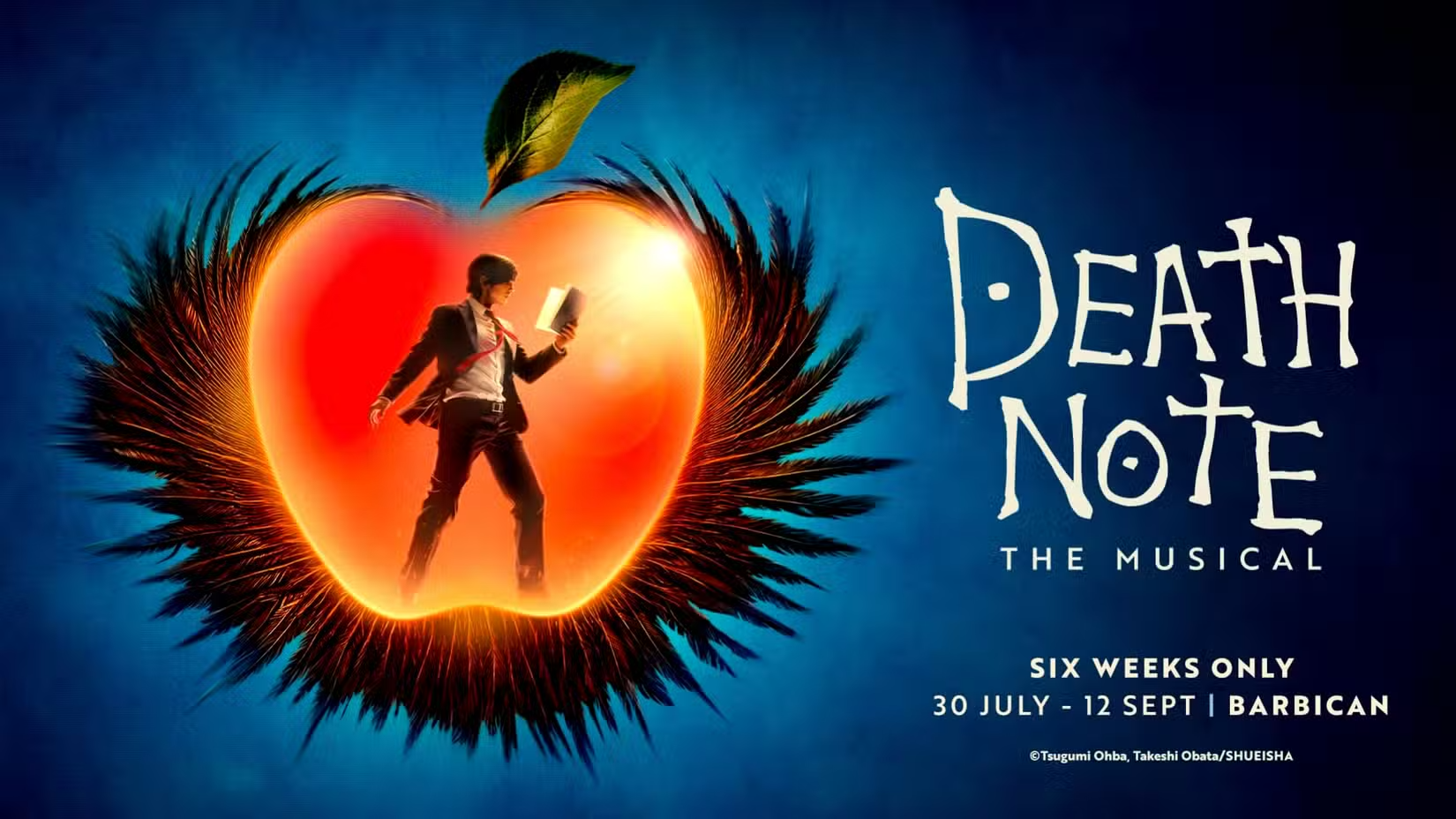
Death Note: The Musical raised its curtain at London’s Barbican Theatre on the evening of July 30, 2026, and it did so with something no prior production of this show has had: a confirmed, publicly stated plan to head to Broadway. Trafalgar Entertainment’s official announcement describes the production as “the definitive theatrical incarnation of this unique story — rooted in the acclaimed original but reimagined for the West End and a planned Broadway run.” That makes the Barbican’s 50-performance run more than a theatrical debut — it is the audition that the producers designed it to be, and the clock is running for anyone who wants to see this version before it potentially becomes a different one on a different continent.
The production is the first fully staged, English-language incarnation of a musical that has been performed across Asia for more than a decade. Based on the manga by Tsugumi Ohba and Takeshi Obata — with more than 30 million copies sold worldwide — the show features a score by Broadway composer Frank Wildhorn, lyrics by Jack Murphy, and a book by Ivan Menchell. The London staging adds newly written songs and a revised script to the original score, making it a meaningfully different work from the productions that ran in Tokyo, Seoul, Taichung, Moscow, and Rio de Janeiro between 2015 and 2025.
From Asia to Barbican: Eleven Years in the Making
The musical was originally created in English. Wildhorn and his collaborators wrote the show in its native language, then watched it premiere on April 6, 2015, at the Nissay Theatre in Tokyo — in Japanese, translated for an audience that had grown up reading the manga in its original form. Korean productions followed that same year, and the show went on to win four Korea Musical Awards at the 2022 ceremony, including Best Musical.
The English-language world heard the show properly for the first time only in August 2023, when a concert staging at the London Palladium sold out three performances so quickly that producers added a second run at the Lyric Theatre the following month. That 2023 run was well-received — WhatsOnStage called it “a West End thrill ride” — but critics also noted fast pacing and technical limitations inherent to a concert format, with prior Asian fully staged productions faulted for trying to condense twelve manga volumes into two and a half hours.
The 2026 Barbican production is the answer to both critiques.
What the Revised Production Actually Changes
This London staging is not a transfer of any prior production. Director Stephen Whitson — whose credits include Hamilton UK and Moulin Rouge! UK — leads a creative team that has rebuilt the show from the ground up for Western audiences. Menchell has revised his own book to address pacing, and Wildhorn has written new songs to fill narrative gaps that the original compressed into dialogue. The orchestrations and arrangements are handled by Jason Howland, whose work on The Great Gatsby musical signals a more elaborate sonic palette than prior productions.
Designer Jon Bausor — who previously designed the West End’s Spirited Away, another anime-to-stage adaptation — brings the visual world of Light Yagami’s Tokyo to the Barbican’s scale. Choreography is by Fabian Aloise, an Olivier Award nominee known for large-scale productions at the Palladium and the Savoy. The result, according to the London Theatre Hub’s pre-opening assessment, is a score that is more varied and adventurous than genre conventions might predict, with musical sequences for Light’s escalating megalomania that trace his psychological trajectory with an emotional precision that straight dialogue struggles to match.
The creative team’s stated approach reflects the unusual origin of this musical: originally conceived in English, performed for a decade in Asian translations, now returning to the language it was written in while being substantially rewritten to account for everything those years of production taught about what the story needs. Telly Leung, who plays the death god Ryuk, described the design philosophy in a pre-opening interview with Anime News Network: the designers asked themselves, “If we were to look at this as a piece written yesterday that didn’t have an anime or a manga, what would our brains and our creativity come up with?”
The Cast
Leading the company is Xander Pang as Light Yagami, making his debut in a role that carries weight beyond its theatrical demands. “I cannot explain how excited I am to be playing Light in this totally unique musical,” Pang said in a statement released alongside his casting announcement. “How iconic Death Note is makes this all the more special, and to see East Asian representation on such a large scale means a lot to me and I think will mean a lot to a lot of people.”
Playing opposite him as the detective L is Colin Ryan, a London-based stage actor whose credits include Hamlet and The Lightning Child. Telly Leung — whose Broadway credits include Aladdin and Godspell — brings Ryuk to life on stage, a challenge that goes beyond performance into physical: Ryuk exists as animation and CGI in prior adaptations, and the Barbican production renders the death god as a three-dimensional stage presence for an audience seated in front of him. The full company also includes Stephanie Zaharis as Misa Amane, Grace Mouat as Rem, and Paolo Montalban as Soichiro Yagami, alongside an ensemble of fourteen.
Why Broadway Is Watching
The framing around this production is unusual for a London premiere. The Broadway transfer is not post-premiere speculation — it is production strategy baked into the London engagement from the start.
That makes Death Note: The Musical something genuinely new in the history of manga and anime adaptations for Western stages: the first title in this category to be built as a London-to-Broadway pipeline from its initial announcement. For comparison, Game of Thrones: The Mad King — which opened at the Royal Shakespeare Theatre in Stratford-upon-Avon just two days earlier — has no confirmed Broadway transfer.
The pipeline has commercial implications beyond this single show. Wildhorn has already worked with HoriPro — the Japanese production company behind Death Note — on Fist of the North Star (2021) and Your Lie in April (2022 Tokyo, 2024 London). Your Lie in April ran as a full West End production at the Harold Pinter Theatre in 2024 — the first West End musical with a fully East Asian cast — and while critics found its English-language book uneven, it demonstrated that manga-adapted musicals can reach London’s mainstream theatrical market. Death Note, with a stronger source IP, a more experienced director, and an explicit Broadway mandate, represents HoriPro’s most ambitious move yet.
Mr. Hori, Chairman of the HoriPro Group, said in a statement at announcement: “Since its premiere in Tokyo in 2015, our aspiration has always been to bring Death Note to the London stage. We are delighted to present this work in partnership with Sir Howard Panter and Trafalgar Entertainment, a collaboration built on an enduring artistic kinship and shared vision spanning more than three decades.”
What the Story Is
For readers unfamiliar with the source material: Death Note follows Light Yagami, a brilliant student who discovers a supernatural notebook that kills anyone whose name is written in it. Light begins using it to eliminate criminals, convinced he is shaping a better world, and in doing so attracts the attention of the enigmatic detective L — a counterpart as intelligent as Light himself, setting the story’s central psychological confrontation in motion. The story ends with Light’s death; the manga’s resolution has been publicly known since 2006 and the anime since 2007.
The musical follows the same arc, with Wildhorn’s score charting Light’s psychological deterioration through character-specific motifs that Leung describes as a natural fit for the form: “In a musical, time sort of stops, and the characters get to sing their feelings and their thoughts. And so in many ways, the Death Note musical is aligned with the
Tickets and Timing
Death Note: The Musical runs at the Barbican Theatre from July 30 through September 12, 2026 — 50 performances only. Press night, when critical reviews will be published, is August 11. Tickets start at £25 (approximately $33 USD), rising to £165 (approximately $218 USD) for premium stalls. During Official London Theatre’s Kids Week promotion, children go free to select performances from August 20 through September 10.
The Barbican is located at Beech Street, London EC2Y 8AE, accessiblenge. Tickets are available at deathnotethemusical.com and the Barbican box office
Currency conversions are approximate and based on exchange rates at the time of publication.
Frequently Asked Questions
Is Death Note: The Musical confirmed for Broadway?
A Broadway transfer is publicly and officially confirmed as planned by the producers. Trafalgar Entertainment’s announcement describes the Barbican production as reimagined “for the West End and a planned Broadway run,” and the production’s own website and Barbican listing both reference the Broadway trajectory. No specific Broadway venue, cast, or opening date has been announced as of July 31, 2026 — the London run must first play out and demonstrate commercial viability before a Broadway schedule is set. That is precisely why the Barbican window matters: this is the version the producers intend to take to New York, and it is the only confirmed opportunity to see it before that process begins.
How is the 2026 Barbican production different from the 2023 London concerts?
The 2023 London performances were concert stagings — the cast performed with minimal staging, no sets, and no full choreography. The 2026 Barbican production is a fully mounted theatrical production with original sets by Jon Bausor, full choreography by Fabian Aloise, a complete lighting design, and an entirely new creative team including director Stephen Whitson. It also contains newly written songs and a revised book — material that did not exist in 2023. The cast has also changed entirely: the 2023 concerts starred Joaquin Pedro Valdes (Light) and Dean John-Wilson (L), while the 2026 production stars Xander Pang and Colin Ryan.
What does Death Note: The Musical change from the anime and manga?
The musical compresses the manga’s twelve volumes into a two-and-a-half-hour stage production, necessarily cutting or condensing secondary storylines. The key characters — Light, L, Ryuk, Rem, Misa, and Soichiro — are all present. The supernatural elements (Shinigami, the Death Note’s rules) are dramatized through Wildhorn’s score rather than internal monologue, which the anime rendered as voice-over. Telly Leung, who plays Ryuk, describes the form as a natural fit: “In a musical, time sort of stops, and the characters get to sing their feelings and their thoughts.” The story’s ending — Light’s death, written by Ryuk in the Death Note — follows the manga. No spoiler-dependent mystery is withheld.
When does the run end, and will there be a cast recording?
The Barbican run closes September 12, 2026. A cast album from the 2023 London Palladium concerts was announced in October 2023 for release on Ghostlight Records, though a release date had not been confirmed as of the time of writing. No cast recording for the 2026 Barbican production has been announced.
ⓒ 2026 TECHTIMES.com All rights reserved. Do not reproduce without permission.
