

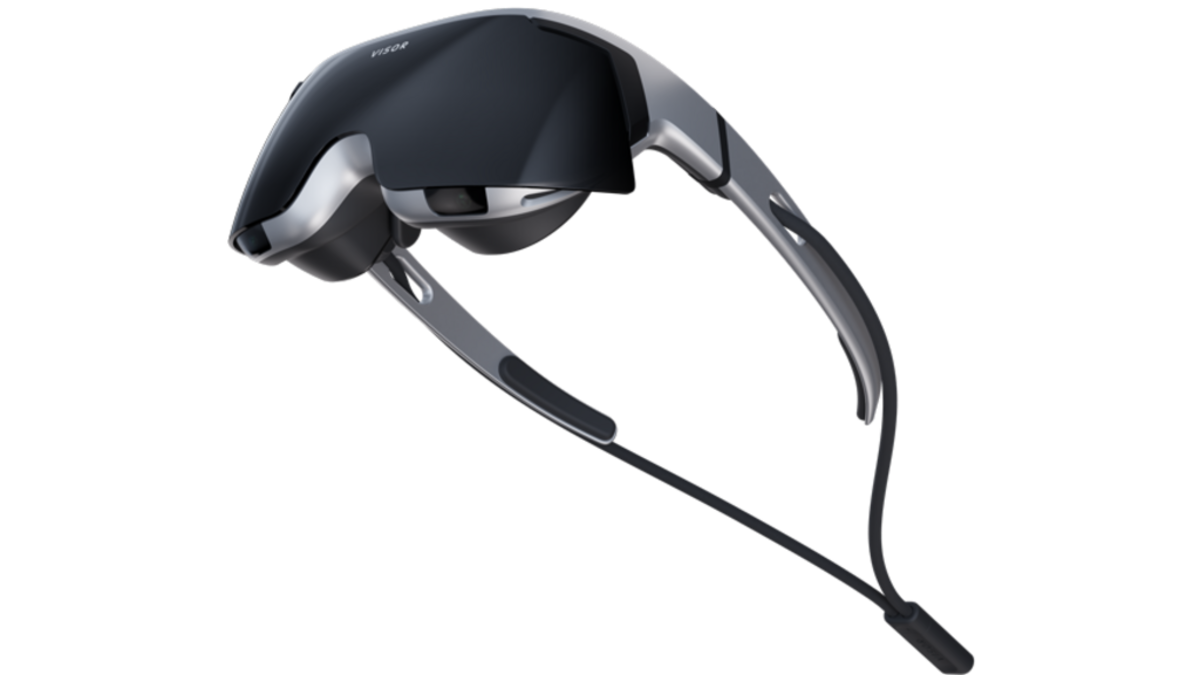
XR startup Immersed sent a weekend email to pre-order customers telling them it is “locking in shipping timelines” — the clearest signal in more than a year that the Visor work-focused headset may actually be approaching production. What the email confirmed with a hard deadline is the price. On August 1, the Standard 4K Edition rises from $500 to $700. The Founder’s Edition goes from $600 to $800. Existing backers have until July 31 to lock in the current rate, according to Road to VR’s coverage of the company’s shipping update.
That price increase is real. Qualcomm notified customers on July 24 that it will raise Snapdragon chip prices by a double-digit percentage on all orders shipping after September 1, 2026, as VR.org reported citing Bloomberg. LPDDR5X contract prices have risen 78-83% quarter-over-quarter, driven by AI data center demand competing with consumer electronics for the same manufacturing capacity, per TrendForce research. Valve’s Steam Machine launched at $1,049 after tracking internally near $750, with Valve pointing directly at memory costs. Immersed’s $200 jump is not a marketing maneuver dressed up as a supply-chain excuse — it reflects a cost crisis hitting every standalone XR manufacturer at once.
The catch, and it is a significant one, is everything the email did not say. Immersed promised a real update next month that will “cover where we are on the production ramp and what to expect next for your pre-order.” There is no ship date for the Standard 4K Edition. No unit count. No factory photographs. No independent reviewer has publicly confirmed receiving a production-ready Visor. For existing backers, July 31 presents a genuine dilemma: pay $200 more later, or lock in a lower price now on a headset with no firm ship date from a company that has now missed or quietly walked back at least four stated timelines.
What the Visor Actually Is — and Why It Weighs Less Than Your Phone
Immersed has been making a free virtual-monitor app since 2020, available across Meta Quest, Apple Vision Pro, Vive Focus, and Pico, letting users bring up to five virtual monitors into VR across Windows, Mac, and Linux, as confirmed by Road to VR. Visor is the dedicated hardware built around that software — a stripped-down, productivity-first headset with no app store, no gaming ecosystem, and no built-in games.
The hardware specifications, if they hold in production, are genuinely competitive. The headset runs Qualcomm’s Snapdragon XR2+ Gen 2 chipset — a step above the XR2 Gen 2 inside Meta Quest 3, with the GPU clocked 15% higher and the CPU 20% higher, and support for more than 12 concurrent cameras, as UploadVR reported at the chip’s January 2024 announcement. It drives dual 4K micro-OLED displays at a 100-degree field of view. Eye and hand tracking enable a Vision Pro-style gaze-and-pinch input system. A tethered external battery provides approximately three hours of use.
The 186 gram (6.6 oz) headset weight — against 515 grams (18.2 oz) for Meta Quest 3 and roughly 650 grams (22.9 oz) for Apple Vision Pro’s headset component — is the engineering choice that defines the product. Immersed achieved it the same way Apple did, by moving the battery outside the headset frame. But Immersed also went further: no integrated speakers (earphones only), no mechanical IPD adjustment (the headset is custom-built to each buyer’s interpupillary distance), and a visor form factor with temporal arms instead of a full over-head strap, as UploadVR’s hands-on reporting documented. The result is the lightest standalone XR headset announced to date, at the cost of a cable and a non-interchangeable IPD.
The micro-OLED panels are manufactured by BOE Technology Group, China’s largest display manufacturer, per XR industry reporting from January 2025. Apple Vision Pro uses Sony-manufactured micro-OLED displays, which have been independently benchmarked in millions of units. BOE’s micro-OLED panels have not been independently tested in any shipping consumer product before Visor, which means the display quality claim — while plausible given BOE’s industrial display track record — remains unverified by any third party.
Real Costs, Real Deadlines: What Is Behind the Price Increase
Immersed attributed the price increase to “global component costs — specifically RAM and storage.” That explanation is accurate in substance and confirmed by independent industry data. LPDDR5X memory pricing rose between 78-83% quarter-over-quarter in the second quarter of 2026, per TrendForce research. Qualcomm — whose Snapdragon silicon powers not just Visor but also Quest 3, Quest 3S, Samsung Galaxy XR, Valve Steam Frame, Pico headsets, and virtually every Android-based standalone XR device on the market — notified its customers on July 24 that chip prices will rise by a double-digit percentage starting September 1, as reported by VR.org citing Bloomberg.
Exchange rate note: All prices are in USD. (This article covers a US-headquartered company; no currency conversion required.)
The structural cause is AI infrastructure. Data center builders are buying every available unit of high-bandwidth memory (HBM) and DRAM from the same manufacturers — TSMC, SK Hynix, Samsung — that supply consumer electronics. Consumer electronics are effectively third in line. A small hardware startup manufacturing a device with 4K-per-eye micro-OLED displays, XR2+ Gen 2 silicon, and high-density RAM is absorbing costs that are rising faster than any pre-order price from 2023 anticipated.
VR.org’s Evan Marcus, covering the same email, noted the deadline component plainly: the update is a promise of an update after near-silence, and the three-day deadline converts existing backers’ patience into leverage by asking them to decide whether to pay more later or lock in a lower price now on a headset with no ship date from a company whose last four timelines all moved, as Marcus documented in his analysis.
Both things can be true simultaneously: the cost pressure is real, and a three-day deadline is still a sales tactic. Backers are entitled to understand both before acting.
How to Think About the Total Cost of Ownership
The hardware price is not the full cost. Visor requires a “Visor Plus” subscription: $40 per month for a 24-month term, or $60 per month for a 12-month term, bundling the company’s Curator Professional AI Assistant, per Road to VR’s coverage of the shipping update.
That means the full cost over two years, at current pricing locked in before July 31:
- Standard 4K Edition: $500 hardware + $960 subscription (24-month plan) = $1,460 total
- Founder’s Edition: $600 hardware + $960 subscription = $1,560 total
- Standard 4K Edition: $700 hardware + $960 subscription = $1,660 total
- Founder’s Edition: $800 hardware + $960 subscription = $1,760 total
For context: Meta Quest 3 is $499 with no required subscription. Apple Vision Pro is $3,499 with no required subscription. Samsung Galaxy XR — which uses the same Snapdragon XR2+ Gen 2 chip as Visor, shipped in October 2025, and has been independently reviewed — is priced at $1,799 with no subscription.
The subscription model is not inherently illegitimate. Immersed’s business logic is the razor-and-blade model applied to XR: price the hardware near cost to build an install base, and generate recurring revenue through the software subscription. For a startup that has raised $38 million primarily from retail crowd investors rather than institutional venture capital, as Road to VR documented, recurring subscription revenue is structurally important. The tension is that the subscription charges for a service the buyer cannot yet use, on hardware that has not yet shipped.
A Timeline of Signals That Did Not Hold
Immersed began accepting pre-orders in September 2023, targeting shipments “throughout 2024,” per Road to VR’s original pre-order coverage.
That target was not met. At a September 2024 event in Austin, Immersed founder Renji Bijoy acknowledged that general pre-orders would not ship until April 2025 at the earliest, per UploadVR’s reporting on the demo event. UploadVR reporters attending that event found only one working headset in the demo room, activated less than 20 minutes before the venue closed. A separate demo unit, per UploadVR’s Ian Hamilton, was reportedly cooled with iced coffee to remain operational long enough to demonstrate.
In October 2024, Immersed published a blog post stating the hardware was “largely complete” but that the company wanted more time for quality control, per the visor.com shipping update. The target shifted to Founder’s Edition deliveries beginning in January 2025.
January 2025 passed without confirmed deliveries. In March 2025, Immersed posted an update saying Founder’s Edition units were “another month or two” away, with fulfillment on “the order of weeks, not quarters,” as UploadVR covered at the time. That post was subsequently edited to remove the specific timeline language, replacing it with a note that “progress continues on Founder’s Edition deliveries as we work through fulfillment,” per the archived version of the post.
On June 30, 2025, Immersed’s official X/Twitter account posted that “All Founder’s Edition Visors shipped by Q2 2025.” As of this writing, no independent reviewer has publicly confirmed receiving a retail-ready Visor unit. Immersed’s own FAQ currently states that Founder’s Edition units “have started shipping” and that customers will be contacted when their order is ready — a company-
John Dagdelen, an XR industry figure, wrote in January 2025 that he had been skeptical of Immersed’s timelines since the beginning, noting that the company had been warned by its own engineers and partners that their stated expectations were not achievable. Dagdelen also said he was updating his view after seeing working prototypes shared with third parties and after learning that Qualcomm and manufacturing partner Pegatron had signed on as tech partners.
The July 2026 email is the first meaningful public-facing communication since the edited March 2025 post.
Does Visor Have a Place in a More Competitive Landscape?
When Immersed opened pre-orders in September 2023, the professional-productivity XR market was defined almost entirely by Apple Vision Pro’s upcoming launch and a field of gaming headsets that happened to support PC streaming. There was a genuine gap: a lightweight, work-first headset with serious display hardware and triple-platform compatibility, priced below $1,000.
That gap is narrowing.
Valve’s Steam Frame — a standalone headset built around 6GHz wireless PC streaming via a dedicated dongle — cleared US customs in June 2026 and is expected to open reservations imminently for a summer 2026 launch, per VR.org’s tracking coverage. It is not marketed as a work-first device, but a headset that wirelessly mirrors your entire Steam library is also a headset that wirelessly mirrors your productivity apps. Pico is developing Project Swan, a puck-tethered thin-and-light headset that shares Visor’s external-compute philosophy, as Road to VR documented. Meta is rumored to be building a puck-tethered competitor internally codenamed Phoenix, targeted for 2027, per Road to VR’s reporting.
None of these competitors is explicitly work-first. But the functional overlap — lightweight form factor, high-resolution display, PC connectivity — is now sufficient to invite direct comparisons that did not exist when Visor was first announced. Road to VR’s Scott Hayden observed that while Steam Frame and other incoming headsets are not work-focused thin-and-light devices in the same way as Visor, the overlap in function between them is bound to draw direct comparisons, which simply would not have been the case in 2024.
Visor’s remaining structural advantages are its 186 gram (6.6 oz) weight, its Linux support (which Steam Frame and most competitors do not offer), and its deep integration with the Immersed app’s existing user base — a figure Immersed has cited in promotional materials but which has not been independently verified. Whether those advantages are enough to sustain a premium over a shipped competitor with independent reviews will be answered by the August production update.
Is the August Update the Real Test?
Immersed’s promised August communication — not the July 26-27 email — is where the company either converts narrative into evidence or extends the pattern. A company with a functioning production ramp typically provides specific, independently verifiable proof: unit counts with a manufacturing partner name attached, factory photographs, or — the clearest possible signal — a review unit sent to someone with no financial relationship to the company.
Evan Marcus of VR.org summarized the cleanest test available: ship one to a reviewer who is not on your payroll. That is all it takes.
Visor’s hardware architecture is still, on paper, distinctively interesting for the professional market it targets: the lightest announced standalone XR headset, triple-platform compatibility, Vision Pro-style gaze-and-pinch input, all within a subscription model designed to keep the hardware barrier below $1,000. The question is whether any of that survives contact with a production line.
Frequently Asked Questions
When will the Immersed Visor shipping date be announced?
Immersed has not announced a specific ship date as of July 29, 2026. The July 26-27 weekend email told customers to expect an August update covering “where we are on the production ramp and what to expect next for your pre-order.” The Founder’s Edition is described as shipping roughly six months before the Standard 4K Edition. Immersed’s official FAQ states Founder’s Edition units have started shipping, but no independent reviewer has confirmed receiving one.
What is the total cost of owning an Immersed Visor?
Hardware alone is $500 (Standard 4K) or $600 (Founder’s Edition) if ordered by July 31, 2026 — rising to $700 and $800 respectively after that date. The required Visor Plus subscription adds $40 per month for a 24-month plan, or $60 per month for a 12-month plan. That brings the minimum two-year total to $1,460 at current pricing, or $1,660 after the July 31 deadline. Both tiers include access to Immersed’s Curator Professional AI Assistant.
Why is the Visor price going up if it has not shipped yet?
Immersed cited RAM and storage costs. That explanation is independently corroborated: Qualcomm notified customers on July 24, 2026 that Snapdragon chip prices will rise by a double-digit percentage on orders shipping after September 1, and LPDDR5X memory prices have risen 78-83% year-over-year. The same cost crisis drove Valve’s Steam Machine to launch at $1,049 against an internal target near $750. The three-day deadline attached to the price announcement introduces a sales-pressure dynamic on top of the genuine cost reality; both are true simultaneously.
How does Immersed Visor compare to other VR headsets for work?
Visor’s primary differentiators are weight (186 grams / 6.6 oz with external battery, versus 515 grams / 18.2 oz for Meta Quest 3), Linux compatibility (which most competitors lack), and deep integration with the Immersed virtual-monitor app. The nearest competition includes Apple Vision Pro ($3,499, no subscription), which has shipped and been widely reviewed, and Samsung Galaxy XR ($1,799, no subscription), which uses the same Snapdragon XR2+ Gen 2 chip as Visor and launched in October 2025. Valve’s Steam Frame, expected to open reservations in summer 2026, is not explicitly work-first but offers 6GHz wireless PC streaming at an expected price of $899-$1,199.
ⓒ 2026 TECHTIMES.com All rights reserved. Do not reproduce without permission.
