

fall out
Episode 4
season 2 episode 4
Editor’s rating 4 stars ****
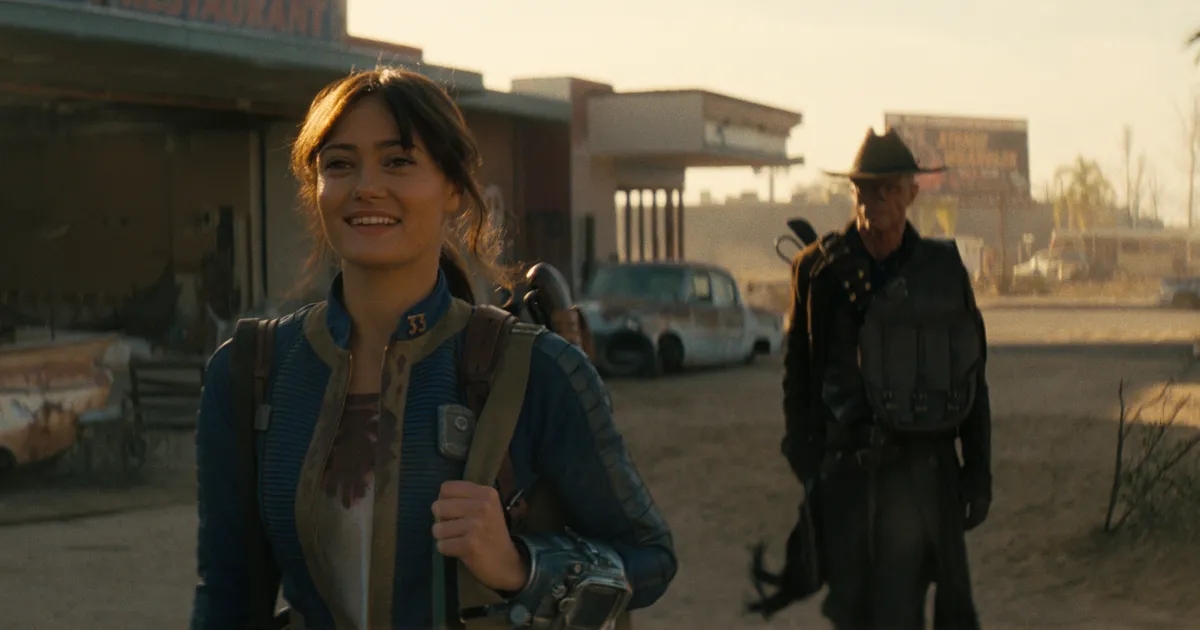
Lucy’s cheerful optimism has officially been replaced by a Bafaut-fueled thirst for violence. Photo: Provided by Prime
Rin a ding ding, baby! Well, it’s been a long journey over four episodes, but we’ve finally arrived in New Vegas. If you’re a Fallout fan, you’ve probably already seen the “leaked” photos of the (very public) Las Vegas set built on top of a Los Angeles strip mall earlier this year. Still, it’s something else entirely to see post-apocalyptic Sin City in all its cinematic, VFX-enhanced glory. The show’s artisanal attention to detail — from production to costuming to everything practical in between, with every craftsman putting effort into each episode — has consistently been one of its greatest strengths, and it’s incredibly exciting to see one of the game series’ most popular landmarks translated to live-action with such replicated accuracy. This is not a strict 1:1 re-creation. The topography of the Strip has changed significantly. For example, in the game there is no gate leading directly from the Las Vegas sign to the Strip. You’ll need to take a half-day detour via the freeside mentioned by Ghoul. Casino placement has also been tweaked.
But when it comes to change, we may have forgotten that idea. The Strip was clearly seeing better days when Lucy and Ghoul arrived there. As far as we know, it’s completely abandoned, and more importantly, it’s home to some of the most formidable and terrifying deathclaws in all of Fallout. Have you ever seen a ghoul in such a horrifying condition? (Search for “Quarry Junction” and you’ll begin to understand why.) As an Uberfan of the series, one of my favorite Fallout elements is that Graham Wagner and Geneva Robertson-Dworet collaborated with the writing team for this episode, written by prolific television writer Jane Espenson, to create a story that fans will love. It’s about how we’ve maintained the balance between service and evolving the universe while risking backlash. It’s a bold move to feature a strip in such dilapidated condition. When we last saw it, it was one of Fallout’s few enclaves of civilization, and also a veritable oasis in the Mojave that encouraged sex, drugs, gambling, and other sins of the flesh. Now, Securitron has been arrested, Gomorrah’s last remaining patron is a deathclaw, and the robotized Robert House is nowhere to be seen. Wasn’t that a blow to the head?
No doubt we’ll find out what happened to the strip during the season. For now, let’s give a little applause to another great cold open that flashes back to Cooper’s deployment to the Alaska front in the 2070s. Here are some Fallout lore lessons for the uninitiated. World War I in 2077 saw the United States and China nuke each other in a matter of hours, but in reality a much longer-lasting, ongoing and hot conflict was ensuing, driven both by the superpowers’ competing ideologies (capitalism and communism, as per tradition) and by a global scarcity of vital resources. In 2067, China invades Alaska in search of its oil reserves. It was the front line of the U.S.-China conflict that would intensify until the world was destroyed 10 years later. Cooper occasionally talks about his time in Alaska throughout the series, including references to the quirky T-45d power armor, a flawed early design that preceded the T-60 (worn by Max’s West Coast Brotherhood in Fallout) and the T-51b (which has yet to appear in live-action). In a flashback, his armor comes under heavy fire from Chinese soldiers and he is almost killed. (One of the Reds sympathetically joked that he would soon be wearing something similar to the defective one. War never changes, etc.)
However, that doesn’t overshadow the key moments in the flashback. Approaching a fallen vertibird in the woods, Cooper spots something huge and horned in the fire and smoke. Like the Xenomorph that bellows at Ripley in Alien, it slaughters Chinese soldiers and then sniffs around Cooper. We are led to believe that this was Cooper’s first encounter with a deathclaw. Although Deathclaws appear to be the byproduct of another postwar nuclear radiation monster, they were actually created in a laboratory by the U.S. government before World War I to deploy as a biological weapon against China. The inclusion of Deathclaw scenes in this central episode suggests that they will be the big villains of the season, aside from Hank and House, of course.
Before Ghoul and Lucy arrive in New Vegas, they take a short break between episodes at the NCR Rangers camp, where Lucy recovers from her period of crucifixion with an IV drip of Buffaut (Fallout steroids, in short). As the episode begins, they continue their journey to Las Vegas, where Lucy begins to have drug withdrawal symptoms. “If you keep the Buff Out infusion for two days, that’s what your body will do,” Guhl says. There are two solutions. Either you have a long and excruciating detox period, or the “only way” is to take more drugs. Lucy, in her drugged state, rationalizes that she doesn’t have a week to chill, and when she drinks another Baffout, her cheerful optimism disappears and is replaced by a cheerful thirst for violence. She brings new bloodlust to the Kings in Fallout: New Vegas. The Kings are a righteous gang impersonating Elvis, who at the time of the show had become Feral Ghouls.
The Brotherhood is over — this feels like the B-plot of the show to me, at least in terms of how interesting it is compared to Lucy and the ghouls’ funny antics — and Maximus is figuring out how to deal with the fallout of Xander’s death. As he admits to Quintus at gunpoint, he’s not very good at making plans. On the contrary, because they work impulsively, they are constantly in trouble. He fails to kill Quintus, but this doesn’t really matter. After Dane steals a cold fusion chip, paranoid elders from various branches of the Brotherhood come together to engulf the West Coast in civil war. Maximus and Thaddeus spend the episode awkwardly pretending to be Xander in a T-60 suit, providing some fun physical comedy with Johnny Pemberton crashing into doorframes and staggering around like drunken Transformers, but they’re definitely on their way to escape into the desert and reunite with their series comrades.
A chaotic threat bubbles beneath the surface in Vaults 32 and 33, with the former continuing to suffer from water shortages and the latter being decisively dealt with by Stephanie. Big announcement here? Chet finds his pre-war identification card in a drawer (don’t ask me why he kept it in such a conspicuous place). This tells us that her year of birth is 2045. She’s also… Canadian! Steph refuses to share Vault 33’s water supply with Vault 32 unless Betty gives her the keepsake box that Hank left in Vault 31. “So you’re holding us hostage,” Betty says. (There’s a 10:1 chance that that box contains Gwyneth Paltrow’s head.) On the ground, Vault-Tec employees in Vault 31 are munching on 219-year-old Brumco mac and cheese, and one of them introduces himself to Norm as Ronnie, Bud’s personal assistant before World War I. He knows something about the nature of the experiments in the Tri-Vault, but that will obviously have to wait for another episode.
• Another thing I admire about this show is that it doesn’t bend over backwards to over-explain all the basic lore behind the many factions, creatures, and entire worlds. Explanations are provided if necessary. Otherwise, writers trust their readers’ intelligence, which feels like a rarity these days. If you’re still a little lost, the Fallout wiki is a great resource for more information.
• There’s something like a cameo from the game early on in this episode. Thaddeus’ child slave bottling facility appears to be Sunset Sarsaparilla’s headquarters in New Vegas. Here, a quest is held involving a cowboy robot called Festus, who asks you to collect 50 special Sunset Sarsaparilla Star Bottle Caps.
• It remains an oddity of Fallout’s logic that pre-war drugs like Buffout and Stimpak are still effective more than two centuries after they were manufactured.
• Super-macho Elder Coronado when Thaddeus says he’s having a panic attack: “What’s a panic attack?”
• Another song from the in-game radio is deployed very effectively in this episode, with Fallout 4’s “He’s a Demon, He’s a Devil, He’s a Doll” closing the episode after a demonic-looking deathclaw emerges from Gomorrah.
• Hardcore Fallout fans often accuse Bethesda of being too harsh on the Brotherhood of Steel, largely based on their portrayal as the all-powerful heroes of the wasteland in Fallout 3. But all other chapters, including those depicted in the show, are more in line with their roots as seen in Fallout and beyond: cruel, calculating, militaristic, hyper-technocratic, and deeply prejudiced.
• In the post-credits sequence, the ruins of Camp McCarran from Fallout: New Vegas are floating, seemingly depicted as being overrun by Caesar’s legions.
Vulture Newsletter
Check out all the drama from your favorite shows!
Vox Media, LLC Terms of Use and Privacy Notice
