

fall out
uranium fever
season 2 episode 6
Editor’s rating 4 stars ****
Photo: Lorenzo Sisti/Prime
Anyone else remember Pluribus this week? Another very entertaining 50-minute TV show, “The Other Player.” It might seem like I’m sitting on the sidelines with such consistent star ratings, but I think Fallout is a solid 4-star show with little deviation either way so far. Similar moral questions are swirling around the series. Is it really worth saving a wilderness where bloodshed, barbarism, and brutality are so prevalent? But what exactly is our species’ propensity for war? Why does war never change? At this point, should humanity just be relegated to the irradiated scrapheap? Consider Hank’s monologue about All Quiet on the Western Front. This is one of the most egregious examples of the series’ writers deploying a somewhat wild but apt metaphor for a never-ending cycle of conflict (this episode was written by Dave Hill, whose credits include Game of Thrones and The Wheel of Time).
“I saw the same thing on the ground,” says Hank, who confronts Lucy in the executive safe. “People fighting over something as trivial as a bottle cap.” (He’s probably so familiar with the world of Fallout that he doesn’t even bat an eyelid by now, but it’s pretty funny to imagine Kyle MacLachlan reading that line in the script for the first time: “Why on earth are they…fighting over a bottle cap?” That, of course, is the preeminent currency deployed across the wasteland, and oddly standardized from coast to coast.)
Anyway, please forgive me for any slight derailment. Back to Pluribus: Hank has personally assembled a large staff of worker bees, obedient automatons controlled by newly sophisticated mind-control chips. (The exploding heads seem to have stopped, but let’s leave off a certain amount of off-screen gore. After all, human sacrifice shouldn’t stand in the way of scientific progress or corporate growth!) Similar to the Apple TV+ series The Others, these surface-dwellers, including former cannibals, legionaries, and other post-apocalyptic denizens, have been stripped of their individualism. Although they don’t share a collective spirit, they are essentially a large group of pacifists and always smiling. Lucy is horrified to see that these people’s lives, memories, and personalities have been stolen as a result of her father’s latest experiment. But how many of them, like our old friend the snake oil salesman, would be willing to give it all up for the chance to undo a lifetime of trauma? There are probably quite a few. As Max and Thaddeus discuss elsewhere in the episode, Lucy’s relentless idealism was only possible because she grew up in the precious bliss afforded by the vault. Sure, living underground has its downsides, but at least you don’t have to go to sleep worrying that you’ll wake up with a knife to your throat or a super mutant dragging you to a faraway cave. (More on this later with Ron Perlman!) No wonder they all want to stay when Lucy gives them a chance to escape, even if they’ve been brainwashed. The most important question here is essentially the same as the Pluribus question. Is peace worth erasing the human spirit?
To be honest, when you examine the situation in the wasteland, the questions don’t feel as sharp and clear as you might expect, and Hank’s Vault-Tec (and RobCo)-approved remedies don’t seem all that far-fetched. But perhaps it’s the conflict that is most present throughout Fallout: the fight to preserve humanity and the human spirit as a whole. (Thanks to its gonzo tone and extremely silly sense of humor, it’s easy to overlook how tragic the world of Fallout is. Child slavery is commonplace. Eating people? Huge appetite!) This conflict also manifests itself as an internal duel between the ghoul and Cooper Howard. The Ghoul and Cooper Howard are two personalities within one prune-wrinkled, noseless man who have been at each other’s throats for two centuries. It tells of him remembering his own basic humanity while he is impaled outside the Atomic Wrangler and struggles to reach the vial before turning into a feral, zombie-like corpse. “My name is Cooper,” he says. “I have a daughter. Her name is Janie. She’s alive.” Don’t quote me on this, but I feel like this is the first time a ghoul has explicitly acknowledged who he once was.
The reminder of his sole purpose, to be reunited with his family, was almost enough for him to unskewer himself, but at the last moment he slipped and slipped from Goolbub. At that point, a gigantic humanoid object appears, like a giant angel descending from heaven, snaps the pole in half like a twig, and carries the ghoul back to the safety of its gruesome, gut-strewn hideout. Fallout fanatics will know this is a super mutant as soon as they see that Hulk-like physique and hear that guttural voice. But for the uninitiated, super mutants are usually what you get when you dip a human into a container of FEV (the Forced Evolution Virus that Norm was reading on Barb’s terminal in the last episode), and various mutants have appeared throughout the series. (In Fallout 3, they are standard enemy fodder, with the exception of intelligent mutants called Fawkes, who can be hired as companions. Fallout 4 takes much the same approach. In other games, such as New Vegas, they are more complex. There is an entire settlement full of friendly mutants called Jacobstown. They are also the main villains of Fallout 1, and the They are led by a crazy monster called the Master.
And yes, huge cameo alert: This particular mutant is played by none other than Ron Perlman! Remember Barb’s line, “War never changes”? It’s the catchphrase of the Fallout games, and has been uttered by series narrator Perlman in every major game installment since the series’ inception in the late ’90s. And, of course, he is a mute character in the play. That deep, gravelly voice and muscular physique – we call it a “brickhouse” here in the UK – are the perfect combination to play a super mutant. He shoved a chunk of uranium into the ghoul’s open stomach hole. “We need you to be healthy because war is coming,” he says. And he dropped a ton of lore onto us, explaining their common enemy as “the people who started all this” and possibly the Enclave, which is the whole nuclear apocalypse thing.
Look, I’m not going to say, “I told you so!” Because if you look back at last week, it was kind of obvious. (I’m a little smug at my seemingly accurate prediction that the Enclave will be revealed as the show’s overarching antagonist by the end of the season, but Fallout likes to overwhelm us, so we always have to be careful of hubris.) There’s a part of me that feels a little unadventurous to default back to the mainline series’ go-to bad guys. Perhaps the program itself could have created an existential crisis. At the same time, their absence probably would have felt a little strange if they had moved on to another season without a more explicit mention. A flashback further confirms that the Enclave was behind everything when Barb encounters none other than Wilzig (Michael Emerson, now with a body) in the elevator at Vault-Tec headquarters. It turns out that he too existed in the pre-war timeline, so he was probably frozen like the other 2077 members who survived the post-nuclear war present. It is also revealed that he was the one who instructed Barb to sell the specter of nuclear war as a business opportunity during the meeting seen at the end of season 1.
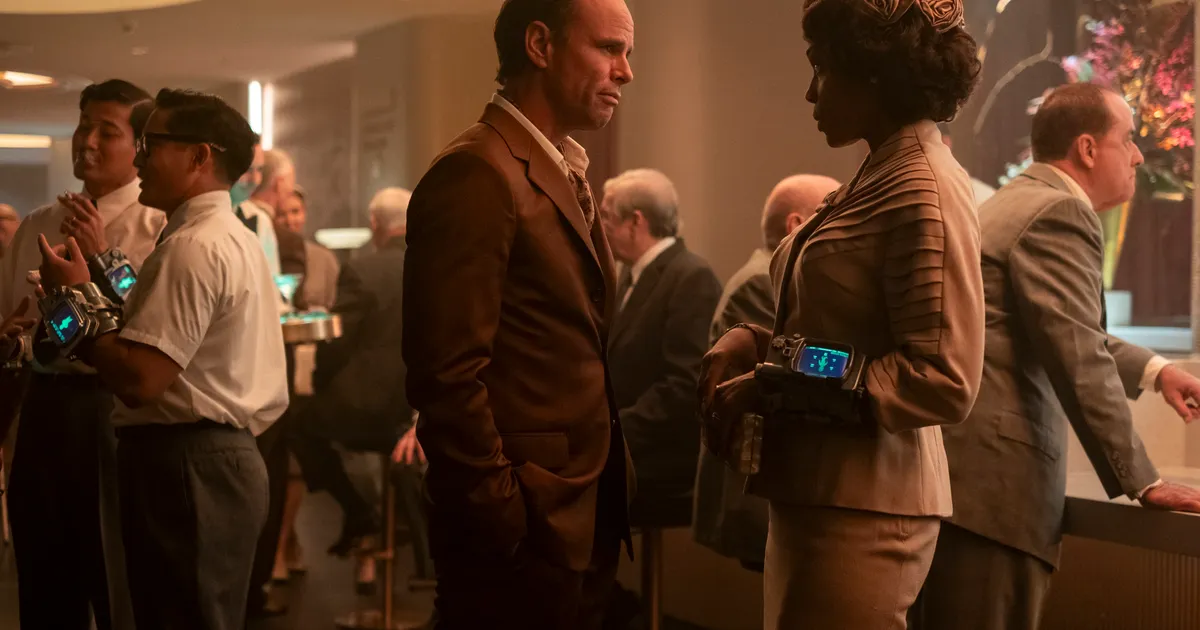
Barb tells Cooper all of this at Lucky 38 after Cooper finally confronts her. The latter is furious that his wife so casually welcomes the apocalypse. She says she will do anything to ensure Janie’s survival. (Including the extinction of countless species, the death of billions of people, and permanently scorched landscapes that will remain essentially uninhabitable for centuries? Yeah, maybe not.) But there are “worse people” than her, she says before telling Cooper about her encounter with Wilzig. Unless it’s a red herring, the Enclave is at the wheel. And in the current timeline, you’d think the ghouls might know more about them than they let on. (After all, he’s been around for over 200 years, and the Enclave has done a lot of bad things in that time.)
Soon after, Cooper accompanies the trashed Hank to the Lucky 38 suite. While he is unconscious, Cooper opens the case where Hank’s wrists were handcuffed. Includes extraction equipment. Barb appears, sticks the device in Hank’s neck, and pulls out the fusion chip. Meanwhile, in the current timeline, Max and Thaddeus are led by ghouls. Scarred and battered by the ordeal at Freeside, but determinedly alive. He doesn’t seem particularly pleased to see them. At least he hasn’t lost his charm.
• Apologies for not mentioning everything going on in Vault 33. But that’s the least interesting element of the show for me at the moment. “Uranium Fever”’s song-and-dance number also makes for a bit of formal fun. We had great direction from Lisa Joy. It is clearly creating a civil war that roughly parallels modern ideological divisions. Boring but sensible realism (Betty and the need for water distribution) versus exciting but unsustainable populism (increasingly power-hungry Reg and his incestuous club). “You’re from Vault 31, and I know things are different there. You generation 31 are different,” he said, adding an on-the-nose xenophobic tone for the age of Trump, to which another Vault denizen chimed in: “It’s so nice to finally hear someone say that out loud!”
• Thaddeus states that he was born in the Boneyard. Boneyard is the first Los Angeles city title in a Fallout game, so named because of the bones-like appearance of the dilapidated skyscrapers that loom over the horizon. Fans are wondering how the Boneyard will fit into the new lore established by the show. He doesn’t do much more than say he lived on the “shithole side,” but it stands to reason that it’s somewhere in the ruins of mainland LA. Still, Shady Sands itself was moved from its original Fallout location for the show. There may be some slight counterattack.
• I hope this isn’t the only NCR vs. Legion action we see this season, but that sequence in the Executive Vault is a fun piece of fan service.
• No, I haven’t forgotten the first scene of the episode. There, House (well, fake House) and Barb discuss replacing mind control devices with cold fusion. Still waiting to see how it plays out in the last few episodes.
• Lastly, speaking of chips, there has been no mention of Platinum Chips in Fallout: New Vegas yet. A storage device containing the data needed to upgrade the House’s Vegas defense system. It was scheduled to arrive the day after the bombs fell. If it had been done in time, none of the nukes would have fallen on Las Vegas – only a handful would have gotten through anyway, and most would have been far from the city itself.
Vulture Newsletter
Check out all the drama from your favorite shows!
Vox Media, LLC Terms of Use and Privacy Notice
