

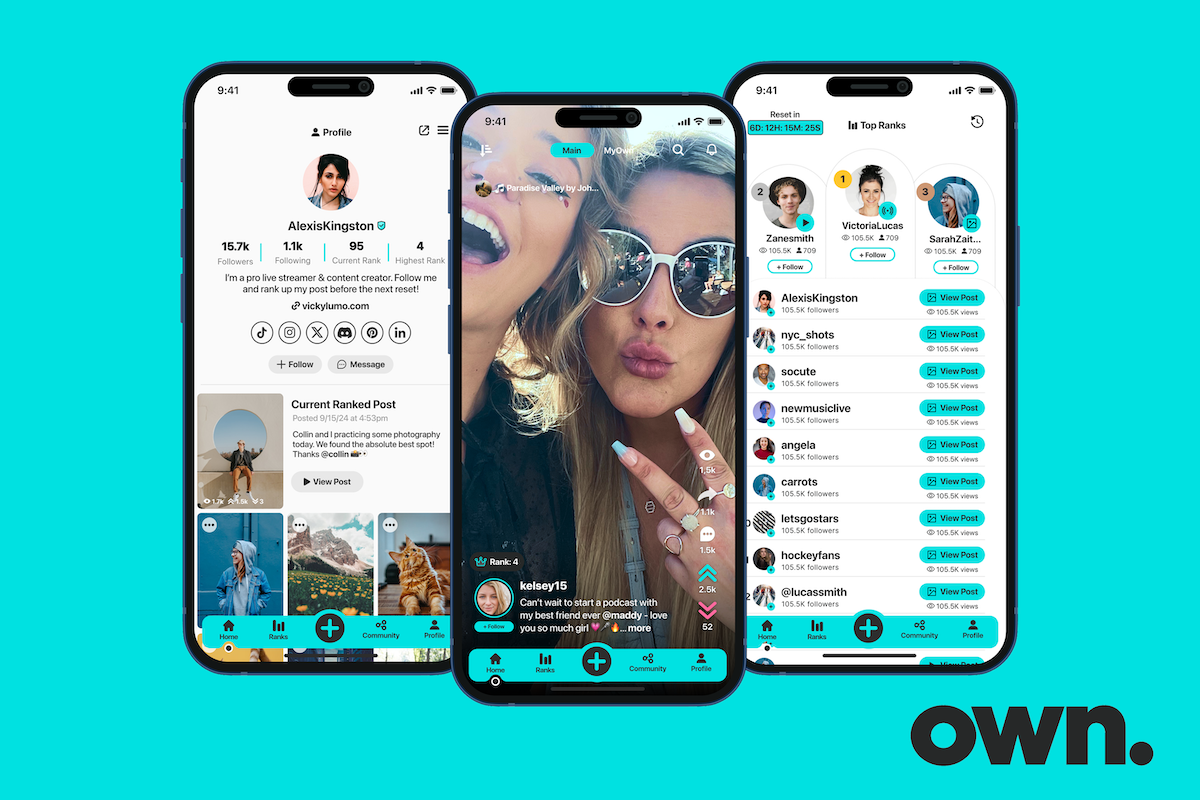
The beta version of a new decentralized social media app was made available to the public on Tuesday, two days before the deadline to sell TikTok’s U.S. operations.
Own is a modern alternative to TikTok that features short videos as well as a swipeable feed of text posts and images, as well as other features such as direct messaging.
However, a new app aims to disrupt the market by leveraging blockchain technology and the token economy. Most notably, the app’s content creators can earn money without any minimum requirements for number of followers or posts.
The app was developed by Amir Kaltak (CEO) and Katia Zaitsev (COO), who previously co-founded Web3 company Lexit. Notably, the app was also co-created by CCO Sarah Mick, who previously worked at major dating apps Tinder and Bumble.
Key highlights include the $OWN token, which rewards creators based on video engagement and is fully tradable. Own operates on a base layer 2 blockchain, ensuring secure transactions and content ownership.
 Image credit: proprietary
Kaltak believes this will be a game-changer for creators, especially since they will be able to earn tokens regardless of their location.
“Most creators around the world don’t have access to monetization on major social platforms simply because of their location. With Own, we’ve built a system that levels the playing field and opens up real earning potential for creators around the world,” he told TechCrunch.
tech crunch event
San Francisco, CA | October 13-15, 2026
Kaltak added that a portion of the platform’s cash proceeds will be used to purchase $OWN tokens from exchanges for distribution to creators. “We are tokenizing the creator economy in a way that fairly rewards creators while creating consistent buy-side demand for tokens in the public market. This will contribute to long-term price resilience and sustainability,” he said.
Rewarding creators with in-app tokens is a common practice, especially in regions outside of the United States. One example is Chingari, a short-form video app that has attracted over 180 million users in India.
Other forms of monetization include tipping, brand sponsorship, and selling items in your Own Shop (the app version of TikTok Shop).
The app promises creators can earn up to 50% more than other platforms. Specifically, in the case of tipping, Own only takes 20% of the revenue, while TikTok takes 50%. With sponsorships, creators keep 90% of the proceeds and only own 10%. Creators benefit the most from Own Shops, keeping 95% of the revenue, while Own Shops only receive 5%.
 Image credit: proprietary
Monetization features, including tokens, are expected to be available during the third quarter from July to September. Own Shop, on the other hand, is scheduled to be released as a beta version between October and December.
Another source of revenue is content licensing. Each piece of content has proof of ownership and provenance and is tracked on the blockchain, allowing creators to license their content while retaining their rights. So, for example, creators can resell their content to brands for use in marketing campaigns and earn 90% of the revenue, while creators get a 10% cut.
The ranking system is also an interesting feature. Viewers can interact with the content by voting by pressing the up or down arrows, allowing them to upvote or downvote posts in a manner reminiscent of platforms like Reddit. Creators with more upvotes can move up the leaderboard and get more exposure.
“Content ownership, consumer authority, global equal pay, equal opportunity to go viral, making meaningful connections and empowering people through self-expression and fair wages are at the forefront of solving current issues with social media,” Mick told TechCrunch. “Without higher platform support for these creators and higher expectations of what their apps are capable of, we will ultimately be doing a disservice to their loyal fans.”
Own is currently available for free on the App Store and Google Play Store. The company claims there are nearly 40,000 people on its waiting list.
To date, the startup has raised over $5 million from Sarah Mick, Michael Terpin (Transform Ventures), Saba Capital, Base Spin Capital, and Stoka Global.
