

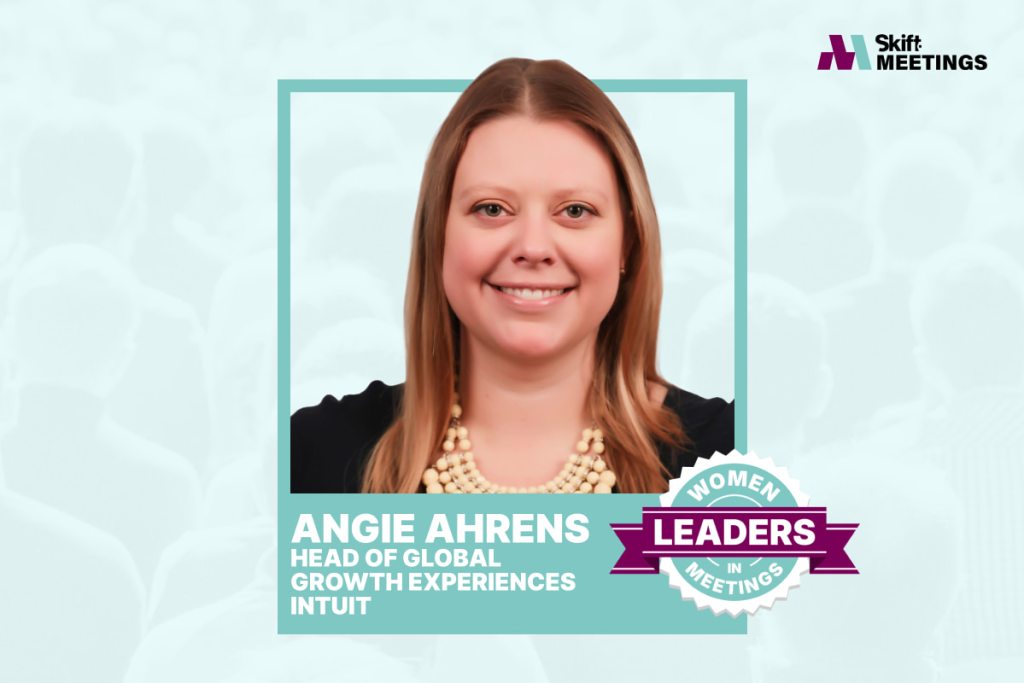
With over 20 years in the events industry, Angie Ahrens has worked in a variety of settings, including LeaderCast, a renowned leadership organization and conference, each of which has contributed to her leadership style. In recent years, she has moved into the technology world, currently serving as Intuit’s Head of Global Growth Experience. She was also recently named to Skift Meetings’ first advisory board.
She has honed her leadership skills, the most important of which, she says, is empathy.
Women Leaders in Meetings is a Skift Meetings series that celebrates notable women leaders who are not only excelling in the meetings and events industry, but championing inclusion and diversity at the top. We focus on women who break down barriers, uplift and advance others, and leave a lasting legacy of empowerment. Through this series, we celebrate the accomplishments and impact of these inspiring women who are making a difference in the world of meetings and events.
When do you feel like a leader?
My thought process as a leader really started when I was scouted to work at Leadercast. At the time, Angela Laub was the CEO. She was a powerful female CEO. She saw things I didn’t see in myself and helped me focus on my leadership skills.
Leadercast was all about research and content and events to teach people and train people how to be better leaders. It happened as I was growing into it myself. In other words, it was like riding a bike and building the bike together. Because of that environment, I was able to surround myself with great leaders. I really appreciate Andrea’s efforts in giving me this opportunity.
Since then, I have always been a leader. At some point during the pandemic, I was fired from Lead Cast and hired by Infor, but there was no longer a team. I realized how much I loved mentoring, helping people develop into themselves, and seeing creativity at work within teams.
I really don’t like operating in my own little silo. It’s always fun to be a dynamic part of a team.
What is your role at Intuit?
Head of Global Growth Experience is a new position. With Intuit’s acquisition of Mailchimp, they reorganized us and gave me a whole new team. We were essentially a field engagement team, but that wasn’t a name that really showcased what we were doing, which was meant to grow the business. It could be an event or an experience. We do everything externally to help people understand the whole Intuit brand.
I have 5 full-time employees and 4 CWs (contingent workers). We are definitely a brand new team and there are many challenges that come with that.
What do you like most about your role as a leader?
We love helping everyone work together and be part of the solution to creating something truly beautiful and memorable.
I’m in this industry because I love connecting people to purpose and experiences, and I believe wholeheartedly in human contact and relationships. It’s great to lead a team that thinks about how we can move the business forward by creating experiences that make that happen.
Can you share some of your most memorable mentorship experiences?
There were a lot of young people in my career and team who were new to the industry. It’s really fun to help them and see where they are now and how they’ve grown. For example, the VP of events at Connect was my coordinator when I was there.
A team member from another job kept calling me asking if I would hire him because he wanted to come back and work with me. It’s very rewarding. Watching people grow in their careers is a highlight for me.
How would you describe your leadership style?
I truly believe in my team and am not a micromanager. Micromanagement of any kind is never a skill. You need to be able to trust your team based on their credentials, what they’ve done, and what they bring to the table.
I can’t do it all, and I don’t have the time to do it all, so I hire based on my weaknesses.
It is very important to develop listening skills and provide feedback in a way that protects and pushes you at the same time. Encouragement is really important.
I also think it’s important as a leader to advocate for those who aren’t there.
How has your leadership style changed over the years?
I spent years learning how to delegate and realizing that I didn’t have to do everything myself and that people wanted to help. I am a person who has to please people in recovery and do everything.
What is an important personal lesson you have learned as a leader?
I get a lot of pressure from my team because I want to protect them.
But burnout is not a badge. I feel like I’ve experienced something similar before, but I don’t want to experience it again. And I don’t want my team to go through that.
I think burnout is a big problem right now, not only in our jobs, but also in the world around us. There’s a lot of pressure. And again, empathy is very important here.
