

Blockchain gaming connects familiar video-game objects with a different way of recording who holds them. Equipment, cosmetics, and collectible creatures can be represented by tokens on a blockchain. The game still supplies their appearance and purpose, but an eligible item can also have a record that supports holding it or passing it to another player.
The practical change is easiest to understand by separating three things: the ownership record, permission to transfer an item, and its use inside a game. They do not automatically arrive together. Some items stay entirely within a game’s own systems, while others enter a transferable collection. Calling a game “Web3,” a term associated with blockchain-based products, does not explain which of those options its players actually have.
Discussions about crypto infrastructure in interviews with industry voices include many elements of blockchain technology, including security aspects. Gaming raises a related practical question: what changes when an in-game item has a blockchain record? Answering it means separating that record from the game’s rules for using the item.
The record represents the item
A blockchain is a digital ledger shared across a network. For a game item, it can record a token’s holder and changes in that holding. This record sits alongside the game’s other components. It does not bundle the artwork, animations, rules, and online services into a self-contained playable object. That separation explains how an item can have a record outside a game’s own inventory system while still depending on the game for its purpose.
“On-chain” refers to records on the blockchain. “Off-chain” refers to records managed outside it, including within a game’s own systems. These terms describe where information is maintained; they do not, by themselves, describe an item’s appearance or what it does in play.
A token is a digital record, not the entire game object. Its identifier distinguishes what is being held, while the surrounding game gives that item its visible form and function. That leaves room for different kinds of collections. A uniquely identified collectible and a quantity of identical equipment do not need to appear as the same kind of inventory entry.
Unique <a href="https://comicvibe.com/a-parade-worthy-lineup-of-collectibles-to-add-to-your-wish-list/” title=”A Parade-Worthy Lineup of Collectibles To Add to Your Wish List”>collectibles and stackable items
Illuvium described precisely that distinction in its December 2025 collection update. In the planned move to a new blockchain, unique assets including its Illuand individual traits. Non-unique equipment and cosmetics would instead appear as stackable entries
Previously, identical items had separate identifiers. The announced structure grouped those interchangeable copies, while keeping genuinely unique assets individually identifiable. This is an inventory question players can recognize without learning the technical standards behind the tokens: does an entry represent a particular collectible, or a quantity of the same item?
The announcement also shows why blockchain gaming does not mean every object receives the same treatment. Illuvium said fuel crates would remain visible as off-chain assets while their corresponding fuel was credited to players. Its collections contained different arrangements for different items.
Transferability is a specific feature
Recording an item and enabling someone to pass it on are separate decisions. A collection needs rules and supporting tools for transfers. The fact that a game uses blockchain somewhere does not make everything in its inventory transferable.
One documented example makes the boundary clear. In GamesBeat’s report on Xsolla’s item-sharing system, published November 17, 2026, Xsolla president Chris Hewish described a system for keeping, sharing, and giving away eligible digital items. Its Backpack serves as an inventory for those items.
Eligibility is central to the description. Items issued to Backpack in transferable form can be passed to another player. Items that remain on a game’s own backend, meaning its supporting systems, continue to work there and cannot move through Backpack. Both arrangements can exist without turning every item into a blockchain collectible.
This also explains why “blockchain game” is a broad category. It describes a technology used within a game, rather than a single set of item rules. The relevant details sit at collection level: how entries are identified, which transfers are supported, and which game systems give those entries a purpose.
The game still determines how items work
Moving a record between holders is different from making an object usable in another game. Xsolla describes movement between supported games. The word “supported” sets the scope: the receiving game needs to recognize and accommodate the item. A blockchain entry alone does not supply that compatibility.
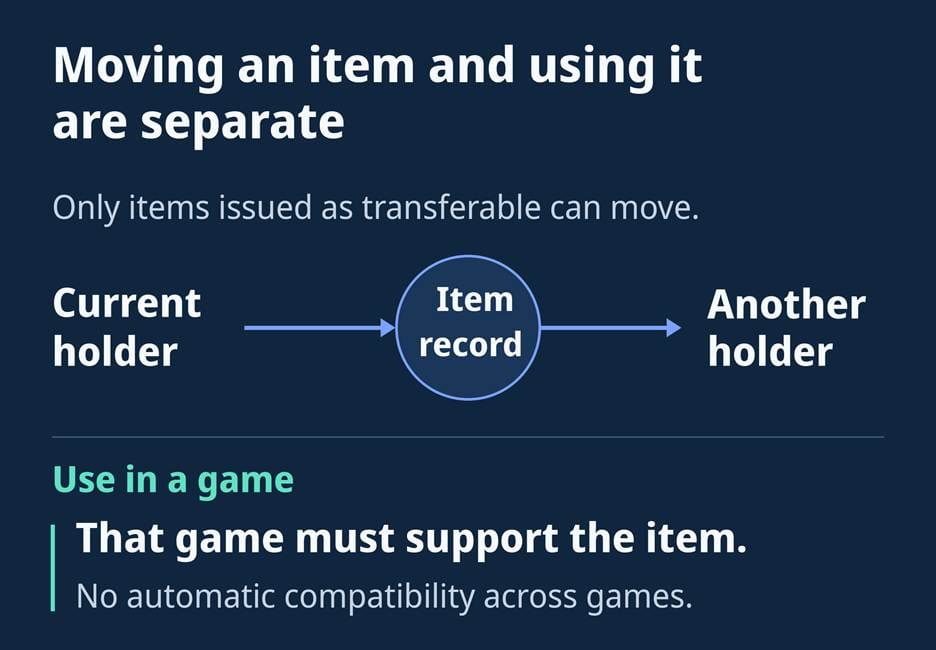
The distinction also applies over time. Xsolla says eligible item records are designed to remain available after the issuing game shuts down. Keeping an item record is different from keeping a game running. The continuing record does not itself provide a playable world, its servers, or another game’s implementation of the object.
This leaves blockchain gaming with a concrete, understandable contribution. It can give eligible game items an identifiable record and supported ways to change hands. How those items appear, what they do, and where they can be used remain questions about the games built around them.

Read Next7 Tech Christmas Gifts Under $50 for Anyone Who Works From Home
