

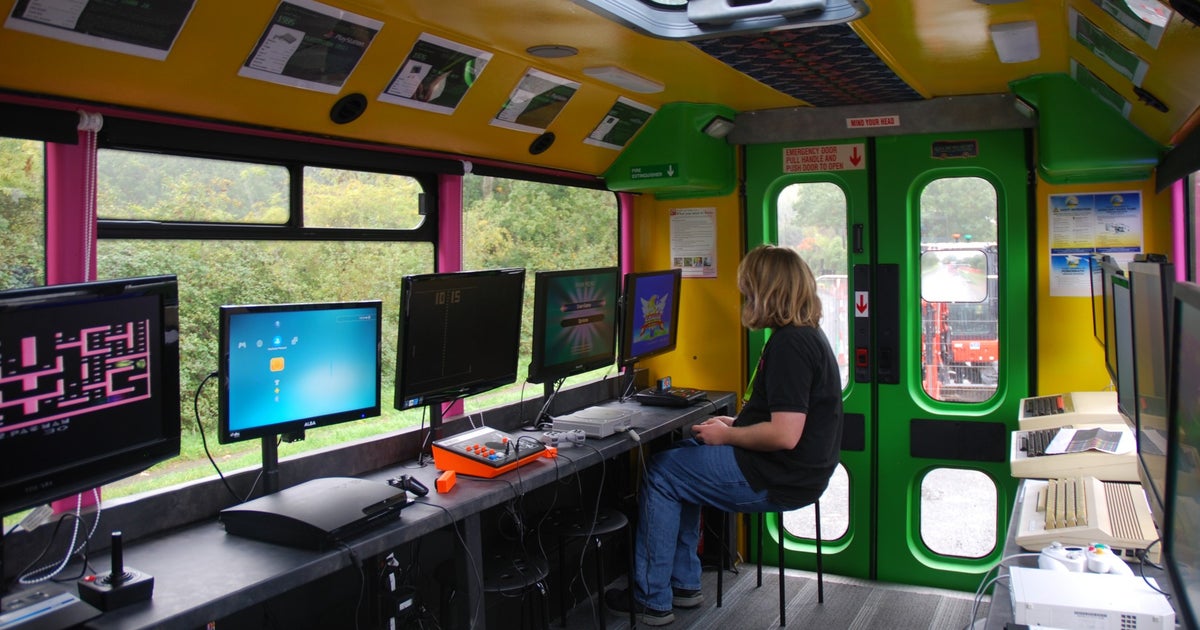
At first the kids jostle to get to the games that they know. “Welcome to the Retro Reset Bus,” says Luke Stoner as the students push to get to the screen that’s caught their eye. Sonic on the Sega Mega Drive is the first they see, and the quickest student to get on board the bus looks triumphant as he nabs the stool in front of the console. Jason, Luke’s dad, asks him what he thinks about the graphics – slightly grainy and slightly pixelated – but he’s not at all bothered and soon engrossed. After a few minutes, though, his eyes keep moving to the back of the bus where “Jackson is a wally” is now emblazoned across a flickering screen in seven different colours. Jackson then gives out a chuffed yell when his code finally works after a couple of restarts. His retort to his mate appears on the 1981 BBC Micro Model B‘s screen as the other students crane to have a look. This is, incidentally, the machine that turned a national broadcaster into a computer retailer (with help from Acorn), says Jason.
Luke’s knowledge is beautiful but the students also find him approachable. As Jason shares: “It’s really inspirational for kids coming onto a bus that they can talk to someone younger like Luke, who knows his stuff and has made something incredible happen.” One student asks where Minecraft is and Luke explains that it doesn’t fit the parameter of being more than twenty years old yet, sharing details of when it was published and by who. Roblox could be included, but Luke isn’t keen because of recent controversies around safety. When this group are reluctantly herded off the bus by even more reluctant teachers, another heads in with just a little gap for resetting the machines and cramming a biscuit.
The bleeps and blips start from the machines as the students start playing. One teacher stops at the Atari 2600 and shares that her family has just bought her one. She is loving the daily dose of nostalgia. Luke and Jason move up and down the bus answering questions, resetting machines and showing the students their collection of old phones. One student winces at he is passed the bag that would have carried the battery for a Panasonic EB-3600 “brick” phone from 1989. When Jason says his dad had one, they give that look of pity reserved for anyone over 30 but are also incredulous that anyone would lug that around, especially when the phone could only do calls. When Jason asks if anyone would like to break an iPhone and have a look inside, all of the hands shoot up. He then talks about memory, RAM and chips, brings out a floppy disk; and tells the tale of where the expression “computer bug” came from. Still, it’s the game on a tape – Jungle Story for the Commodore 64 – which they all turn away from screens to see. Perhaps we have Stranger Things to thank, but the tape has retro currency and they all think it’s sick.
The event is being run by East Sussex Careers Hub and is specifically aimed at students with SEND (Special Educational Needs and Disabilities). More than twenty-five schools turn up and most teachers leave with a flyer, chatting to colleagues about where the bus could park onsite. Jason says that the response to the bus, since Retro Reset’s launch as a registered charity in August 2025, has been phenomenal, and they could easily fill a full week with visits. For now, he is juggling it with work commitments.
The bus was Luke’s idea and inspired by a visit to The Centre for Computing History in Cambridge, where visitors can get their hands on home computers and consoles from decades gone by. The family started thinking about what was possible and finally, after Luke finished college, began kitting out the bus: buying or accepting donations of hardware, researching which monitors would work with the ancient systems, and installing it all within the cabin.
On a basic level, the charity is telling the story of how technology has iterated. But by allowing visitors to take apart their machines, and giving brief lessons in coding with Basic, it also pulls the veil back on the work that goes into making a game – while opening students’ eyes to what they could create themselves. “I guess it’s bridging the gap between the polished and finished latest game,” Jason says, “which could be perceived as not achievable for them, to seeing how all that coding came about. Other than making sure they are really accurate with their typing; they realise that coding can be quite simple and something that they can actually do. I would go further and say that when they have written some code, nearly all of them have a big smile on their face.” This, he hopes, might be the spark for some students to get into coding, especially for PC games, where under-18s are an underrepresented demographic.
It also hit the road as the popularity of retro gaming continued to surge. According to a Consumer Reports survey published last February, 14% of US gamers regularly play games made before 2000. This is reflected in the staggering stat that the retro gaming market is estimated to be worth $3.8 billion globally, with a projected rise to $8 billion by 2033. Retro-focused videos on YouTube and TikTok rack up millions of views of views, and communities formed on reddit or Discord – some with hundreds of thousands of members – discuss nothing else.
Nostalgia is playing a huge part. Atari’s Implicit Conversations is built on just this, creating retro games for modern consoles like PlayStation 5 or the Nintendo Switch. For Luke, though, this misses the point. He likes the click when you put a cartridge in a machine; and he likes that he is just him and the game. The parents of visiting students appreciate this too, and often share how overwhelming it feels to keep their kids safe in the online gaming environment. “Parents of younger children [tell us that] they hate that Minecraft and Roblox can allow their kids to play against perceived strangers. Even the more technical parents say they still miss safety measures and would prefer the games not be online at all,” Jason explains.
Last month, Ofcom published its Growing Up Gaming summary report, which found that almost two-thirds (64%) of parents of three to 17 year olds who game online are concerned about their child talking to strangers through games or their chat functions. And, while the vast majority of young players go online without incident, it is true that those who use chat functions will likely interact with strangers. The same research found that more than half (55%) of children who game online say they play with people they have never met offline at least sometimes, while one in five (20%) do so all or most of the time they play.
Luke shares too that he became nervous of the data he was sharing with gaming companies, and conscious that this was all being stored, thus making it vulnerable to breaches. He also baulked at what he felt was a constant money grab from gaming companies, including moves that render games unsupported or completely obsolete. Retro gaming is cheap in comparison and therefore more accessible, especially for younger players. “When you tell them that they can get an old console for less than £100 and often games come free when you buy them second hand, their ears really prick up,” Jason says. “For a lot of the youngsters, the cost of modern gaming equipment is unattainable. And of course, we explain that they could take old computers and laptops and then load free operating software onto them. This gets them online, often for free. Once they are there, they can game.”
John W. Champeau is founder of Champ Games, a Connecticut-based venture, which develops retro games system primarily for the Atari 2600. He has Scramble, Galagon, Gorf Arcade and Elevator Agent on his line-up. He agrees that price point is a huge part of the appeal of retro gaming. “Atari has released a line of “+” systems that are modern reinterpretations of the class Atari 2600 and 7800 hardware, but at a lower price point but with modern conveniences such as HDMI support, firmware updates, and new controllers,” he notes. These systems can also play older cartridges that were released back in the day. “This means that the games themselves can be acquired at a low cost as well, sometimes even free if someone is lucky enough to know someone with a box of old Atari carts in their basement or attic.”
But there may also be something intrinsically different about how these games are designed to be played that is driving their renaissance. In December 2025, Newsweek shared the views of two mental health professionals that “90s Video Games Were Better for Kids’ Brains.” In what was sure to be a contentious piece (and perhaps that was the point), mental health counsellor Veronica Lichtenstein, and Melissa Gallagher, a licensed clinical social worker, argued that the very nature of gaming has changed and is now damaging. Retro games had a start and an end – and with the latter came a big hit of dopamine for achieving victory. Modern games are designed as “loops for addiction” with no real end; and constant prompts to buy. Satisfaction is constantly deferred. Lichtenstein also says that modern games leave little room for critical thinking, as a quick search online will delivers solutions if a player ever gets stuck.
Champeau agrees. “Our games are not designed to be addictive ‘time stealers’ like some modern video games that encourage players to ‘stay online’ for hours on end to acquire additional resources needed to complete a game or advance to a new level, etc,” he says, adding: “All of our games are designed to be short burst distractions that don’t rely on long gaming sessions to feel a sense of accomplishment.” He says that the lower graphics resolution and primitive sounds are actually a relief for many after years of hyper-realistic gaming. “Retro games distance the gap between game and reality, which was the intention of video games in the first place,” he argues.
Back on the bus, Sonic may have attracted the initial crowds but it is now Pacman and the Binatone that the students are huddling around. Jason has given up one control for the tennis game to a student and a noisy competition is now taking place. The graphics are basic as is the premise, but scoring is tricky and the battle to get to 15 points hard-fought. The teacher laughs. “The bleeps from that game are bringing back memories,” she says as she tries to encourage her students to finish and hand over the controllers. But with faces lit up by the screen and set in concentration, they don’t hear her. This is play for play’s sake, with no distractions, and could be why the games of the past might be just the future these kids need.
