

The grammar of genocide
Offering a raw account of ten genocides, this comic on totalitarianism and state-sanctioned violence shows how political power invents reasons why some lives count for less.
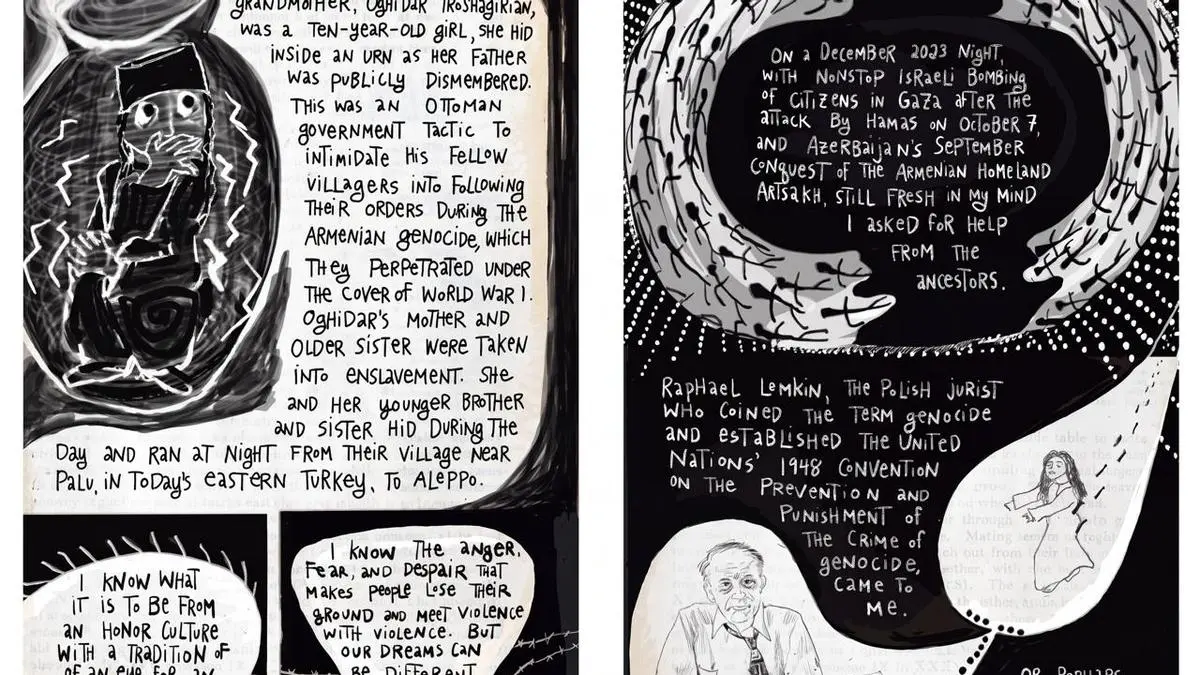
A panel from The Book of Genocides.
| Photo Credit: https://www.bookofgenocides.com/resources
There is something unsettling about turning the pages of a comic book when those pages carry the histories of mass murder and extermination. Imagine a full page crowded with black, upright human silhouettes, punctuated by red marks, that evoke both collective suffering and the transatlantic slave trade. On the facing page, the author handwrites an account of the forced transportation of Africans to Brazil, the Caribbean, and North America, tracing its consequences to the social structures of the US. Here, comics, for once, lose their innocence, playfulness, and frivolity. Images speak volumes: such is the force of Dana Mashoian Walrath’s graphic non-fiction, The Book of Genocides, which confronts the horrors of genocide. And it arrives at a moment when genocide is once again central to international politics and public argument.
My first encounter with Walrath was through Aliceheimer’s, a graphic memoir about her mother’s dementia. There, the Armenian genocide appears as a personal undertone in the story of her grandmother, a survivor. Genocide and mass violence find fuller expression in Like Water on Stone, a verse novel, before returning in a transformed form in The Book of Genocides.
Art Spiegelman’s Maus (Holocaust), Marjane Satrapi’s Persepolis(Iranian Revolution), Benjamin Dix and Lindsay Pollock’s Vanni (Sri Lankan civil war), and Joe Sacco’s Palestine (Israeli occupation) have all used comics to bear witness to historical trauma and state violence. Continuing this tradition, Walrath, an Armenian-American comic artist and descendant of genocide survivors, offers a raw account of ten genocides across history and geography spanning the Americas, Australia, Armenia, the Holocaust, Black Americans, Palestine, Cambodia, Rwanda, Bosnia, and Myanmar. As an anthropologist, Walrath grounds these accounts in field work rather than archival research alone. Her journeys matter because they unsettle the authority of the distant observer.
Her Armenian grandmother reappears in the “Introduction” to The Book of Genocides as Walrath traces the history of the term “genocide”. Raphael Lemkin, the Polish Jewish jurist who coined the term, escaped the Nazis but lost 49 family members in the Holocaust. Yet, when the 1951 petition “We Charge Genocide” called on the United Nations to recognise violence against Black Americans as genocide, Lemkin rejected it. The Book of Genocides treats this rejection as a warning about the limits of moral recognition. Although the ten genocides differ, Walrath attends to the recurrent mechanisms that make them possible: the seizure of land, scientific racism, medical experimentation, and the gradual conversion of exclusion into destruction.
This book, which confronts the horrors of genocide, arrives at a moment when it is once again central to international politics and public argument.
| Photo Credit:
By special arrangement
The Book of Genocides
Harvard University Press, 2026
Pages: 424
Price: Rs.2,730
Across these histories, the body becomes a site of violence. Representation is equally central. To present a group, for instance, as vermin, parasites, or an invading presence is to prepare the ground for defending its destruction. Adolf Hitler’s statement quoted in Maus, “The Jews are undoubtedly a race, but they are not human”, finds a grim parallel in the Hutu extremists’ description of Tutsi people as “cockroaches”. The echo is chilling. For Walrath, every genocide rests on an argument of purity, a belief in an uncorrupted national or religious identity, as in Myanmar’s Theravada Buddhist-nationalist rhetoric, which is “dedicated to creating a pure Buddhist state”.
That argument becomes particularly relevant in the chapters addressing Palestinians and the Rohingya. These are not histories safely contained in the past tense. They confront readers with the contested vocabulary of international law, the politics of recognition, and the uneven distribution of public sympathy. The Rohingya chapter, for instance, compresses Myanmar’s history into a few urgent pages: Ne Win’s military rule, Aung San Suu Kyi’s fall from democratic icon to state defender, and the mass expulsion of the Rohingya into Bangladesh. Image and text complement each other as charcoal sketches, Lilliputian silhouetted bodies, abstract cartography, and rough black backgrounds turn each page into a record of displacement. A graphic history cannot settle every political dispute, but it can challenge the habits through which certain populations come to be perceived as threats.
Disaster comics
The Book of Genocides belongs to the category of “disaster comics”, a term introduced by the comics scholar Hillary Chute to describe graphic narratives that present large-scale human catastrophes such as war, genocide, and nuclear bombing.
But why comics? Spiegelman was often asked this question after the publication of Maus. Walrath, in an interview with the editorial staff of Harvard University Press, offers her explanation: “They’re accessible, a bit of an outsider medium, and they work on several levels at once—image, text, rhythm, silence—which is exactly what layered, difficult stories need.” Her reasoning is persuasive; after all, genocide cannot be understood through a single explanatory register. That layered quality is immediately visible on the page. The panels hold faces, collage, line drawings, photographs, redacted texts, maps, historical documents, and fragments of archival material, refusing the smoothness of history. Such visual verve is complemented by Hannah Arendt-like pronouncements—“Only states commit genocide. Amongst their machinery, states have the power to amplify and disseminate stories to justify their violence.”
Elsewhere, on the book’s final page, Walrath writes: “Every act of connection across a divide brings us one step closer to ending, preventing, and healing from genocide.” Such statements recur, making The Book of Genocides a graphic treatise on totalitarianism, human wickedness, and state-sanctioned violence.
The book’s most striking device is an interactive turn-the-flap sequence. A panel is divided into sections that can be cut and rearranged to produce changing combinations of human and non-human features. The gesture is uncomfortable by design, and its implications are instructive: a person can be made to appear monstrous through the manipulation of representation. Here, the reader is drawn, uneasily, into the position of ethical witness.
Ultimately, The Book of Genocides is an invitation to recognise how political power invents reasons why some lives should count for less than others. Genocide, it insists, is an outcome of power and narratives that decide who lives and who does not. The Book of Genocides boldly exposes such mechanisms without reducing these histories of genocide to a single narrative of human wickedness. Walrath’s book does what the Mexican-American poet-educator Cesar A. Cruz ascribed to art at its most necessary: it comforts the disturbed and disturbs the comfortable.
The reader may close the book; the histories and wounds will not.
Sathyaraj Venkatesan is a Professor of English at the Department of Humanities and Social Sciences, National Institute of Technology, Tiruchirappalli.
