

Advances in AI and virtual reality are making immersive training more accessible, but many fire departments remain on the sidelines
Editor’s Note:This article originally appeared in the FireRescue1 industry report,“What Firefighters Want in 2026: Time to Train.”Explore our full coverage in theWhat Firefighters Want re
The airline industry spends billions every year on simulators and virtual reality training because they understand a critical fact: When things go bad, people don’t magically perform above their training level. You simply cannot wait for real-world experience to build competency, which is why pilots train repeatedly for catastrophic events they may only encounter once in an entire career.
We all know the prime example of this: When Captain Chesley “Sully” Sullenberger successfully landed US Airways Flight 1549 on the Hudson River after a dual engine failure, some people called it a miracle. Sully himself pointed to years of training and simulator repetitions that helped prepare him and his crew to manage an almost unimaginable emergency under extreme pressure.
A ability, communication skills, and stress management long before a real emergency ever occurs. Meanwhile, in the fire service, we still rely heavily on PowerPoints, tabletop discussions and the occasional live burn while expecting firefighters and command officers to perform flawlessly in chaotic, high-risk, rapidly evolving environments
FireRescue1’s What Firefighters Want survey supports this assertion, as approximately 80% of respondents reported that their fire departments use little or no artificial intelligence (AI) or virtual reality (VR) in training. It’s a striking statistic considering that many departments are facing shrinking budgets, pressure to reduce overtime, increasing service demand, staffing challenges and growing incident complexity.
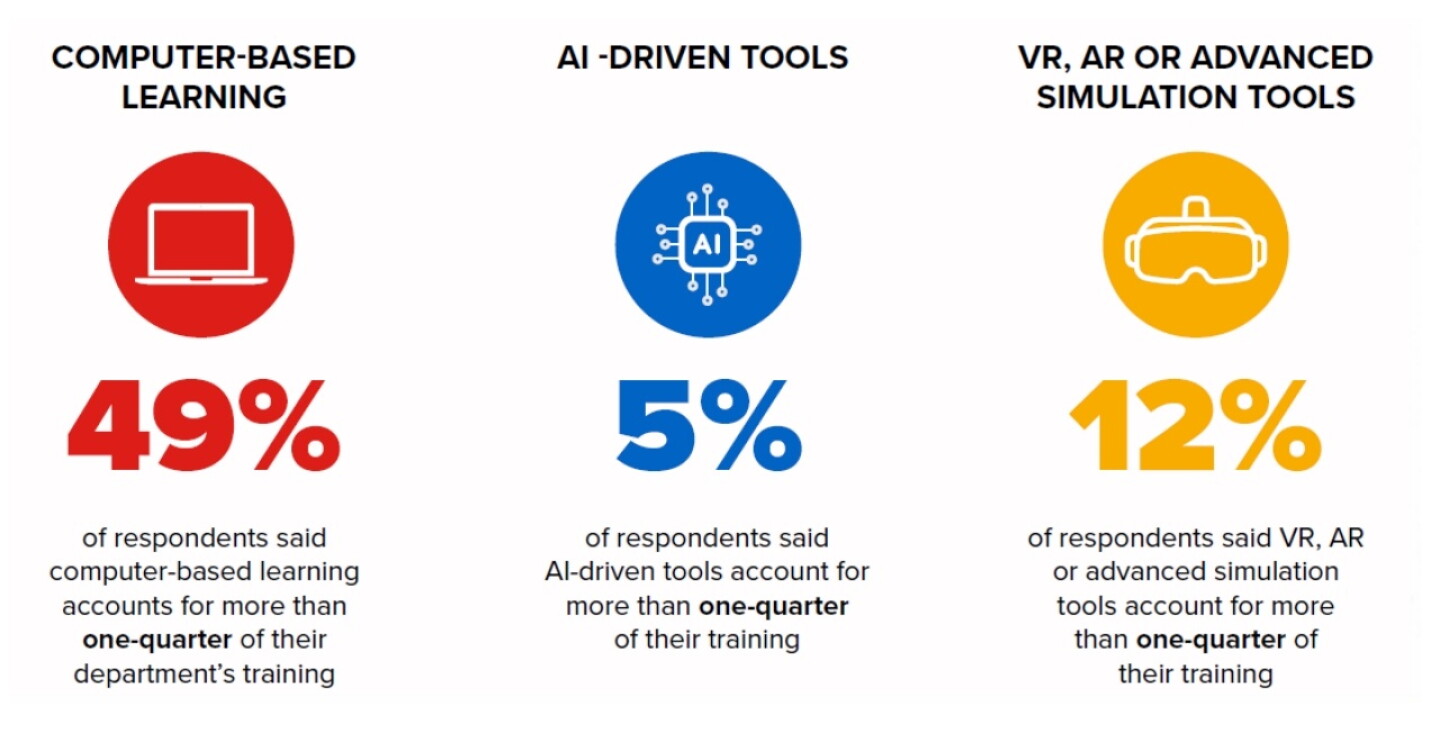
As AI and VR rapidly reshape training across nearly every other high-consequence profession, the fire service must ask a difficult question: Are we training for the emergencies we actually face today or the ones we faced 20 years ago?
The VR gap
For most departments, the mental image that comes with VR is still a room full of expensive equipment, a technical trainer who doesn’t exist on staff, and a headset that needs to be turned on by someone with years of IT experience before every session. That image was accurate a decade ago. It isn’t now.
Standalone or wireless headsets changed the hardware math. No computer, no cables. One device, self-contained. The cost of entry dropped, and the complexity of running a VR training session did as well. But perception doesn’t update as fast as technology does. A lot of chiefs are still making budget decisions based on what VR cost in 2016, not 2026. That lag between what’s real and what departments believe is one of the most persistent barriers to this technology entering the hall.
The software problem is worse, but it comes from a different place. Simply put, the first wave of VR training for firefighters wasn’t good. Scenarios were limited, skills you could practice were simple, and smoke behavior and other physics looked nothing like actual fireground conditions. Departments that invested early and got a poor product largely wrote off the whole category.
Realistic fire simulation is genuinely hard to build. Getting fuel takes years of development. Fortunately, the software has caught up considerably since those early versions, but in the fire service, a bad first impression holds. Changing that narrative takes a live demonstration in front of a skeptical crew, not a spec sheet or marketing doc
A third barrier gets underestimated in almost every technology conversation: support. Buying hardware is the easy part. Getting a full department to use something consistently, troubleshoot it when it breaks, and work it into an actual training calendar requires setup help and someone who answers the phone when things go wrong. Without that structure, technology becomes indefinitely shelved within a few months.
Departments that have made VR work long-term almost always have one person inside who believes in it, drives the program and refuses to let it sit unused. When that person transfers or promotes out, the program often goes quiet with them. The good news: New VR systems have become simple to operate, and the best come with constant support, so when the VR champion moves on, it’s simple to hand over the reins.
Where VR earns its value is in the scenarios that are impossible or unsafe to replicate otherwise: mayday situations, lithium-ion and other hazardous incidents, SCBA failure under pressure, and search in conditions you can’t control in a live building — repetition-based skills that are hard to get reps on without burning resources or creating risk. Research on VR learning outcomes shows significantly faster skill acquisition and stronger retention at 12 months compared to classroom-based instruction on these scenarios.
Additionally, modern tools now let instructors build or modify scenarios without a developer in the room. Change fire conditions, move patients, adjust timing, tailor a scenario to a specific SOP or JPR. Run a debrief inside the simulation itself. Training officers have a tool they can actually control rather than just operate.
For departments not ready to commit to a VR kit, 360-degree video is a lower-overhead starting point. Shot at real incidents or controlled burns, these videos put a firefighter into a first-person perspective with minimal equipment and no specialized setup. The interactivity is limited, but for a department building its first VR program, it’s still a better learning experience than classroom-based scenarios alone.
The AI gap
For most of AI’s history as a training tool, the main barrier wasn’t cost; it was expertise. Using AI in a fire department required custom development, data systems, and a staff member who could define the use case, build the system and keep it running. Few departments have that person, and even fewer have the budget for them.
That situation has changed, and it’s important to be clear about how. The difference isn’t that AI became cheaper. It’s that most firefighters have now tried it themselves. We’ve seen this before. Mobile mapping didn’t start with a department-wide rollout. Firefighters were already using digital maps on their phones before features like live hydrant layers and preplans were added to the trucks. Personal use came first, then operational use, and eventually, no one thought of it as new technology. AI is following the same path. Most fire service members have already used it in some way, whether writing a report, looking up information or solving a problem at the kitchen table. The fear of the unknown that stopped the conversation a few years ago is lower now, because AI isn’t just an abstract idea anymore.
But being familiar with AI isn’t the same as trusting it, and this is where the biggest gap remains. With VR, there was at least a precedent — aviation and the military had used simulation for years, so departments could look to proven examples. AI in fire service training doesn’t have that. There’s no standard for what “good” looks like, no leading department to follow, and no published guide for adopting it responsibly. Most chiefs, understandably, don’t want their department to be the test case.
There’s another, tougher problem. With most training tools, you can see exactly what you’re getting. With AI, it’s often unclear what the system is referencing or how it arrived at an answer. AI can give a response that sounds smooth and confident, but is actually wrong, a tactic that seems reasonable but goes against fire behavior, or a scenario detail that doesn’t match your SOGs. This isn’t a reason to avoid the technology; it’s a reason to make sure a qualified instructor reviews everything before it reaches a trainee. Every AI-generated scenario should be seen as a draft, not a finished product. The departments doing this well aren’t the ones with the fanciest tools; they’re the ones who decided early on that a human should approve everything before it goes to a trainee. We must be intentional about where AI earns its keep. Right now, that’s a few clear areas:
- Generating and adapting scenarios, adjusting difficulty, conditions and variables faster than an instructor could by hand;
- Supporting after-action review by surfacing patterns in performance data;
- Driving simulation characters that respond dynamically to a trainee’s decisions; and
- Handling administrative load like scheduling, records and incident report drafting.
The departments moving forward sensibly are starting with the low-risk administrative wins, building confidence with the tool before they ask it to carry weight in actual training.
The next evolution
The fire service has always adapted when the stakes demanded it. We moved from horse-drawn apparatus to engines, from paper maps to GIS and from instinct alone to data-informed decision-making. AI and VR are simply the next evolution of that progression. Departments do not need to become technology companies overnight, nor should they blindly chase every new platform that appears in order to accept this change. What they do need is the willingness to critically evaluate tools that can improve decision-making, increase repetition-based training, reduce risk and better prepare firefighters for the complexity of modern emergencies. After all, the question is no longer whether these technologies will become part of the fire service, but whether we will shape how they are used or wait for the future to force the issue upon us.
Scott Roseberry is a battalion chief with the Garland (Texas) Fire Department. He has a bachelor’s degree in emergency management and a master’s degree in public administration. Roseberry holds the designations of Executive Fire Officer, Certified Public Manager, Chief Fire Officer, Fire Service Chief Executive Officer and Chief Fire Executive. He is the chairperson of the International Association of Fire Chiefs (IAFC) Technology Council and a member of the FEMA Region 6 Regional Advisory Council and serves on the Department of Homeland Security First Responder Resource Group.
Justin Brunner is the founder and CEO of Decisolve, building AI-powered tools supporting fire and emergency services trainers.
Evan Sitler-Bates is the co-founder and CEO of XpertVR, a Canadian company that builds VR and XR training simulations for fire departments and safety organizations.

Education & Training
On-demand webinar: What do firefighters really want — and need — from training?
Learn what the newest What Firefighters Want survey reveals about training access, quality, effectiveness and the barriers departments face
Artificial IntelligenceEducation & TrainingTechnologyWhat Firefighters Want
