

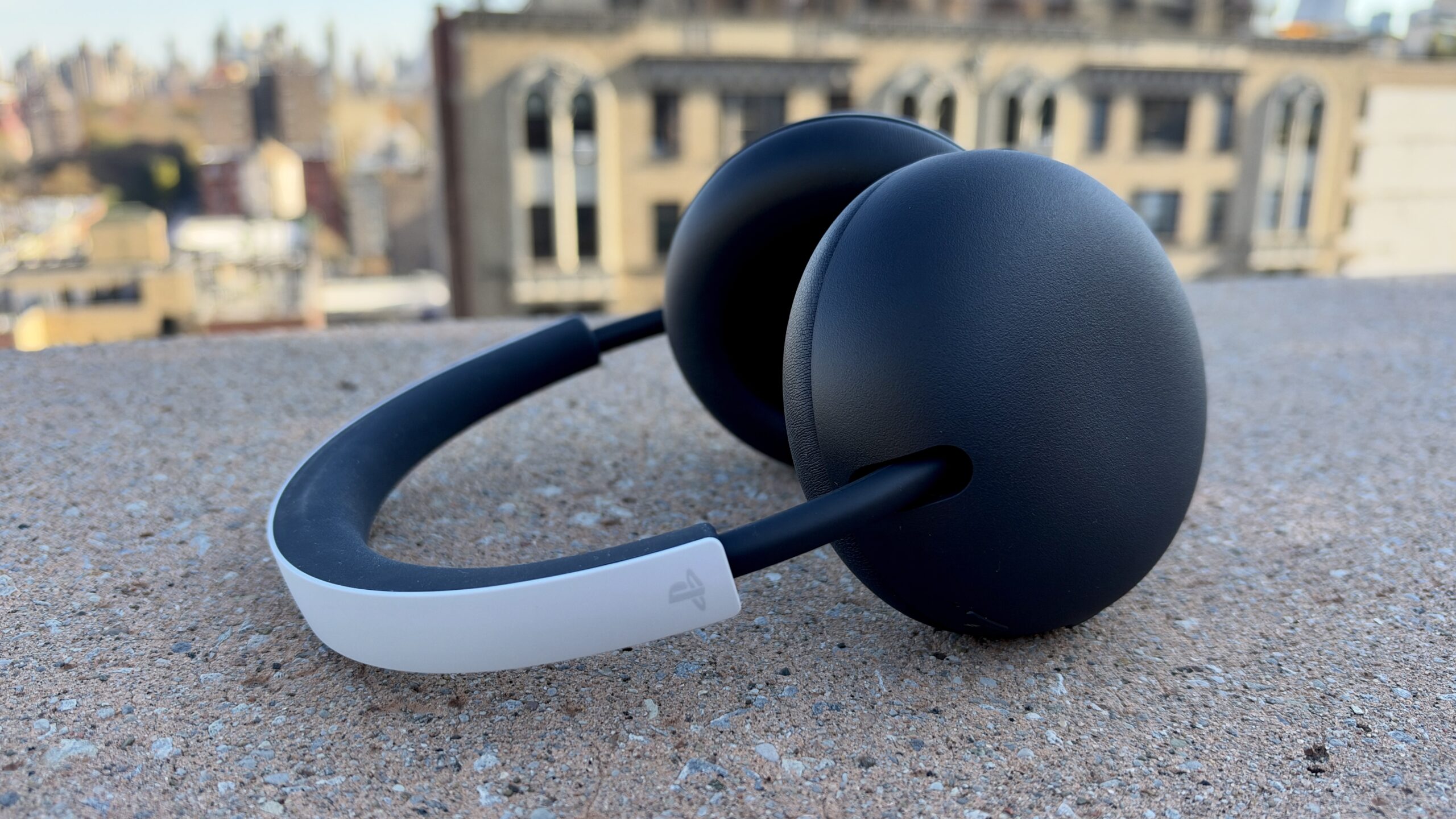
Sony PlayStation Pulse wireless headset
Pros & Cons
- Affordably priced
- Lighter and more compact with no boom microphone and fold-flat design
- Larger planar magnetic drivers deliver excellent sound with improved bass performance
- Comfortable to wear for longer gaming sessions
- PlayStation Link USB-C wireless dongle (included) and Bluetooth connectivity
- Compatible with PS5, MacOS, Windows, Nintendo Switch, iOS and Android phones
- Good battery life (up to 30 hours)
- No active noise cancellation
- Limited feature set
- Bass may be a little lacking for some people
- No app for audio tuning — it’s all done through a PS5
This fall, Sony unveiled two new wireless gaming headsets — the PlayStation Pulse and the step-up PlayStation Pulse Edge — but it’s only releasing the $100 Pulse that I’m reviewing here in 2026. While both headsets have low-distortion planar magnetic drivers with improved bass performance, the Edge has more advanced drivers (eight magnets instead of four) along with active noise cancellation and the option to use a detachable boom microphone or the headset’s built-in mics. Pegged for an early 2027 release, the Edge headset doesn’t have a price yet, but you can bet it will be significantly more expensive than the Pulse, which has a lot to like for its relatively affordable price.
Is the PlayStation Pulse Headset comfortable?
The Sony PlayStation Pulse Headset is a very comfortable headset with good weight distribution (it weighs approximately 272 grams). Although the headband seems a little narrow, the nicely cushioned earpads add to their comfort and passively seal out a good amount of ambient noise.
One area of concern is the earcups’ textured matte finish, though. I like it but am worried it could be susceptible to showing scratches and scuffs. I was fairly careful when handling and storing the headset, which doesn’t come with a case like the step-up Edge does. There’s no USB-C charging cable included, either.
The headset has a more understated design than its predecessor’s, yet still manages to tap into the PlayStation aesthetic. The Pulse not only leaves off the detachable boom microphone but is more compact, so it looks like an everyday headphone and can be used as one, too. It also has rotating earcups and can fold flat, which makes it a lot easier to carry around than the bulkier Pulse Elite that I reviewed a couple of years ago.
Connectivity
This is a purely wireless headset that requires power to operate and doesn’t support USB-C audio. Battery life is rated for 30 hours at moderate volume levels. For lag-free audio, you can opt to use the included PlayStation Link USB-C wireless dongle with your PS5 or any Windows PC or Mac that supports USB-C audio. Along with the PS5 and a MacBook Pro, I also connected the dongle to a Nintendo Switch 2 and additionally tested the Pulse with my PlayStation Portal, which has PlayStation Link built into it, so no dongle is required. I do wish the dongle was a little smaller — it’s longer and wider than a typical thumb drive.
The headset also supports Bluetooth audio streaming, so it works fine with iPhones and Android phones, and you can have the headset connected to your phone and the USB-C dongle at the same time, allowing you to accept a call on your phone while you’re gaming. That said, Bluetooth’s audio latency (100-250 milliseconds) makes it less than ideal for competitive gaming. (Using the 2.4GHz PlayStation Link USB-C wireless dongle cuts the latency down to 15-30 milliseconds.)
Feature-wise, the headset is pretty basic. There’s no active noise cancellation, no wear-detection sensors that automatically pause your music when you take the headset off and no companion iOS or Android app with an equalizer. However, you can tweak the sound with the equalizer on the PS5 and save those settings to the headset (all firmware updates are done via the PS5). It’s also worth noting that while you get volume controls on the headset, there’s no physical button that allows you to pause tracks on your phone or skip tracks forward or backwards.
More bass but maybe still not enough
Sony has once again equipped its latest gaming headset with custom planar magnetic drivers that it says “deliver exceptional sound separation and spatial accuracy” and make “it easy for players to pinpoint directional cues, such as footsteps or reloads in competitive first-person shooters.” When Sony acquired Audeze in 2023, it bought Audeze’s patented planar magnetic driver technology that, at one time, was only found in high-end headphones and gaming headsets. Audeze drivers were once built by hand. Now, with Sony’s investment, the drivers are mass-produced by robots in a factory, which is why you now see them in a $100 headset.
One of the complaints some people had about Sony’s earlier Pulse Elite headset was a lack of bass (yes, gamers tend to like the bass that delivers some visceral impact to match the on-screen action, particularly in combat games). To that end, Sony has equipped both the Pulse Edge headsets with larger planar drivers to create “fuller, deeper bass, while keeping the clean sounds players have enjoyed from Pulse Elite.”
From my testing, I’d say that’s true. The headset delivers a bit more bass while exhibiting the clarity and low-distortion that planar drivers are known for, but the bass still lacks oomph. While I haven’t listened to the step-up Pulse Edge, its planar magnetic drivers have double the magnet volume (eight instead of four magnets) compared to the Pulse, so they’re designed to output even bigger bass with more depth to it.
Both headsets are compatible with Sony’s Tempest 3D AudioTech-supported games, and I tested the Pulse with Returnal and some other 3D Audio-supported PS5 games, including Demon’s Souls and Marvel’s Spider-Man: Miles Morales (Returnal is considered the gold standard for 3D Audio implementation). Note that you do have to turn on 3D Audio for the headset in your PS5’s settings.
The headset delivered an immersive gaming experience that sometimes wowed me, as I could really feel where sounds were coming from and found myself flinching at times or physically dodging spells and projectiles directed at me. Using a headset like this is really the best way to play some of these games, particularly for those who don’t have advanced surround-sound home theater speaker set-ups.
As for music listening, the Pulse definitely punches above its price class and sounds great with well-recorded tracks, which tend to include a lot of tracks from 30-50 years ago. The sound is well-balanced and pretty open, with a fairly wide soundstage. As with the Pulse Elite, the clarity and bass definition are what stand out. To a certain degree, these have an audiophile sound profile, which has its pros and cons, depending on your taste in sound. Some people who aren’t used to this much clarity may find the Pulse a little bright. Like the Pulse Elite, if you prefer warmer sounding headphones that are a little more bass-heavy, this headset may not be your cup of tea.
On a side note, I still can’t understand why Sony hasn’t brought planar magnetic drivers to its line of 1000X consumer headphones, which could potentially reach a whole new level for sound. So far, Sony hasn’t heeded my suggestion, though I’m eager to try the Pulse Edge headset, which seems even more suited for double duty as an everyday headphone, depending on how good the active noise cancellation is.
Microphone performance
I don’t play a lot of multiplayer games, but I let my 17-year-old kid test the headset with his friends playing Fortnite. He typically uses a HyperX Cloud III headset, which has a boom microphone, and his friends said he sounded just fine on the Pulse, though they preferred how he sounded on the HyperX Cloud III a bit more (his voice sounded slightly clearer, according to them). They gave the microphone performance a B.
I made some calls on the headset in the streets of New York, and it did a very good job eliminating background noise, but callers said that when I talked, my voice sounded noticeably digitized and glitched occasionally. So it’s also not top-tier for voice calling on phones and, again, more in the B-grade range.
Sony PlayStation Pulse final thoughts
Sony has done a lot to address the criticisms of the 2024 Pulse Elite headset. The Pulse is lighter, more compact, leaves off the boom microphone and folds flat, making it easier to transport. Microphone performance may not be stellar, but thanks to the larger planar magnetic drivers, the headset sounds pretty great overall, though the bass may still be a little lacking for some.
The long and short of it is the PlayStation Pulse delivers strong bang for your buck — you’d be hard-pressed to find a better wireless headset for $100 for the PlayStation. However, those with bigger budgets may want to wait for the Pulse Edge to arrive next year, especially if they’re looking for a headset better suited to everyday listening when they’re not gaming.
