

Patrick A. Reed is a pop culture historian, curator, journalist, and DJ who grew up in Charlottesville and now lives in New York. He recently authored Spider-Man Total Universe: More Than 60 Years of Every Comic, Every Character, Every Story, which combines eye-popping archival images, character spotlights, and detailed story arcs from Spidey’s history into 800-plus pages. As comprehensive as it is entertaining, the book offers insights and reflections for longtime Spider-Verse fans as well as newcomers to the Marvel Universe. Reed spoke to C-VILLE ahead of his book talk on November 14 at New Dominion Bookshop.
C-VILLE: Growing up in Charlottesville, how did you get into comic books?
Patrick A. Reed: I grew up in an era where comics were everywhere: They were at the supermarket, they were at the People’s Drug in Barracks Road. And I was reading from an early age because I had older siblings who I wanted to impress. My older brothers were very kind to let me handle their treasured comic books but also to make sure that I was reading the good stuff. They were pushing a lot of early Marvel comics into my hands, and Spider-Man was also everywhere in that era: on TV, on The Electric Company, on Slurpee cups at 7-Eleven… the character was incredibly universal. I can’t really think of a time when comics—and Spidey in particular—were not part of my life.
Since then, you’ve planned and hosted panels for Comic-Con and curated exhibits.
And all of that is also tied to Charlottesville. The way that I started working in museums was that I was introduced to a colleague of Richard Herskowitz, who I’d worked with at the Virginia Film Festival for years. … And about six months later, we’ve cooked up a project where we’re going to do a hip-hop and comics festival for two days, and then about six months after that… all of a sudden, I’m working on a museum exhibition about Marvel [in 2017].
So, walk me through the years since then, to this book.
I’d been writing for MTV News [and other outlets] and doing independent journalism while I lived in New York and worked as a bartender. After I started moderating and organizing convention panels, and then began working on the exhibition, “Marvel: Universe of Super Heroes,” which was preparing to open in Seattle at MoPOP, I was hired as a marketing consultant. … My theory was there are people who are devoted comic readers and have been for their entire life. But I don’t just want people like me to go see the show. … We need to build bridges if we’re going to reach the widest possible audience and—as it always comes down to for me—share the stuff I like with other people. It quickly became apparent that I was going to be working with the curation team in doing this. And so within about six months, I was the associate curator of that exhibition. And it just became, oddly, my career.
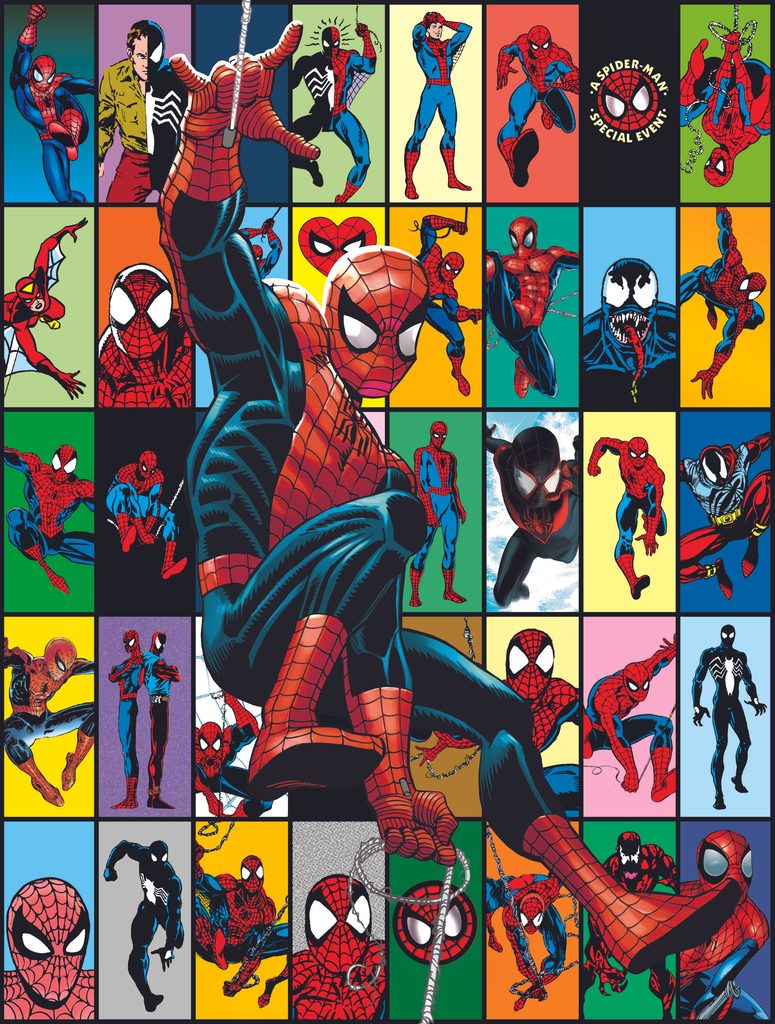
I ended up co-curating a second Marvel exhibition that opened in New Zealand. And in 2022, I co-curated the “Spider-Man: Beyond Amazing” exhibition, which was celebrating what was then the 60th anniversary of Spider-Man, and so I spent about a year with Spider-Man as pretty much my full-time job. After working on that, somebody recommended me to do [this] book… which was not a small task. When you’re talking about individual Spider-Man comics, you’re looking at between 7,500–12,000 individual comics, depending on how you want to count.
How is it digging through archives, both as a curator and working on the book?
It’s wild. Marvel has a digital archive but they don’t have a publishing archive… but there were also a lot of things that weren’t in Marvel’s digital archive… To actually look at the original issues and the ads, the cultural context, most of that research was done going through boxes at conventions, picking up issues, going through my own collection and that was a pretty mammoth task.
As a reader and a fan, I grew up knowing that… Stan Lee and Jack Kirby and Steve Ditko and John Romita did the Marvel comics. These things were made by people. And in working with Marvel, it’s been fascinating because a lot of the names I knew growing up are suddenly actual people I’m speaking to about their work.
Ultimately, I hope this is a book that works as a reference, that you can pull off the shelf if you want to look something up… I tried to write it in a way that sets up the story and follows it more or less chronologically. So… hopefully it works as a thing for that nerdy kid that I was and, as you can tell, still am.
Free news is good news!
Nearly $1 million a year goes into the work you’re reading—covering local government, spotlighting the arts, and telling the stories no one else does. If you value that, help fund it for $10 a month (or whatever tax-deductible gift you can afford). Click to save the free word.
