

Central Michigan University President Neil MacKinnon speaks during the 2026 State of the University Address in Plachta Auditorium in Warriner Hall, Wednesday, Oct. 28, 2026. MacKinnon outlined three priorities for the university: student success, innovation and change and a culture of care. (CM-Life | Ali
Central Michigan University expects international enrollment to continue declining as visa difficulties prevent international students from coming to the United States, President Neil MacKinnon said during his annual State of the University address Wednesday, Oct. 28, at the Plachta Auditorium.
“This is a national challenge where many international students that want to come in this country, cannot obtain visas,” MacKinnon said.”And we know some countries can be disproportionately affected, with those being in India, where majority of our international students come from.”
According to a Oct. 5 report from Central Michigan Life, the number of international students decreased by 497 students from the fall of 2025 to 2026.
“So sadly, we do not see this changing,” MacKinnon said. “We will continue to see a decline in international enrollment.”
Despite the challenges, CMU has seen domestic enrollment stabilize after years of decline. MacKinnon said domestic enrollment grew 0.9% over the past four years, while peer universities continued to see declines. He said the university expects domestic enrollment to grow over the next four years.
“This is a remarkable turnaround,” MacKinnon said. “I am very optimistic about our future.”
MacKinnon said the university’s Strategic Enrollment Management Plan (SEM), which outlines strategies to increase enrollment over five years, has helped increase enrollment. MacKinnon said the university has now completed 63% of the plan.
MacKinnon also organized his address around three themes: student success, innovative change and a culture of care. He discussed efforts to improve student support, attract potential students and strengthen the university’s campus community.
“We believe it’s an unbeatable package,” MacKinnon said.
He said the university is working toward student success and innovation through programs like COMPASS (Community, Outreach, Mental Health, Persistence and Student Success), a program developed by the university’s Counseling Center that trains students to support their peers in areas such as mental health, anxiety, stress and overall well-being.
He said that about 500 students received hands-on suicide prevention training during the past year, more than 2.5 times the number trained the previous year.
“The state of our university is resilient,” MacKinnon said. “And we are well positioned for the challenges of tomorrow.”
MacKinnon also said Go Grants and Keep Going Grants help improve student success by funding programs developed by CMU faculty and staff.
The university has invested nearly $1 million in more than 45 initiatives. He called the first Go Grant Symposium in Febuary, where the first 27 grant recipients shared the programs impact, “one of the highlights of this entire academic year.”
MacKinnon said the program’s value extends beyond the financial guarantee, building on services such as career counseling, internships, study abroad and leadership development.
The university is also working to align academic programs with workforce needs such as theDigital Strategy Minor. MacKinnon said the 21-credit hour minor focuses on social media content, creation, website analytics and content monetization, preparing students to pursue careers as social media influencers.
MacKinnon also said the Counseling Center provided support to 1,083 students, giving a “confidential, safe environment” to help students remain enrolled at CMU.
Fundraising and university growth
MacKinnon said CMU’s Forge the Future campaign has raised $237 million during its silent phase, which is double the amount raised in the university’s previous campaign.
According to CMU’s website, Forge the Future is a university-wide fundraising effort supporting student success, community connections and university initiatives. Donors could be alumni, community members or businesses.
“We are coming off back-to-back record-breaking years of fundraising for this university,” MacKinnon said.
The university is also working to expand academic and professional opportunities. MacKinnon discussed plans for the new College of Medicine building in Saginaw, Michigan. It is intended to bring medical education programs together and create new training opportunities.
“Industry buildings allow to ramp up and increase that class size and produce more positions for the state,” MacKinnon said.
CMU also joined the Detroit Promise as an unlimited partner in 2025 and partnered with the Lansing Promise in September. Both programs help eligible students access college scholarships.
He said the university is working to strengthen its presence in southeast Michigan and coordinate its community engagement efforts across the state.
“We want to create the body and kind of coordinate that, and to keep our approach cohesive and comprehensive,” MacKinnon said.
MacKinnon discussed anemployee value proposition developed using surveys and focus groups with faculty and staff. The initiative centers on three priorities: feeling valued, doing meaningful work and having opportunities for professional growth.
Last year, the staff turnover was 10.5%, the lowest CMU has seen in over a decade. He said this was something he has been working on over the past year.
“Of course we can always do better,” MacKinnon said. “But this gives reason for optimism. We want them to stay here for 20, 30 years.”
MacKinnon said the university asked employees questions such as, “What keeps you at CMU? What can we do better?”
He invited Dr. Rachael Nelson, a professor of exercise science in CMU’s School of Health Sciences, to speak about the university’s culture of care and the importance of building stronger relationships across campus.
“We’re all busy, we’re experts from our area, in our department, in our college, in our office,” Nelson said.
“And so providing those opportunities where we can get together outside those meetings with budgets and agendas is fantastic.”
Nelson said the opportunities such as ice cream socials, give employees an opportunity to connect outside of work.
His address concluded with a focus on the university’s long term culture and the importance of making employees feel valued and appreciated.
“If you work at CMU, you’re contributing to the success of our students, whether directly or indirectly,” MacKinnon said.
Following the address, members of Students for a Democratic Society displayed a sign and began chanting in front of faculty, students and other attendees before moving outside, where the protest continued with a megaphone.
From previous CM Life reports, SDS has repeatedly criticized CMU’s response to revoked visas from international students on Oct. 14.
Days later, SDS posted on their instagram on Oct. 19, advising students to attend the address and speak on protecting international students. The post said that CMU administrators are failing to bring in more international students because of the Trump administration.
At the protest, members chanted, “International students are under attack. What do we do? Fight back.”
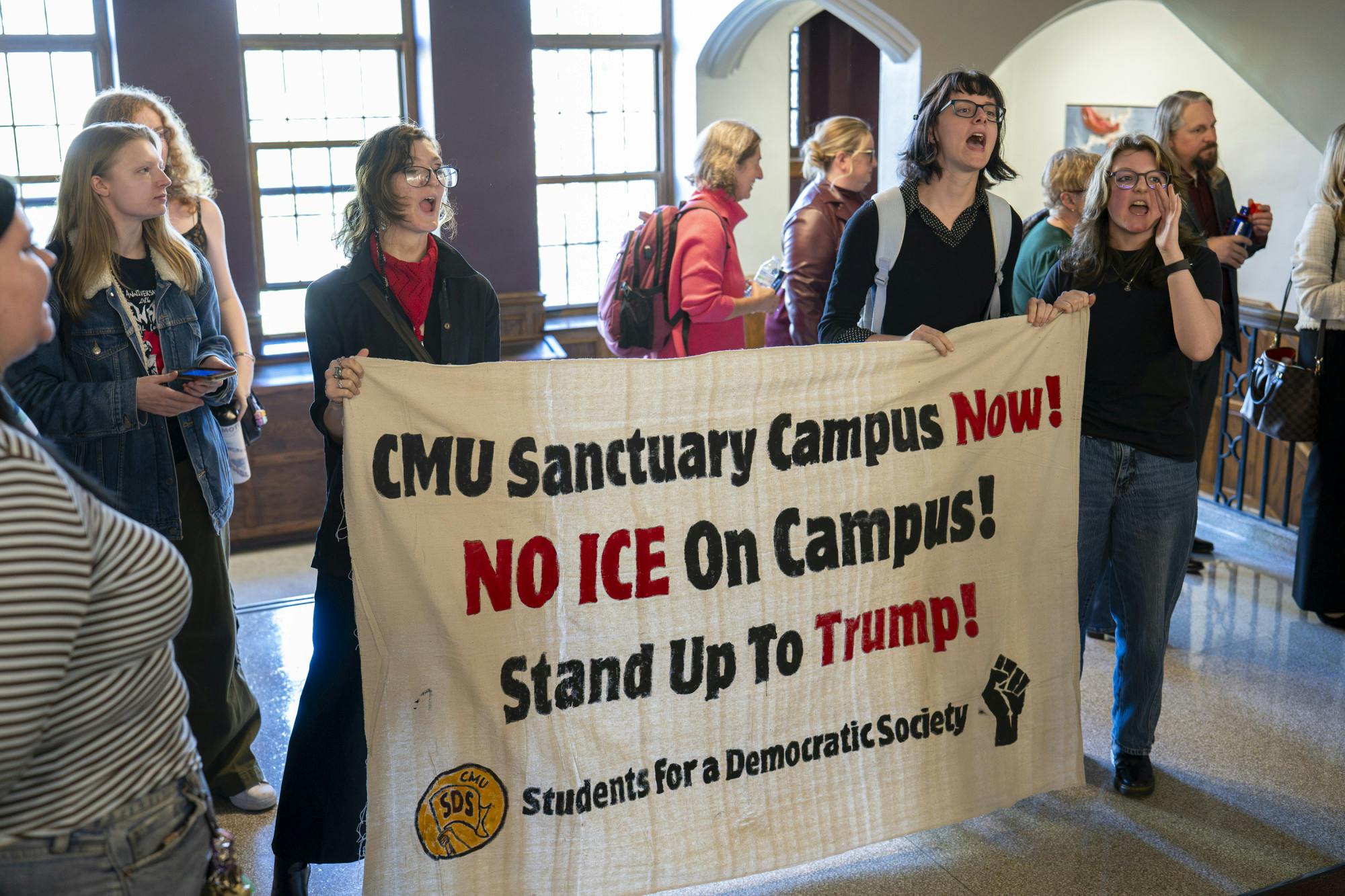
Central Michigan University Students for a Democratic Society (SDS) chant in Warriner Hall, Wednesday, Oct. 28, 2026. (CM-Life | Alivia Cranick)
