In March of 2009, I had just gotten married and nabbed the latest in survival horror, Resident Evil 5 on the PS3. With my new bride not being much of a gamer, she quickly found that she enjoyed sitting in the passenger role as spectator, puzzle-solver, and over-the-top analyzer. This was the beginning of my wife’s Resident Evil fandom despite never having played a single game. Later, I’d take her through the entire saga, including the original PS1 releases and their respective remakes. Shortly after we punched a boulder and destroyed Wesker, my wife and I wanted to find another game equally as enjoyable for both player and spectator. My best friend, who notably introduced me to Mass Effect, came in hot with another solid recommendation: BioShock. Having experienced the game nearly 2 years earlier on the PC, my friend knew it had just released on my platform of choice in 2008, the PlayStation 3.
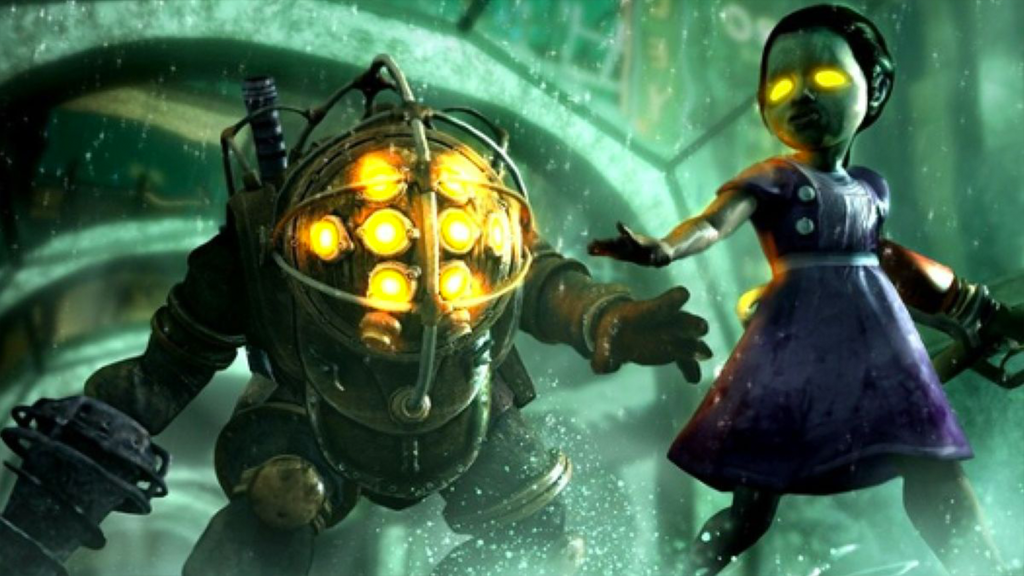
Knowing that my pal’s instinctively top-notch recommendations often hit, I followed his advice and collected my own copy of BioShock. Quickly, my wife and I were en-Raptured (I regret nothing) by the majesty of utopian civilization beneath the ocean’s surface. Upon our arrival, we found that this utopia was anything but. Quickly, we began to explore the horrifying and fractured halls of Rapture, a city developed by the anti-statist Andrew Ryan, who had grown disillusioned with the governments of nations and sought to develop a world free from their shackles. Ryan’s dogmatic approach to his own uncompromising and individualistic philosophy fostered a world perfect for virtual exploration and consumption. Early on, players were presented with choices, including the iconic binary quandary of harvesting Little Sisters to gain power or rescuing them from their physical and cognitive enslavement. Narratively, choice would prove to be an illusion as Ryan reveals that he’s pulled the strings all along. Now, the creator of BioShock and the team over at Ghost Story Games are looking to continue BioShock‘s legacy spiritually with the much-anticipated Judas, but with one key difference: true player agency.
BioShock’s Biggest Limitation is Player Agency
In drafting this piece, I originally titled this segment “BioShock’s biggest weakness is limited player choice.” But in all actuality, that isn’t a weakness when paired with the story that BioShock is trying to tell. The game’s biggest reveal, in fact, is that your character’s ability to choose was merely an illusion and that Andrew Ryan had brainwashed the protagonist into following his every command by disguising himself and prefacing his instructions with a key mental trigger, “Would you kindly…” It’s truly an astounding twist that smashed expectations and ultimately clashed with Ryan’s own espoused ideals of freedom and agency. The lack of autonomy speaks volumes about Ryan’s true motives and the veil he pulled over the eyes of the citizens of Rapture. So, technically speaking, control was always the point of BioShock. Without a tight player focus, the narrative wouldn’t have landed as spectacularly as it did.
The moment where players truly could be free is combat engagement. BioShock offered players several powers through Plasmids, an arsenal of weaponry, and environmental hazards that could be exploited. Upgrading these mechanics was a matter of choice in how players chose to engage with the hostile elements of the world. But mechanical flexibility isn’t the same as a player being able to control, or at least influence, the broader story. And even if the lack of narrative control worked well for BioShock, it is an actual limitation that Judas will seemingly abandon.
Judas is Expected to Enhance Player Agency
Last year, Ken Levine hopped over to the PlayStation blog to share some insight into the trajectory of Judas and how players will be able to interact with the game’s world, characters, and story. One of the most remarkable layers of Judas is that the villain isn’t cut-and-dry like past BioShock games. In fact, the player can influence what main characters can become the villain through story interaction (or the lack thereof). The idea is that players will engage with certain characters but ultimately alienate another, which will eventually lead to villainous complications. Levine remarks that Middle-Earth: Shadow of Mordor’sfamous nemesis system truly emerged as a game-changer wherein players could form small relationships with orcs depending on the trajectory of the fight and the leaders the player chooses to eliminate. It was a truly innovative AI system that clearly lent inspiration to the team at Ghost Story Games.
The narrative agency doesn’t stop and end with how players engage with the characters in Judas. In fact, Levine explained that it’s a two-way street. The main characters observe you, the player, and how you tackle the obstacles in the world. They will acknowledge and possibly be influenced by how you handle yourself in “combat, hacking, and crafting, but most importantly your interactions with the other two characters,” Levine shares. With all of these variables at play, it seems as if the development team must have a monumental task on their hands, weaving such an intricate web. Earlier this year, Levine explained to IGN in an interview why Judas has taken nearly a decade to develop, and it’s not because of technical advancements, generational leaps, or anything of that nature. It had everything to do with the complexity of the “narrative Lego system” that the team had to build. Judas has the potential for one story to shift into many stories, all fueled by the game’s reactive elements to the player’s choices. If Levine’s words are any indication, Judas‘s player agency will go far beyond branching paths we’ve seen in other titles such as Mass Effect, The Witcher 3, or even Telltale and Supermassive games.
Judas Could Make Replayability About More Than Different Endings
Games with different endings based on player choices have been happening for a long time. Some are more rudimentary than others. While the original BioShock had three distinct endings, we also have games like Baldur’s Gate IIIor The Quarry that have ending variations beyond the one-hundred mark. For a time, I truly believed that different endings could double or triple a game’s perceived replayability. But the truth of the matter is that I often hardly replay games just to see different endings. I usually turn to YouTube to see what I missed out on instead of starting again from scratch.
I believe Judas, however, can truly add replayability value with its level of narrative interactivity. Replaying a game will no longer be about seeing a different ending. Now it will be about experiencing an evolving relationship that could be legendary or turn dangerous and villainous. Instead of trying to see a single different (ending) scene, players will be compelled to see the entire progression of how different choices and play styles influence dialogue, game mechanics, and story development. Judas seems to truly be taking player choice in an entirely new direction. Plenty of games promise meaningful decision-making for players. Often, these decisions don’t have any true heft behind them when it comes to changing the script. Sure, we may hear some different dialogue, nab an extra reward, or see an altered scene, but Judas is so intriguing because of the high degree of possibility. Consequences will seemingly take shape before your very eyes and land long before major forks in the story or the end credits.
BioShock is a legendary game that challenged all of us to question just how much control we had over our own actions. It came with a gnarly philosophy that our supposed freedom had been engineered all along. The fact that Judas might seemingly upend this idea by taking this philosophy and running in the other direction with it shows just how ambitious and creative the team behind these games truly is. With the studio in the final stages of development, hopefully we’ll be hearing about Judas and a possible release date sooner rather than later. If the ambition behind the game proves to be fruitful, Judas might not only be a spiritual successor to BioShock, it just might be the next evolution in player agency that we’ve all been chasing for years.
Mass Effect 5 Developer Reveals New Details on Canceled Game
More Gaming
Image Courtesy of Ubisoft
Gaming
6 hours ago
Assassin’s Creed’s Future to Be Detailed by Ubisoft This Week
<img src="https://comicbook.com/wp-content/uploads/sites/4/2026/10/MARVEL-Cosmic-Invasion-_-DLC-2-_-New-Game-Mode-Trailer-1-17-screenshot.jpg?w=300" alt="Marvel Cosmic Invasion’s New Doctor Doom DLC Is Adding a Mode Perfect For Roguelike Fans“>Image Courtesy of Dotemu
Gaming
7 hours ago
Marvel Cosmic Invasion’s New Doctor Doom DLC Is Adding a Mode Perfect For Roguelike Fans
Courtesy of Electronic Arts
Gaming
8 hours ago
BioWare’s Shutdown Reflects EA’s Current Direction, & It Should Be Concerning For Fans Of Other Studios
Image Courtesy of Electronic Arts
Gaming
8 hours ago
Mass Effect 5 Developer Reveals New Details on Canceled Game
Courtesy of Arkane, Bethesda Studios, and Marvel Games
Gaming
10 hours ago
Marvel’s Blade Game From Arkane Gets Hopeful New Update
Gaming
10 hours ago
Insomniac Games’ Xbox Game From 2014 Just Got a New Update After 12 Years
Gaming
10 hours ago
Pokopia Leak Reveals Every Pokemon Being Added in Next DLC
Gaming
11 hours ago
Remasters of Two PS1 Games Announced for Nintendo Switch 2