Reading time: about 7 minutes
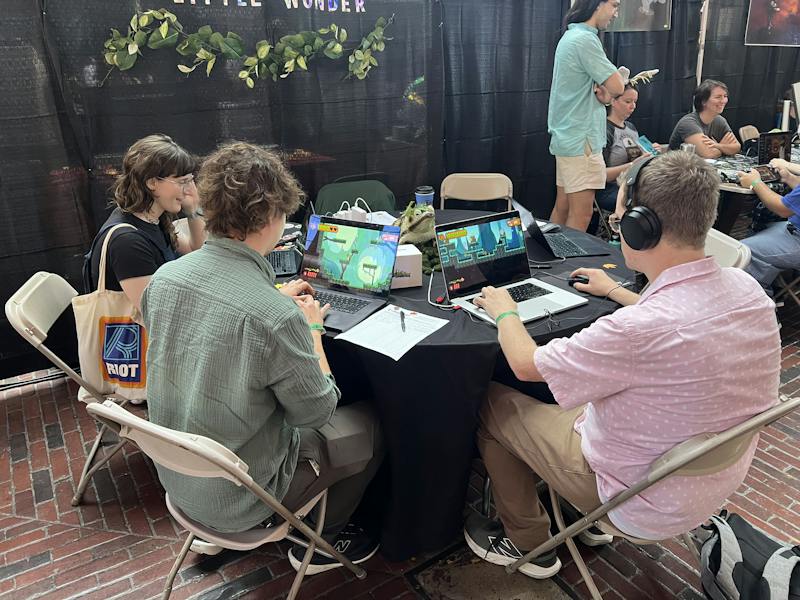
A gardening bee runs a potion store, a sentient acorn fights evil mushrooms to protect their dying mother tree and an artist battles against their own rogue tools to meet a deadline. These descriptions all come from the original student-made video games that represented Cornell at the Boston Festival of Indie Games on Oct. 3.
Three digital games from CS 3152: “Introduction to Computer Game Architecture” were selected as finalists for BostonFIG, a highly selective annual festival where independent game designers are given the spotlight to premiere their projects to an audience of industry professionals and local video game enthusiasts.
The student games — BeeWitched, Little Wonder and Monsterpiece! — made up three out of twenty-one of the digital games selected for the festival.
“There may have been one other year that I had three teams, but now you’re talking … probably like eight, nine years ago,” said Prof. Walker White, computer science, who instructs the course. “It’s been a long, long time.”
CS 3152 — crosslisted with INFO 3152: “Introduction to Computer Game Design” — gives students first-hand experience in video game development. Students are split into groups consisting of both computer scientists and designers, bound together with the sole objective of creating a video game.
At the start of the Spring 2026 term, students were only given three weeks to learn the basics of video game design. By week four, their project proposals had to be finalized.
When asked if there were any limitations to what a group could create, White said that the students had the freedom to design whatever game they wanted, as long as the project could be finished in one semester and attempted to push the boundaries of game design. Personally, he prefers games that are entertaining to those that are simply technical.
“I don’t care how cool your algorithm is or how fancy your tech is,” White said. “If I can’t see it on the screen, if I can’t experience when I play it, it doesn’t exist.”
Groups spent the remainder of the semester rushing to meet weekly deliverables, ranging from non-digital prototypes to playable levels that the professor and teaching assistants would try to break.
“No one took it as just a class assignment,” said Christian Stefan Amadeo ’28, the project lead for Little Wonder. “It was great working with a bunch of people who really took it seriously and who also had fun together.”
Teams that found the most success were the ones that could bridge the gap between computer science and design the fastest. Most conflicts arose from programmers being unable to appreciate the work of the designers, or vice versa, White recalled.
Camille Beck-Belaman ’26, the project lead for Monsterpiece!, facilitated brainstorming sessions to connect the two contrasting sides of her team.
“We’ve had so many hours of just talking through ideas, throwing ideas at walls, and just trying to really make sure that everyone’s being heard,” Beck-Belaman said.
Only after a semester’s worth of extensive team-bonding and grueling work were the games in good enough shape to be submitted to BostonFIG.
The games chosen for BostonFIG each had to balance creativity with technical rigor.
BeeWitched is a potion-crafting and gardening simulation game where players help a bee named Alchie grow ingredients for his potion shop.
“It’s pretty similar to other kinds of restaurant management games, like Papa’s Pizzeria, that type of thing, where it’s re types of potions, which you need a set amount of ingredients for, which you grow in the garden,” said Sixinyang “Tom” Tian ’28, the programming lead for BeeWitched
The game is marketed as “relaxing and charming” on the official BostonFIG website, tapping into a cozy, pastoral-themed digital genre that has been increasing in popularity since 2020.
Little Wonder, meanwhile, is a platformer shoot-em-up that follows a sentient acorn warrior on a quest to save their dying mother tree from evil mushrooms beneath the forest floor.
Platformer shoot-em-ups are one of the oldest video game sub-categories, arguably debuting in 1978 with the arcade hit Space Invaders. In these types of games, players move freely through 2-D levels, shoot at enemies, and dodge attacks.
Little Wonder aims to combine the classic platformer shoot-em-up with a whimsical fantasy environment, partially inspired by David M. Bird’s “Becorns” photography. In the photography, Bird found natural acorns and twigs, glued them together and took aesthetic forest-themed photographs, positioning the acorns as sentient creatures.
“It’s his line of art,” Amadeo said. “And when I brought forth the idea of the acorn people, everyone was kind of on board.”
The final game, Monsterpiece!, follows an artist who has to battle sentient, aggressive tools in order to fill a blank canvas and meet a deadline. Players progress through the game by using a coloring tool to defend themselves from attacks. As a result, the blank canvas is filled by splatters of not blood, but paint.
“Monsterpiece! is a color-splotching fighter game with a slight puzzle side to it. We were inspired by MS Paint for a slightly retro look on the art side,” Beck-Belaman said.
Additionally, the music design for the game, developed by student Annabelle Ford ’28, took inspiration from Stardew Valley while also maintaining a more action-focused beat to fit the game’s battle component.
White believed that each game was selected for a different strength.
“Monsterpiece! is the most interesting in terms of gameplay. Little Wonder is the most traditional, but well executed in that. BeeWitched … is really going after sort-of a cozy game, non-traditional market, and doing that very well, and so they all got accepted for very, very different reasons,” White said.
The video game industry is a competitive field that generated a total revenue of $60.8 billion in just 2025 alone. BostonFIG helps connect passionate students with real-world industry professionals and provides a platform to showcase their games to potential new customers.
“There’s a lot of press there,” White said. “And so what happens is that sometimes people, they’ll go to these things, and the press will pick up on them. And if the kids have a Steam page or an App Store page, if they’re mobile, ready to go, they’ll get a lot of players after this.”
Tian thought that the most valuable part of being selected for BostonFIG was the professional development opportunities.
“I think it was definitely a learning experience for us, because there are other more established studios out there, making games, showcasing them, so there’s definitely a lot to learn,” Tian said.
Beck-Belaman, meanwhile, praised the inclusivity of the festival.
“I think it was also just really special to see people truly love something that we spent so long working on and really is our brainchild, in a way,” Beck-Belaman said. “And to see people who really care about the industry, who really do enjoy playing games, actually appreciate what we put out there was very special.”
BeeWitched is now available to the public for free on Steam. Little Wonder and Monsterpiece! are forthcoming, with estimated release dates in early 2027.
Insectapalooza: Inside the Wacky World of Insects

Seeing What’s Missing: A Cornell-Built Detector Reveals More About Materials