

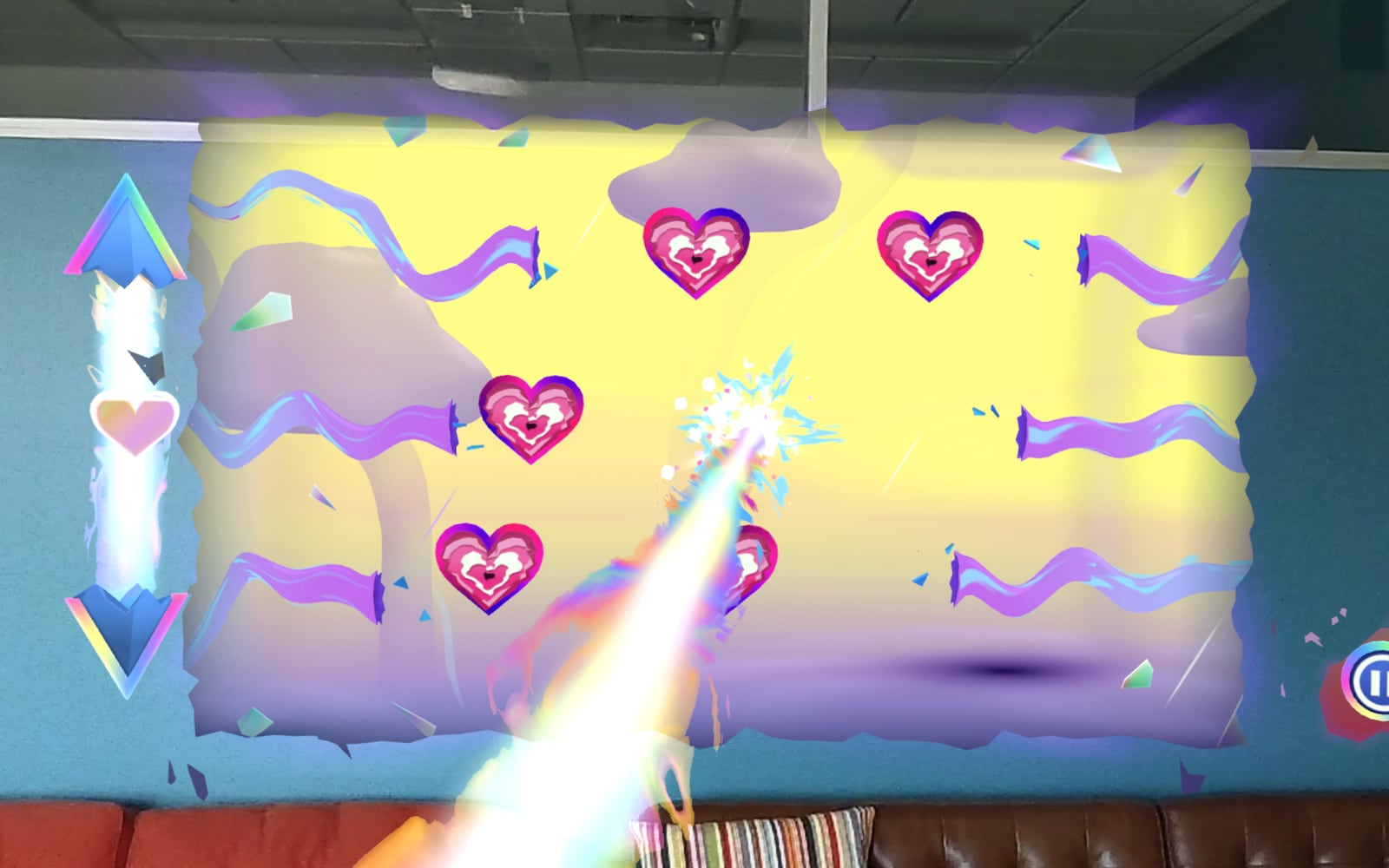
The game is Hyper Visor, which Owlchemy’s <a href="https://pressreleases.triplepointpr.com/2026/10/22/owlchemy-labs-reveals-hyper-visor-a-reality-bending-arcade-blaster-launching-on-xreal-aura/” rel=”nofollow noopener” target=”_blank”>announcement calls “an original XR arcade blaster” and prices at $1.99 on the Google Play Store. Its premise is the hardware itself. The player puts on “a mysterious pair of living shades” that reveal fractures hidden in their own room, then fires “an energy stream straight from their hands” through eight levels, each with its own targets, challenges and a boss standing in front of a rift. Road to VR, reporting the reveal, called it “decidedly more 2D-based than a fully immersive game,” and Owlchemy’s press screenshots bear that out: every level is a torn-edged rectangle hung on a wall, with the room visible on all four sides of it.
“XREAL Aura is essentially a pair of shades, which makes XR far more approachable for anyone who may have been hesitant to put on a headset before,” Andrew Eiche, Owlchemy’s chief executive, said in the release. He made the same case through what he calls the cafe test in a Game Developer interview recorded at Gamescom, and Evan Marcus took that interview apart here last week, agreeing that the headset is the barrier and arguing that the barrier, more than any studio’s choice of genre, explains this year’s layoffs. Hyper Visor is a product built on the half of that argument he agreed with.
What does “launch title” mean when the hardware has no date?
As of Thursday morning, Hyper Visor was not on Google Play. Owlchemy’s developer page there listed four apps: Job Simulator and Vacation Simulator at $19.99 each, plus Inside[JOB] and Dimensional Double Shift, both free. The release says all four come to AURA at launch alongside the new game, and its subhead puts Hyper Visor’s own availability at “when XREAL Aura launches.” That date has not been set. When XREAL named the $1,279 and $1,499 prices on October 7 it said only that shipping begins before the holidays in the United States, Canada, Japan and South Korea, and the AURA product page still says Fall 2026.
