

Warning: This article contains major spoilers for “VisionQuest” Episode 3, “Reboot.”
Through Episodes 3 and 4 of the newest Marvel Studios series, “VisionQuest” is certainly living up to its expectations as a “trilogy-capper” for this drama unfolding (mostly) on streaming. Picking up fairly directly from where “WandaVision” came to a close, the show’s plot borrows crucial elements from the storyline of “Agatha All Along” in order to continue the arcs of Paul Bettany’s synthezoid Vision and his wayward son Tommy (Ruaridh Mollica). But, more than anything else, the emotional heft of the series comes from their continued struggles to deal with the aftermath of the chaos unleashed by the missing figure at the center of it all, Wanda Maximoff (Elizabeth Olsen).
But did Marvel fans expect “VisionQuest” to address the events of “WandaVision” as frankly and with so little room for interpretation? To set the scene, let’s astral-project our minds back to early 2021. The studio’s first Disney+ series had just revealed that the sitcom-heavy antics taking place in Westview, New Jersey, had actually been the result of a witch’s hex, conjured up by a grieving Wanda to avoid dealing with the loss of her beloved Vision in “Avengers: Infinity War.” Of course, this essentially meant enslaving an entire town of innocents and puppeteering them into play-acting supporting roles in her fantasy world. Where some saw this as a villain origin story in the making, underlined by that post-credits scene showing Wanda dabbling with the Darkhold and teeing up her outright heel turn in “Doctor Strange in the Multiverse of Madness,” others viewed her as a victim of her own turbulent emotions and a hero who didn’t mean to cause harm.
Well, “VisionQuest” makes it abundantly clear where it falls on this divide, and it may come as a shocker.
VisionQuest Episode 3 sets the record straight on Wanda Maximoff’s actions in WandaVision
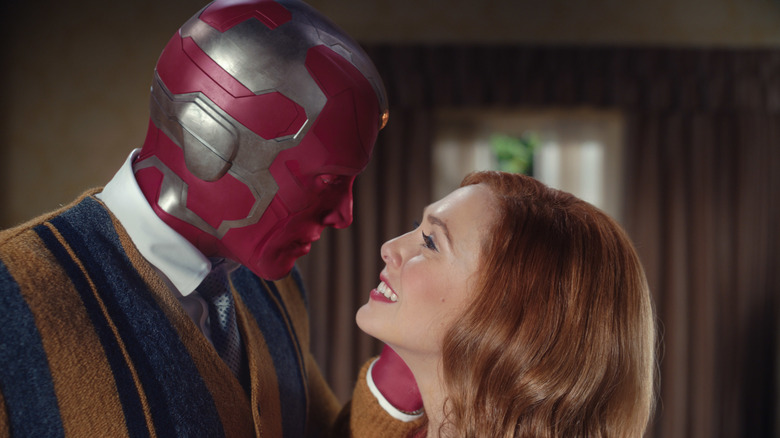
Is the greatest strength of the Marvel Cinematic Universe also its greatest weakness? The reaction to “WandaVision” in the immediate wake of the show’s conclusion would seem to suggest so. Audiences have always gravitated towards this franchise because of its charismatic and utterly likable characters, first and foremost. But, occasionally, a movie or series will attempt to challenge viewers and ask them to shift their perception of their favorite heroes just a bit … and, inevitably, these have usually ended up becoming some of the MCU’s most divisive entries. Granted, “WandaVision” is widely acclaimed by critics and fans alike, but controversy arose from how fans viewed Wanda’s actions while consumed by her grief.
Allow “VisionQuest” to weigh in on the matter. In Episode 3, titled “Reboot,” Vision attempts to connect with his estranged son Tommy and finally explain the truth of his origins. While mapping out the first in a series of simulations (although we don’t know that at the time), the synth tries simply laying out the bare facts of what happened — the hex, Wanda’s creation of her “sons” Tommy and Billy, and the idea that her actions throughout all of this were “morally abhorrent.” That last part is bound to ruffle some feathers among the fandom, even though it’s hard to say that Vision is entirely wrong.
Sure, he’s quick to clarify that he’s not the same Vision who experienced the events of “WandaVision” with her (given that he’s the so-called White Vision, reconstructed from Vision’s parts, rather than the idealized Vision conjured by Wanda). And, while he clearly shares the original Vision’s love and grief for Wanda, he’s less clouded by emotions. These traits, however, only make his objective perspective even more reliable.
Is VisionQuest fixing one of the biggest mistakes from WandaVision?
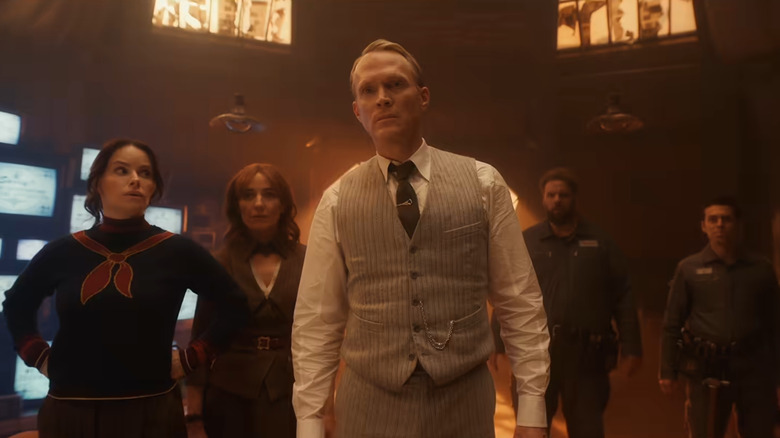
If we take Vision’s commentary on “WandaVision” as truth (or, at least, the truth as he sees it), what then does this suggest about “VisionQuest” as a whole? It raises the intriguing possibility that writer, director, and showrunner Terry Matalas might be able to pull off something remarkable. For those of us who liked but didn’t love “WandaVision,” perhaps this series might finally help fix one of the biggest mistakes the original series ever made.
At the risk of further inflaming an already-passionate fanbase, allow us to explain. I previously wrote about how the “WandaVision” finale fails its title character and completely lets her off the hook in the span of its concluding scene. Once the hex is lifted, her makeshift family disappears, and she’s forced to confront the angry townspeople she spent all this time controlling, Wanda remains impenitent and remorseless to the end — even to the point of the series reframing her as the ultimate victim. She’s the one who actually deserves gratitude from these people … never mind that she “saved” them from the mindscape hell she created for them in the first place!
It was a questionable, head-scratching thesis to end “WandaVision” on, but maybe “VisionQuest” could help set right that one glaring wrong. After all, it’s not necessarily judging Wanda and dismissing her as an irredeemable villain. It’s acknowledging her terrible actions, yes, but it’s also treating her creation of Tommy as an unequivocal good. Vision might not be the well-adjusted father figure that Tommy so desperately needs, but he’s trying. As he put it so eloquently in “Avengers: Age of Ultron,” there’s grace in his failings — and in Wanda’s, as well.
New episodes of “VisionQuest” stream on Disney+ every Tuesday.

1 Comment
Pingback: Daler Mehndi row: Sona Mohapatra recalls singer’s ‘disappointing’ Delhi show amid Uttarakhand controversy - Comic Vibe