


Another New York Comic Con is in the books (or more accurately, your cloud photo dump) and some people loved it, some people hated it and most loved and hated it simultaneously, like me.
I love the energy, the passion, the friends, the costumes, the buzz. I hate the crowds, the lines and over all commercialism. NYCC might more accurately be called “The New York Festival of Brands,” as the floor is increasingly taken over by giant booths from giant brands looking to connect with consumers. Walmart, Ebay Live, WhatNot, Citizen, TikTok, and pop culture related ones – Webtoon, Marvel, DC, Scholastic, Hasbro, Funko, VeeFriends, Topps, and so on. An increasing number are related to collecting itself – PSA, CGC, Hot Flips. And of course lots and lots of manga/anime booths.
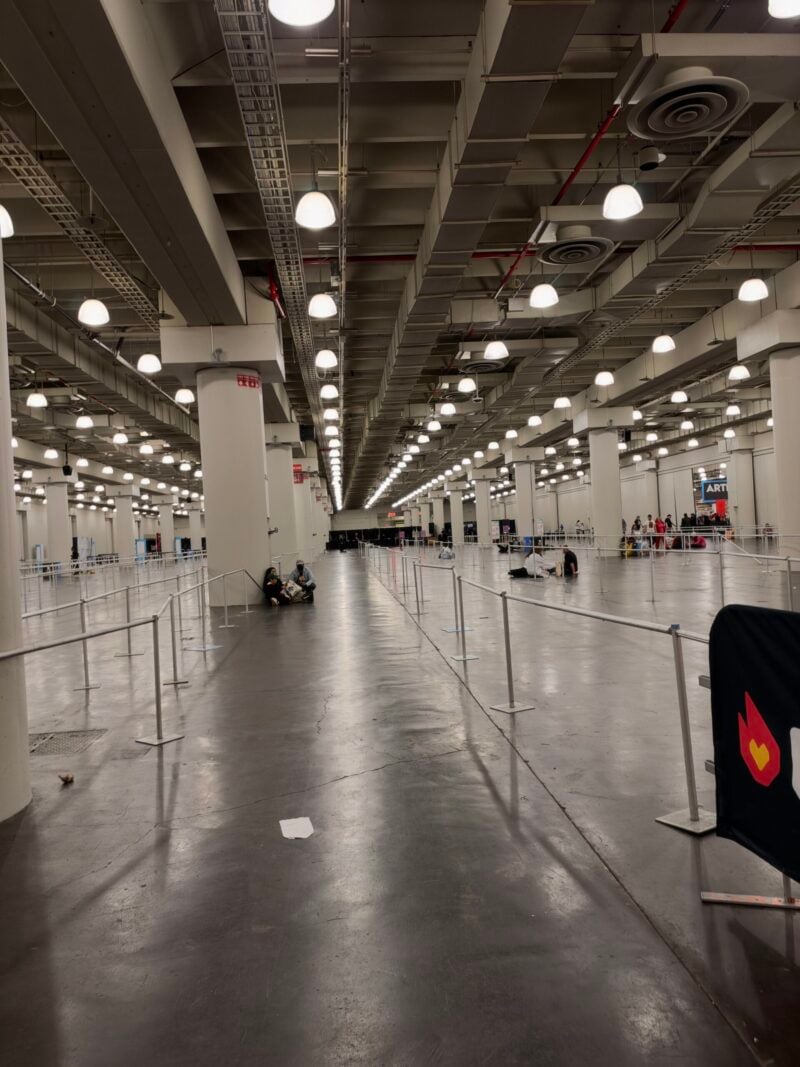
Most of these booths were impossible to see in their ideal state because of the crowds. It wasn’t until Sunday at 4 o’clock that I realized that instead of a giant Luffy balloon as in the past few shows, there was a giant frozen diorama of Loki’s legs, with an animated screen supplying his torso. Some extreme foreshortening, and hard to get the right angle if there were a lot of crowds.
Which there always were.
Before we get to the complaints, let’s talk about what worked! Over on Threads,@kandace_does wrote:
This doesn’t apply to every criticism of NYCC this year (bc there are def valid ones), but it seems like a lot of the complaints I’m seeing boil down to: “I wasn’t given enough free things, I wasn’t made to feel special enough, it was harder to get what I wanted.” I get that the thrill of buying is a pillar of all comic cons, but I don’t know, man.
Did y’all try connecting with other fans at meetups, giving compliments to artists you appreciated, learning something new at a panel?
Of course, any comic convention is what you make of it. Just feels like with the influx and prioritization of the studios/industry that a lot of the *community* aspect of cons has also been set aside by a great majority.
Celebrity signings and autographs are cool, sure. But geeking out with your fellow nerds and being kind to each other is also very fucking cool. It is also the *cornerstone* of fandom culture. (Regardless of what any megacorp wants you to think. They don’t create it, *we* do.)
Writer@workseen.copointed out that NYCC embraces all kinds of people and gives them spaces to feel comfortable even in the chaos (And a much fuller essay on the topic at their Substack.)
Every year, New York Comic Con makes HR and DEI conferences look embarrassing.
And every year I come home like: HELLO??? PEOPLE PEOPLE??? ARE WE SEEING THIS???
Because once again, I have receipts
Cold storage for medication! Quiet rooms! ADA access + priority seating! Scooter charging! Prayer rooms! Gender-neutral restrooms! Family spaces. Consent reminders EVERYWHERE!
Service animals are welcome. (Nobody tell SHRM, they might throw a fit)
And that is still not the full list.
But the thing I can’t stop thinking about is this: Comic Con knows it has a huge, diverse, multigenerational, multicultural audience, so inclusion and accessibility aren’t treated like cute little extras.
They’re part of how the event actually works.
Wild concept for the HR industry, I know!!!
These are very important things to remember: for every one complaining about costs or crowds, another person was meeting up with fellow fans and enjoying the community that NYCC still embraces. And the con’s commitment to providing services for all kinds of people and fandoms is commendable.
In the safe haven of the press room, I talked to one Italian cosplayer who had travelled all that way to experience the 20th anniversary show…and he was having the time of his life.
If you had a good time, I am very happy for you. I had a good time, too.
BUT. Looking at the price of tickets (for EVERYONE including comics pros), and the lack of space, the limits on programming and other issues, I find myself wondering just how sustainable NYCC really is?
To look at the big picture, there are two super shows in the US, SDCC and NYCC, both pop culture behemoths. Both suffer from the same issue: not enough space, and no way to make more money to offset rising costs.
SDCC showrunners have been begging for a convention center expansion for years, going so far as to warn that they might haveturn Hall H into exhibit space.
The reason for this is the capped attendance. SDCC has capped badges at 130,000 for years and years. As they repeatedly state, the only way for them to make more money is to charge more for badges, exhibit space and sponsorships. They’ve been reluctant to raise prices on badges so as not to freeze out fans of more modest means. A four day pass already runs $383 (minus fees) in 2026, with individual days at $85.
The Beat’s own Billy Hennehan did an analysis ofNYCC’s price rise this year,with a total of$321.17 for a four day badge. Individual days had dynamic pricing, however, with Thursday going for $93 and Saturday for $109.
Where NYCC really clamped down this year was pro badges: $180 for a full four day pass (you could get a complimentary badge for Thursday only.)
There was an immense amount of grumbling about this, and a lot of people refused to pay. But a lot did. And I’ve heard that NYCC was really strict about getting people to pay for badges – no free rides. NYCC has charged for pro badges for a long time, and I can understand why: almost everyone can cobble together some kind of professional application in New York, and that would be hundreds of extra people straining the re
NYCC has the same problem as SDCC: a cap on space and ticket sales in a venue that was never meant for a huge consumer show and which has some of the highest costs to exhibit in the US. It’s a given that costs have risen a lot since the pandemic, and will continue to rise. So NYCC has the same concerns about how to cover costs from badges, floor space and sponsorships.
According to official PR from ReedPOp, NYCC 2026 had more than a quarter of a million attendees.
New York Comic Con (NYCC) welcomed more than 250,000 attendees to the Javits Center from October 8 through October 11 to celebrate the best of fandom and pop culture for the event’s 20th anniversary. With a star-studded lineup of your favorite celebrities, today’s biggest comic creators, must-have merch, mind-blowing cosplay, and more, NYCC drew visitors from around the world, boosting New York City’s economy by an estimated $91M, according to New York City Tourism + Conventions. What started in a single hall at the Javits Center overflowing with 33,000 attendees has grown into one of the world’s biggest pop culture events as NYCC brings together hundreds of thousands of fans annually for a four-day celebration of fandom and community.
You’ll notice the “more than” leaves a lot of questions. How many more than? 5? 5,000? NYCC is run by ReedPop, a for profit company, and they have never had a hard cap on attendance. NYC fire marshals seem to be a bit more open to looking the other way when a few extra thousand tickets are sold.
The result: the horrible crowds we’ve all come to know and fear.
In the past, NYCC has experimented with a lot of offsites. At one point they held programming at MSG and the Hammerstein Ballroom, many blocks away, or had satellite events at nearby event spaces. That seems to be a thing of the past however, for reasons that aren’t entirely clear.
Offsites and programming are important because they create foot traffic away from the show floor. Keeping people moving along, giving them a place to sit and chill. More places for those 250,000+ people just to BE. Without those places, NYCC will continue to be what was described to me by various people as “hell” or “a nightmare.”
That brings me to a more sensitive topic: like all entities in late stage capitalism, ReedPop’s mandate is to cut costs and make more money every year.
I want to stress that this is not on the ReedPOp employees who put on the show. They are all deeply caring about the event and are committed to putting on the best show possible. But there were signs of the cost cutting everywhere, starting withsunsetting Popverse. There seemed to be fewer people to do everything this year, includingsecurity at media panels. Talking to folks in the comics area, I heard multiple stories about needing more security or badges but being told they would have to pay for them. In one case this was for a camera crew filming a promotional video.
One of the biggest cutbacks was the lack of any kind of printed map for the show. The printed programming guide has been gone for years, but at least a little map would be a useful thing when wifi is bad (often) or phone batteries are low. This was a topic several people brought up at the Talk Back panel, and the ReedPop folks on the panel seemed noncommittal about bringing it back.
The VIP experience has also lost its luster. A four day VIP badge costs $990, which is a pretty big investment. While I take Reddit complaints with a grain of salt, VIP perks seemed to be one of the main areas of dissatisfaction. From Threads again,@belle_bibioltherapy:
Sharing this with @bornfromthetree ‘s permission because people considering VIP deserves to hear what happened at #NYCC2026. Several(12+) of us purchased VIP tickets at significant cost, and no one actually received a single signing reservation we actually wanted. For example my partner and I BOTH ranked two experiences as our 1st and 2nd choices for 4 days and between us didn’t get ONE. Yet regular ticket holders were able to them. To be clear, I’m happy for them,it’s not about that.
They did nothing wrong. But then exactly were we paying a premium for? Because my biggest issue isn’t that VIP didn’t guarantee every signing. It’s that the benefits we were sold appear to have fundamentally changed AFTER people purchased their tickets. “First access” became “priority consideration” in a lottery. Umm, those aren’t the same (and was either an exaggeration or a falsehood) based on what I saw. I’m local so imagine fans who flew in for this and paid for stays,fare,etc.
Similarly, VIP panel access was advertised w/o reservations, but attendees were subsequently turned away because rooms were at capacity. Obviously, fire safety must come first, but why wasn’t space reserved? You can’t market a premium experience around specific privileges, change how those privileges work after taking people’s $, and then act as though customers received what they paid for. I’m tired of this enshittification and people being treated like this while corporate profits soar.
What bothers me even more is how unnecessarily stressful and inaccessible some of this became. @bornfromthetree had to line up at 3:30 AM on NYC streets (opening being at 8am for it) to try to secure an experience (Sunrise) despite having paid for VIP. My partner arrived around 4 a.m. and still missed out. They only had 98 tickets and never mentioned any of that. I also personally witnessed people using wheelchairs arrive on time with their wristbands and leave empty-handed.
Once again, people complaining that they didn’t get enough free stuff, is nothing new and has to be weighed against what was actually available. According to the website, VIP tickets grant “Reserved seating in our Empire and Main Stages. You must arrive 25 minutes prior to the start of each panel to guarantee your seat” which seems pretty straightforward.Still, arriving in the middle of the night and still not getting the event you paid $1000 for would annoy anyone.
I’ve heard similar complaints about VIP perks from folks who go to Fan Expo shows. And that’s really where we’re going with this. Fan Expo events are solid, entertaining shows with lots of celebrities, but they aren’t “super shows” like NYCC. (Fan Expo Canada is huge, but I’ve never been, so I’ll reserve judgement on that.)
A lot of people of all kinds – pros and fans – felt that the 20th anniversary celebration was “lackluster,” and certainly the programming was just the usual this year. Most of the panels seemed to be promotional in nature, unsurprising, but with New York’s access to the coolest people on earth, so much more could be done. Every year I hear about panels with amazing guests that get rejected, but given the lack of programming space, it’s inevitable.
Programming is NYCC’s most problematic area, and it got a lot more problematic in 2026 when longtime programming head Alex Rae left to join PSA back in June and several folks including new hires had to step in and try to pick it up. NYCC gets thousands of panel submissions and can only select a few hundred. The emphasis on community and participation means that there are also a lot of workshops, meets-ups, and things like “Padawan Saber Training.” Throw in the necessary panels for exhibitors, publishers and promotions, and you have very few spots left.
The split between professional programming and pin trading does seem to be a good idea. So many creators and pop culture professionals attend the show, and giving them dedicated networking space is highly useful. But just hiding out in the Press Lounge for five days seems like missing out on a lot of cool things.
I do find myself wondering though: what is the future of NYCC? Given the corporate mandate to make more money every year, how can they do that AND make it a better experience for everyone? While final attendance is always a slippery number, it has to be capped at some point, and we have reached that point.
We’ve gone far beyond that point.
NYCC can’t sell more tickets, so the only way to make more money is to raise prices on everything – and everyone says the show is already too expensive. Unless they start having more offsite activities (which cost a lot of money because this is New York after all), the crowds will continue while the amenities will get worse.
One little news bite that that I missed over the summer is thatReedPop has a new head, Marie Browne,who has moved over from their B2B side.In an interview with Varietyshe teased the show going to five days, a move that is already well under way. She also had this to say:
“One of the things that we’re teasing a little bit for next year is really exploring if we’ll offer a Wednesday ticket,” Browne says. “I would say that’s still under exploration. Potentially, we would open it up to press and professionals at first — but not to keep it exclusive because we don’t want to do that. We want to make the event more inclusive. If anything, we would be doing it as an experiment to make sure that we’re doing it right. Anything that we add to the event, we’ll test with the fans first to make sure it’s right. And if it’s right for the fans and it’s right for the event, we’ll consider launching it because we have very little room to grow within our existing venues, so we have to figure out how to grow in other ways and most of that will be with probably deeper experiences than a bigger physical footprint.”
Figuring out how to grow in other ways is going to be a tough one. The large and elaborate booths on display in 2026 definitely can offer a deeper experience, but who will pay the price?
SDCC and NYCC are both larger than life carnivals of fandom and creativity. Attending either one is a difficult, expensive journey, but a rewarding one that is unique and unduplicated.
As someone who worked on the first two NYCC’s as a consultant, I’ve always had a vision for the show. The current event is far from that vision but that’s okay – 250,000 people can’t be wrong. But inflation, the problems with the Javits Center itself, and ReedPop’s own corporate mandates make putting on the show a series of compromises, and it isn’t going to get any easier.

3 Comments
Pingback: 'Big Bang Theory' stars were 'outraged' over request to take pay cut for new co - Comic Vibe
Pingback: The NYCC Musical Trailer Premiere For The Princess Murders, Leaked - Comic Vibe
Pingback: Hayden Panettiere 911 Calls Detail Frantic Attempts To Save Her Life - Comic Vibe