

https://p.dw.com/p/5NVcB
In a dark underground hideout, dim light spills from a handful of oil lamps. A comrade fiddles with a rifle. A red flag hangs on one of the roughly hewn stone walls, bearing a hammer and sickle on a white star — the symbol of the ChineseWorkers’ and Peasants’ Red Army. Weapons are scattered on the ground. One is picked up, and soon the action moves into the snowy forest, where gunfire erupts among the trees.
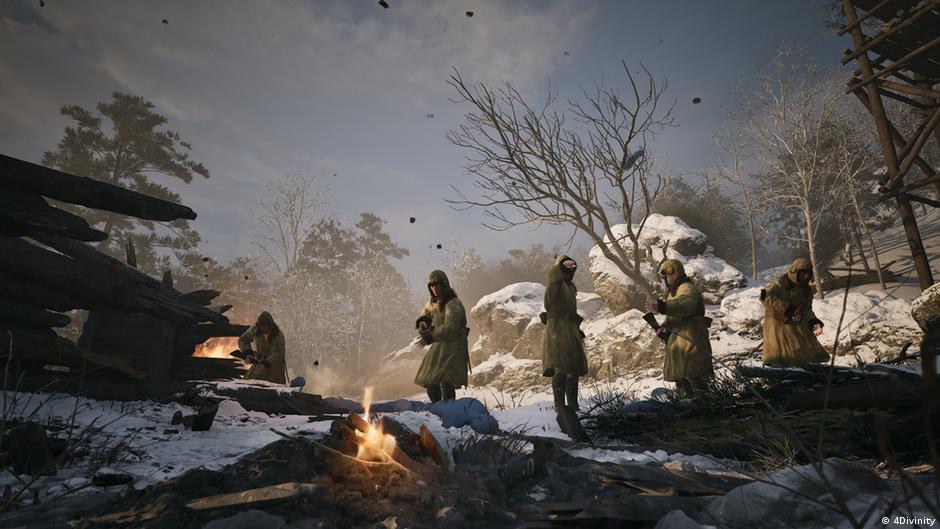
Such a scene could fit in a new installment of “Call of Duty,” the popular first person shooter game that transports players to battlefields past, present and future. But it is actually from “The Defiant.” The game is currently being developed by the Chinese studio Hoothanes Technology in Hangzhou. It tells the story of Chinese forces fending off the Japanese army in the 1930s and 1940s.
Developer Connor Xu tells DW the weapons featured in the game are unique. They were used only in Asia and are therefore unfamiliar to many Western players, he says. The same goes for the story, which Xu says has never before been told in a video game.
“The Defiant” is also designed to appeal to an international audience. In just a few years, China has emerged as a major player in the global gaming industry despite strict regulations, censorship and a former ban on video game consoles.
Gaming is part of everyday life in China
More than 700 million people in China regularly play video games. According to market research company Newzoo, most consider gaming an important part of their lives. Many use games to stay in touch with friends.
“Games make life more interesting,” developer Xu says. “I can try different roles, different stories, different characters, because we only have one life to live, but we can play a role in another story. That’s really attractive, I think, to Chinese users.”
People in China primarily play games on PCs and smartphones, while consoles are much less common. There are historical reasons for that: While gamers in Europe and North America debated whether PlayStation or Xbox was the better console in the early 2000s, the devices were not officially sold in China between 2000 and 2014. Chinese authorities said the restrictions were intended to protect children and teenagers from becoming addicted to gaming.
Limits on gaming time and extensive controls
Minors in China are currently allowed to play online games for no more than three hours a week. There are no such limits for adults, but gaming is subject to strict controls. Anyone who wants to play must register using their real name and a personal identification number. That effectively allows the state to track who plays what and when, as well as whom they communicate with.
There is also a gray area that the Chinese government appears to tolerate. Some players log in using VPNs, giving them access to games that are not officially available in China. Some younger players use their parents’ accounts to get around the limits on gaming time.
Despite its strict controls on underage gamers, China has become increasingly receptive to video games in general, having recognized the industry’s enormous economic potential. Early on, games released for Chinese players often appeared to be copies of Western titles. At the same time, Chinese tech companies such as Tencent and NetEase invested in numerous Western gaming companies.
No license? No sales in China
One distinctive feature of the Chinese market is its licensing system. “Unlike a lot of the other big video games markets in the world, China has a tightly regulated and licensed official video games market,” George E. Osborn tells DW. The journalist advises NGOs and governments on video games and spoke at the Gamescom congress. In his book “Power Play,” he describes how authoritarian states use video games to pursue political objectives.
The rule for all games in China is simple: No license, no sales. “That system essentially forces developers who want to release their video games to go through multiple layers of approval from China’s Ministry of Propaganda, Ministry of Culture,” Osborn says.
Strict criteria for video games
Games are prohibited from containing material that threatens China’s unity, sovereignty or territorial integrity, among other restrictions. Pornographic content and gambling are also banned. Games may not incite crimes that threaten national security or spread information authorities believe could disrupt public order.
“The whole point around this criteria is that it’s deliberately designed to be pretty vague,” Osborn says. Whether a game violates the rules is a matter of interpretation. Sometimes games are altered even after release. In the 2025 action role-playing game “Wuchang: Fallen Feathers,” for example, enemies based on famous Chinese figures from the Ming Dynasty suddenly could no longer be killed. Instead, they would collapse from exhaustion.
Chinese culture is an international hit
The Chinese action role-playing game “Black Myth: Wukong” became an unexpected international hit in 2024. By then, it was clear Chinese developers could do more than cater to the domestic market — they could create successful games for a global audience as well. The game was inspired by the 16th-century Chinese literary classic “Journey to the West.”
Osborn sees nothing wrong with bringing Chinese culture to audiences around the world. The question, he says, is how much the state actually intervenes in the games themselves. “I think in general, video game players are actually quite deeply skeptical of these kinds of things. They are generally very good at spotting when someone might be selling to them or someone might be propagandizing. And so I think if it’s too obvious, it won’t work,” he says.
The problem of self-censorship
Because of the licensing system, Western developers also have to comply with government requirements if they want to sell their games in China. And they do want to, Osborn says, because the market is too big to ignore. “But I think when you start thinking about the potential impact this has on creative standards around the world, I think it’s really important that developers ask themselves the question of what will we or won’t we compromise on here?”
He fears the real danger lies in self-censorship. That could lead developers, for example, to leave queer characters out of their games. That would represent a major step backward, he says, because games help many people explore their identities.
China is not the only country where games are modified to comply with national regulations. In Germany, for example, symbols that violate the country’s constitution, such as the swastika, may not be shown in games unless the game in question explicitly contributes to the country’s culture of remembrance. Depictions of extreme violence also have to be removed from German versions.
History from a Chinese perspective
Glorifying violence is prohibited in China, too, yet Xu’s team is still allowed to develop a war game. How does this add up? Xu explains it this way: “I think in this game, the most important thing is not violence. The most important thing is to tell history.”
Xu says the team is committed to delivering a historically accurate product. Whether it succeeds will be for historians to judge.
This article was translated from German and edited by Sarah Hucal.

2 Comments
Pingback: Exclusive | Willem Dafoe on 'Tenzing' and Why He Prefers Movies to Streaming Series: ‘They Don’t Hold Your Feet to the Fire’ - Comic Vibe
Pingback: WB Games Has Huge Expectations From Hogwarts Legacy 2, Says It Will Drive Gaming Growth - Comic Vibe