

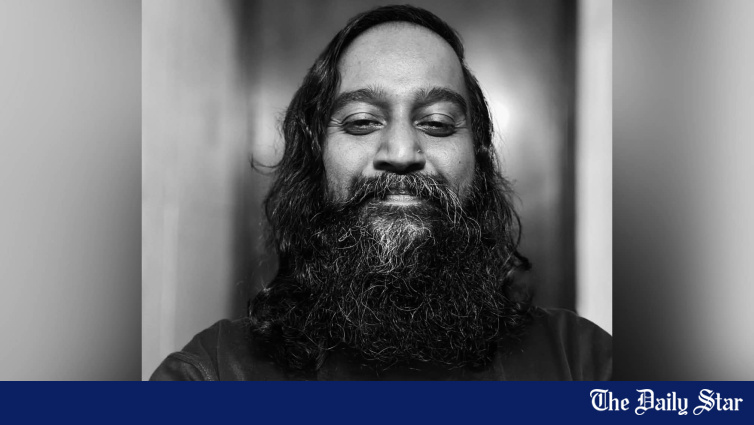
The year was 2010. I was up all night listening to songs, completely dazed, and I remember my body finally giving in around 7:00 in the morning after hours of staring at the screen. Doomscrolling wasn’t a word back then, but that day, the portmanteau Blunderware would be etched into my personal dictionary forever. I was scrolling with the last bit of energy I had when I came across the music video for “Afeem Chaash”. For the next two hours, I remained paralysed in my chair, listening to the song on loop.
Not long after, I got to meet the members of Blunderware at a small show on the Cofi 11 rooftop. That was when I first met Rushnaf Wadud. For the next five or six years, this man would become an integral part of my life.
In those days, Rushnaf truly seemed like a mystery. He would grace stages with his immaculate voice, charm the heck out of his audience and take them on a ride they couldn’t resist. He was full of knowledge, well-read, the <a href="https://comicvibe.com/the-best-vr-headsets-for-2026/” title=”The Best VR Headsets for 2026″>best writer I ever came to know and my favourite songwriter. He was laid-back and spontaneous. He was crazy and collected. He was a mad genius and a fool. These contradictions remind me of the time he told me about the theme of his album: duality. In retrospect, it makes sense.
I was a scrawny young adult, making trouble at home, never focusing on my studies and trying to find my own footing in music. It was the perfect time for me to meet the man who would become my mentor. Only a couple of years older, he spoke with a wisdom beyond his years.
Eventually, we grew close enough that I would follow him around the streets of Dhanmondi, going wherever he went just to pick his brain. I have fond memories of us lingering at the Goethe-Institut and Cilantro, talking for hours. He’d teach me about songwriting, tell me about artistes I should listen to and explain poetry to me. Things like the etymology of the word “matter”, which he traced to a word for mother, would open my mind to the possibilities of language and music.
For Rushnaf, I think these two were the same. I don’t remember how many languages he spoke, but I am sure he spoke one language all too well: music.
After a couple of shows, a lot of strolling, meeting people and securing himself a place in the hearts of many, he returned to India for a while, where he had spent much of his childhood.
He came back in 2011, and his return would solidify his identity in the music scene. His first show that year drew a packed audience eager to watch Blunderware. As if overnight, everyone seemed to know who they were, and the audience sang every word of “Afeem Chaash”.
Rarely does one get to see a sensation taking shape up close. I, on the other hand, was fortunate enough to witness it happening before my very eyes.
That year, something changed. The music scene had finally heard a new sound. Suddenly, rock and metal had competition, and people started coming to Blunderware shows. Organisers followed suit, promoting newer indie musicians.
It wasn’t just the band. Wherever Rushnaf went, he would be asked to sing. He always had something new to share, and we would go home with a new artiste to listen to.
I don’t think either he or anyone around him fully comprehended what was taking shape. But I definitely had an early hunch about the phenomenon unfolding, and I could bet my favourite guitar that if you trace today’s Dhaka indie scene back to its beginnings, this was it. Rushnaf Wadud was where it all came from.
Knowing Rushnaf, I know he wouldn’t agree. In fact, he would tell you that Arnob’s first album was what changed the music of our time.
I can assure you, that was not the case.
You see, our generation had plenty of indie musicians exploring new musical styles, but no one set us straight. No one told us, “This is how it should be, and you’re good enough to get it done.”
Rushnaf did.
As he was to me, he was a mentor to many others who crossed his path. The man had plenty of time in those days, and even after he found employment, it was at a popular radio station, where his network and influence grew further.
Rushnaf invested his time in meeting young people, seeking out those he could share his knowledge with, play music alongside and learn from.
Blunderware went through many lineup changes, and some of today’s finest musicians were associated with the band thanks to Rushnaf. I could mention names, but I think it’s best that I don’t speak for others.
Those who knew him and admired his work were always waiting for the Blunderware album to drop. As an insider, I can tell you that he wrote enough songs to fill several years’ worth of releases, both for his band and his solo projects.

For all latest news, follow The Daily Star’s Google News channel.
However, they never came to fruition. One thing or another always got in the way. In fact, the album was almost fully recorded in 2014, only for him to decide later that it wasn’t worthy of release.
I have many memories with Rushnaf, but eventually, we grew apart. Blunderware’s album never came out. I, on the other hand, was able to complete my band Orfred’s debut album.
The first person I know I should thank for that is Rushnaf.
I would like to think that those of us whose art and lives Rushnaf touched through his interactions are his true legacy.
Those of us who take the time to craft something new, refine our work over and over until it feels just right, and never try to fit in are the true progeny of Rushnaf Wadud and his beautiful teachings.
We all have a little Rushnaf in us. We are all cut from the same cloth.
Sadly, my dear Rushnaf bhai passed away on October 12 this year.
I wish there weren’t a word limit on articles because I really haven’t been able to sum up everything about him.
I just know that there is no limit to how much you can love a person, even when they are no longer around. I hope our love keeps him alive in our hearts and minds for a long time to come.
”… You must ignore the relentless, cruel tugging motion, Not the one at your heart, but ‘tween your fingers’ hold; And you must learn to let go of colourful things that fly, For what must fly must fly, and what must go must go.”
— Rushnaf Wadud, excerpt from his poem “To Elle, How I Told A Child At The Fair Of The Futility Of Balloons As Imaginary Friends”

1 Comment
Pingback: One Piece Chapter 1196: Release date and everything we need to know - Comic Vibe