

How the 1990s Console Wars Changed Video Games | HISTORY
How the 1990s Console Wars Changed Video Games
Nintendo and Sega’s fierce battle reshaped the video game industry and helped define a generation of gaming.

Gregory Wakeman
Published: September 28, 2026Last Updated: September 28, 2026
Companies like Atari, Halcyon and the Commodore had oversaturated the market with technically limited consoles and poor quality games. “Atari’s ‘ET: The Extra Terrestrial’ video game was returned in such large numbers they had to dump them in a landfill in a desert,” says Megan Condis, an assistant professor of game studies at Texas Tech University. “The industry lost billions of dollars and multiple companies exited the market.”
In 1985, Japan’s Nintendo helped turn the industry around with the Nintendo Entertainment System (NES). Hit games such as “Super Mario Bros.,” “Duck Hunt” and “The Legend of Zelda” helped win back consumers, while Nintendo marketed the NES as a toy rather than just another home electronics product.
Nintendo soon came to dominate the revitalized video game industry, capturing at least 80 percent of the market. In fact, the company became so closely associated with gaming that, rather than saying they were playing video games, people started referring to it as “playing Nintendo,” says Jess Morrissette, a professor at Marshall University who has studied the cultural significance of video games.
But Nintendo’s wholesome approach left an opening for other consoles. Soon, Sega would ignite a console war that would change the industry forever.
Nintendo’s Game & Watch Collection Makes History
Corey takes an interest in a seller’s collection of Nintendo Game & Watch handhelds, knowing collectors may try to squeeze an extra life out of them.
Nintendo vs. Sega
Nintendo had strict guidelines on what content could be shown in its games, prohibiting depictions of smoking, drinking, sexually explicit material and excessive or graphic violence, Condis explains. “It was almost like the Hays Code in movie history,” she says, “because they thought, ‘Kids are going to be playing, we can’t show any bad stuff.’”
In contrast, Sega branded itself as the rebellious alternative to Nintendo. However, Nintendo’s dominance in North America and Japan was so strong that the 1986 Sega Master System failed to break through with consumers, Condis explains.
It wasn’t until the U.S. release of theSega Genesis in 1989 that Sega finally started to rival Nintendo. One of the first consoles of the 16-bit era to reach the North American market, the Genesis offered more advanced graphics and immersive audio than the 8-bit NES. Sega showcased those capabilities in more violent games with action-heavy titles such as “Altered Beast,” “Last Battle,” “Thunder Force II” and “Super Thunder Blade.”
“The Genesis was seen as a system for teenagers and young adults, while Nintendo was a system for children,” says Morrissette. “This is best summed up by their famous ad campaign: ‘Genesis does what Nintendon’t’.”
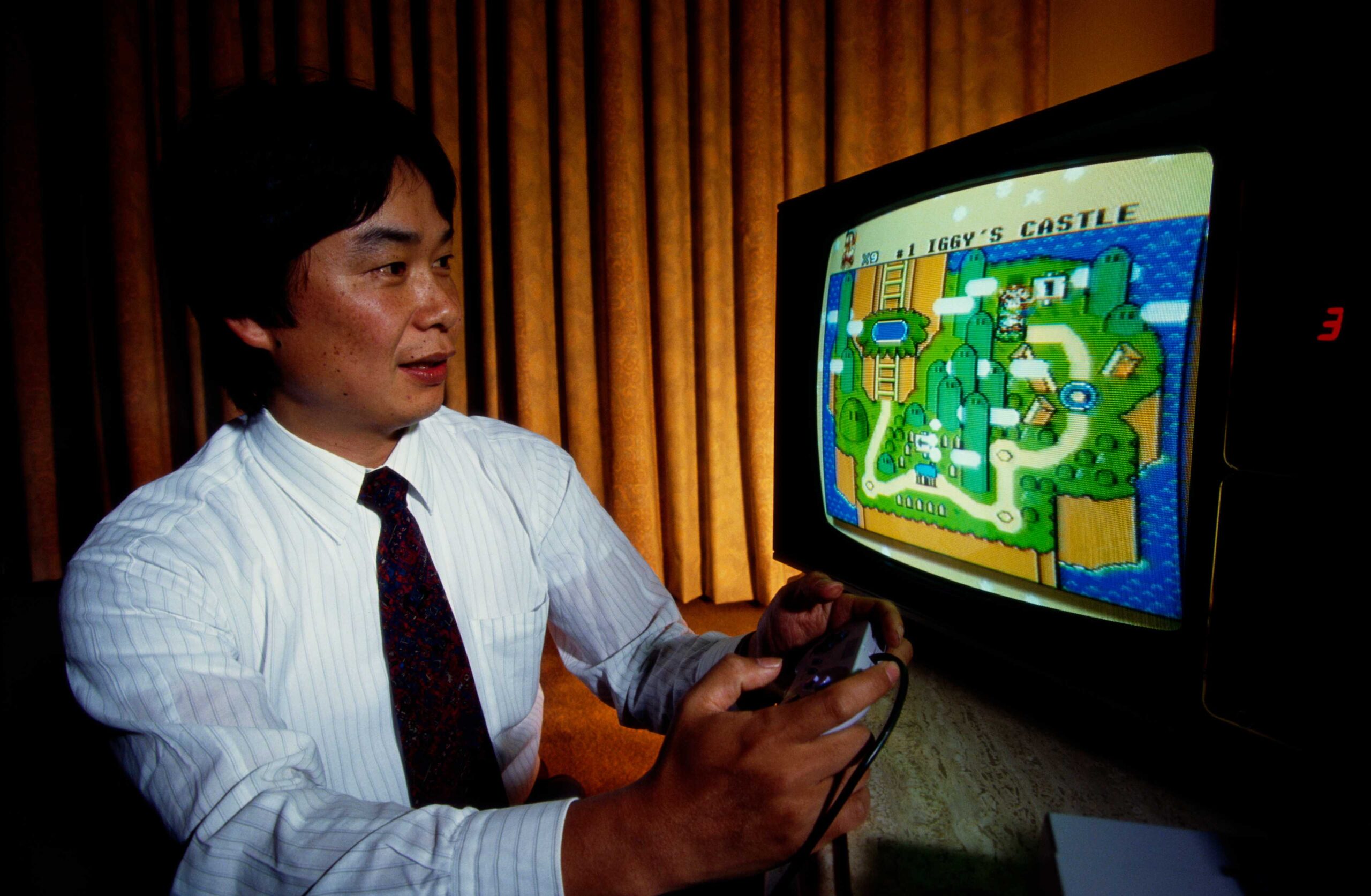
Shigeru Miyamoto, creator of Mario and other characters and video games for Nintendo, plays Super Mario World on a Super NES System.
Sonic vs. Mario
In June 1991, Sega released the first “Sonic the Hedgehog” game to highlight the Sega Genesis’ graphics and edgier image compared with the NES.
Sega created Sonic as a mascot who could serve as the face of the brand, much as Mario did for Nintendo, Morrissette says. Sonic’s speed was designed to highlight the console’s processing speed. “Sonic blasts through levels compared to the much slower paced Mario,” she adds. “That made the difference pretty clear.”
While Mario was always smiling and kid-friendly, Sonic would impatiently tap his foot and look at his watch if he remained idle for too long.
Sega Goes Gory
Sega emphasized sports games, including “Arnold Palmer Tournament Golf,” “Joe Montana Football” and “Pat Riley Basketball.” In 1990, Sega secured a contract with EA Sports to release its various sports titles for their consoles, such as John Madden Football and FIFA International Soccer. By promoting the Genesis as the go-to console for sports fans, Sega sought to appeal to an older audience, Morrissette says.
The U.S. release of “Mortal Kombat” on the Sega Genesis and Super Nintendo Entertainment System on September 13, 1993, proved to be a pivotal moment in the console wars. Video game fans wondered how the consoles would depict the classic arcade game’s blood and violence.
“Nintendo released a sanitized version that removed the blood and took out the gory fatalities,” says Morrissette. Although Sega also released a censored version, a secret code re-enabled them. It soon became an open secret that the Sega Genesis had the real version.
This is what secured Sega’s status as the console for teenagers. “There was even a survey where kids said, ‘I don’t want to tell my friends at school that I have a Nintendo because it’s embarrassing’,” says Condis.
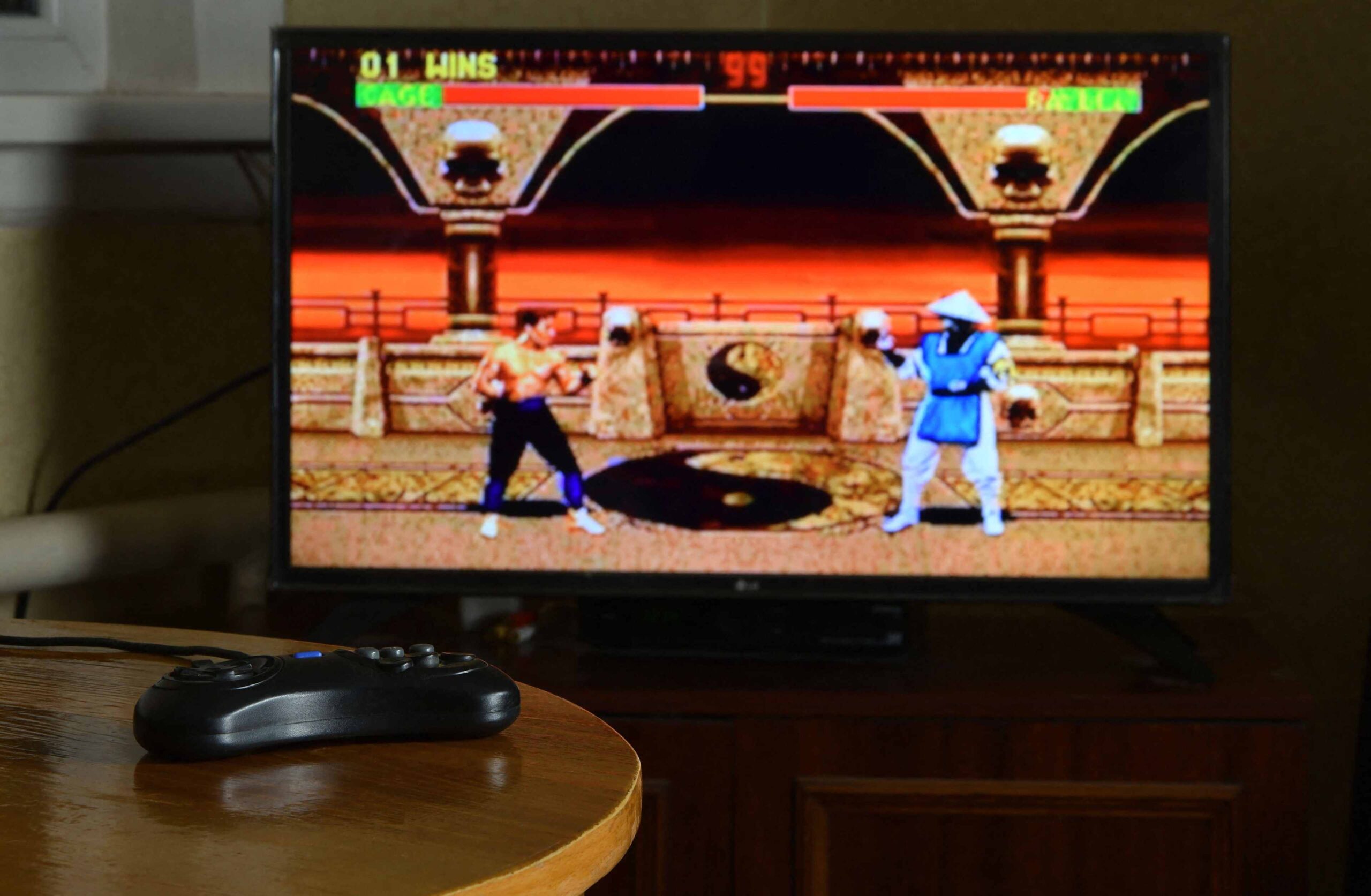
Sega Genesis video game controller on table with Mortal Kombat 2 on the display.
Nintendo Fights Back
In 1991, Nintendo released the SNES, its first 16-bit console, in the United States. Although the SNES was a success upon its release, thanks to games like “Super Mario World” and “F-Zero,” it initially struggled to catch up with the Sega Genesis. By 1992, Sega had surpassed Nintendo’s North American market share.
Nintendo, however, was confident that its well-known characters and franchises would help it withstand Sega’s challenge. “Nintendo wasn’t willing to completely shift its brand identity. Their appeal to the entire family is still very much the same today,” notes Condis.
It was the release of “Super Mario All-Stars” in August 1993 and “Donkey Kong Country” in November 1994 that reinforced the strength of Nintendo’s established franchises. These games showcased the SNES’ three-dimensional graphics, music and gameplay.
Sega Stumbles, Sony Takes Over
Between May 1995 and September 1996, three new consoles arrived in the United States, reshaping the battle for gaming dominance.
In May, 1995, Sega surprised people with the sudden release of the Sega Saturn. “They essentially released it several months earlier than promised,” says Morrissette. “But it hits the market very early at a high price tag and with very few launch titles.” Consumer confidence in Sega had also wilted in the previous years as they repeatedly released add-ons, upgrades and expansions to the Genesis that were of middling quality, adds Condis.
Just four months later, Sony released the PlayStation in the United States. Not only was it $100 cheaper than the Saturn, but games like “Tomb Raider,” “Resident Evil” and “Tekken 2” helped establish its appeal among teenagers and adults. “A lot of their marketing was for full blown horror and fighting games, as well as sports simulations, that showed their graphic capabilities,” says Condis. “It also had a sleeker design that looked good under your television.”
The Saturn never took off with consumers. As PlayStation became the console for older gamers, Sega’s dominance faltered. “By that point Sega wasn’t really competing with Nintendo.” says Condis. “Their competition was Sony and the Playstation,” remarks Condis.
Melissa Weinberg, 7, and 81-year-old Joe LoBue play “Pokémon Puzzle League” on the Nintendo 64 in 2000.
With the release of the Nintendo 64 on September 29, 1996, Nintendo brought Mario, Donkey Kong and Zelda to a new generation. Thanks to its 64-bit processor, the console could handle 3D graphics and support four-player games like “GoldenEye 007” and “Mario Kart 64.”
The original PlayStation ultimately sold more than 102 million units worldwide, compared with nearly 33 million Nintendo 64 consoles. Only about 9 million Sega Saturn consoles were sold worldwide.
While they tried to fight back with the Dreamcast in 1999, Sega was unable to find a place between Sony and Nintendo. In 2001, they exited the console hardware market.
Over the next 25 years, Sony emerged as a major force in the video game industry with five generations of PlayStation consoles. Nintendo, meanwhile, has continued to draw on its established characters and franchises and perform strongly with handheld portable consoles like the Game Boy and Nintendo Switch.
Advertisement
Advertisement
Advertisement

HISTORY EducationHISTORY Vault™HISTORY AppsHISTORY en Español®Military HISTORY®Newsletter Sign UpShare Your OpinionsFAQ / Contact UsAdvertise with UsA+E Factual Studios™A+E Studios®Employment OpportunitiesAccessibility SupportTV Parental Guidelines


Advertise with UsA+E Factual Studios™A+E Studios®Employment OpportunitiesAccessibility SupportTV Parental Guidelines
Terms of UsePrivacy PolicyCopyright PolicyCookie NoticeAd Choices
Advertisement
Advertisement
Advertisement

1 Comment
Pingback: Roblox downgraded, Royal Caribbean upgraded: Wall Street's top analyst calls - Comic Vibe