

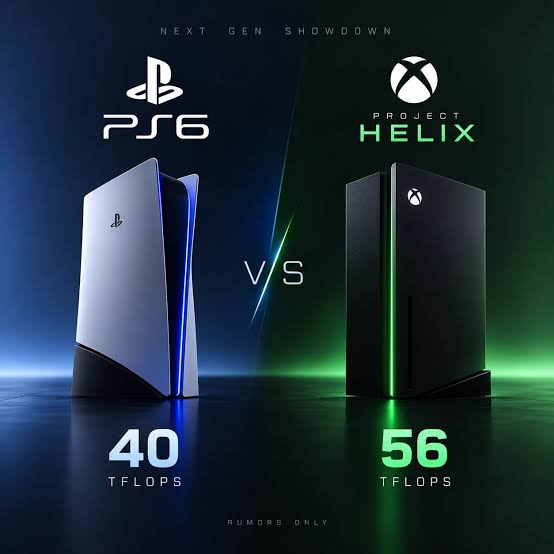
Xbox Helix Is 40% Faster Than PS6, and That Could Ruin Next-Gen Consoles
ByJinPublished about 6 hours ago•6 min read
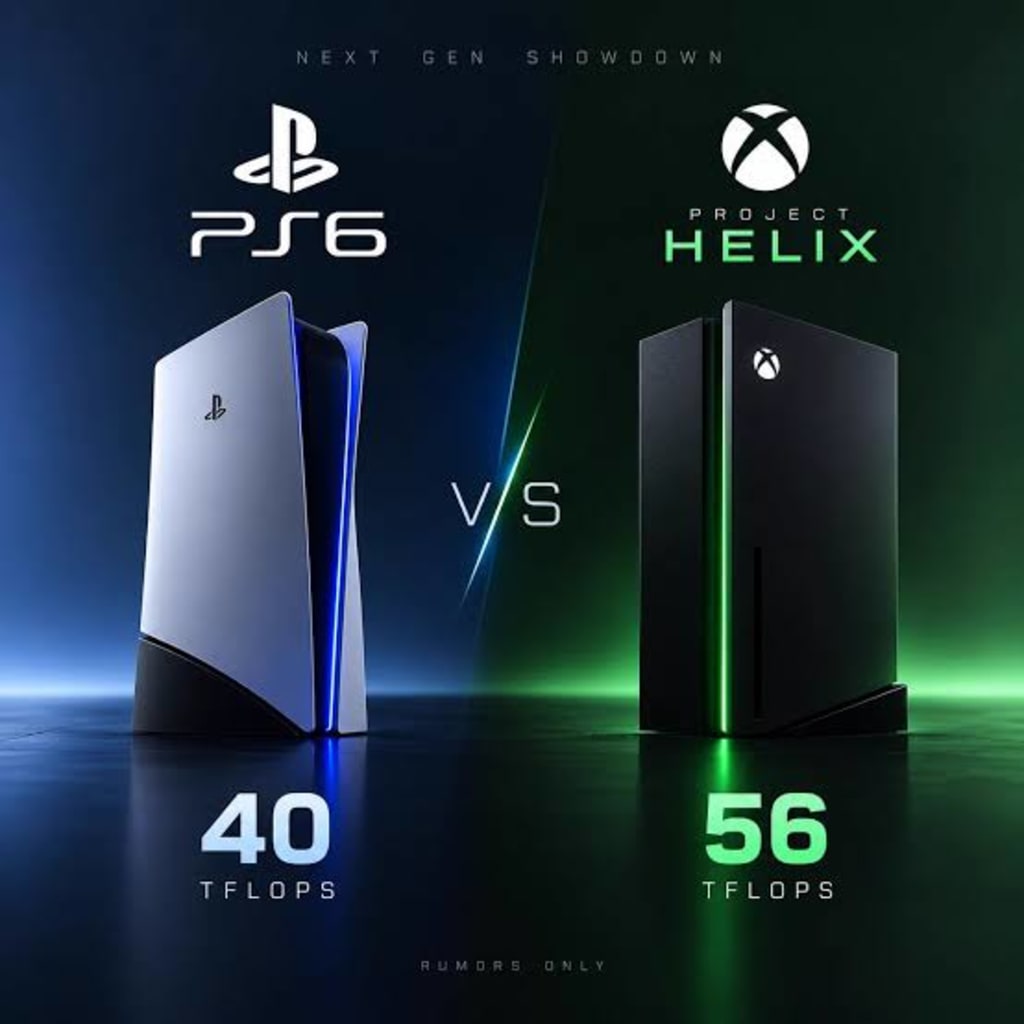
The Cost of 56 TFLOPS: Xbox Helix Is 40% Ahead, and That May Not Matter
In September 2026, AMD leaker Kepler_L2 released a set of numbers. The PS6’s FP32 compute is 40 TFLOPS. Xbox Helix’s is 56 TFLOPS. On paper, that is a 40% gap. The RTX 5080, a current high-end desktop GPU, has an FP32 compute of roughly 56.28 TFLOPS and sells for nearly 10,000 yuan. The PS6’s 40 TFLOPS sits between the RX 9070 and the RX 9070 XT. On paper, Microsoft’s next console has caught up with a flagship graphics card.
But the focus around these two consoles quickly moved from which is faster to who can still afford one. When the 56-TFLOPS Helix and the 40-TFLOPS PS6 face the same question, the average player’s wallet, the arms race changes.
How Much of That 40% Paper Lead Reaches the TV?
Xbox Helix has 68 RDNA 5 compute units, with GPU clocks above 2.5 GHz. The PS6 has 52 to 54 CUs, clocked at 2.6 to 3.0 GHz. Helix’s GPU is about 25% to 30% larger, and with higher clocks, the 40% TFLOPS lead holds on paper.
TFLOPS has never been equivalent to frame rate. Kepler_L2 said the gap is not enough to double frame rates. PS5 chief architect Mark Cerny has discussed compute inflation and pointed out that TFLOPS is not the best way to measure a device’s performance. This generation offers an example. The PS5’s paper compute is about 20% lower than the Xbox Series X’s, yet the real-world gap in games is tiny. Ray-tracing efficiency, AI acceleration units, and software optimization do not show up on a floating-point balance sheet.
Helix has another variable. It is positioned as a hybrid of console and gaming PC. If it runs a customized Windows and natively supports Steam and the Epic Games Store, then part of its performance will go toward PC-side overhead. The paper advantage that lands in actual games could shrink to between 10% and 20%. That is not a gap the eye can discern.
Cost Is the Real Decider
In March 2026, Kepler_L2 estimated the PS6’s bill of materials at $760. At the time, a $699 MSRP still seemed possible. Three months later, that number rose to about $960, a 26% increase. Sony’s likely response is to launch the PS6 at $900, absorb a small launch loss, and recover it through game purchases and PS Plus subscriptions. The PS6 uses a monolithic design, with a die area of about 280 mm², on TSMC’s N2 process. Structurally, it is restrained.
Xbox Helix is more complicated. It uses a chiplet design: a 144 mm² SoC plus a 264 mm² GPU, for a total area of about 408 mm², on TSMC’s N3P process. Chiplets can improve yield, but packaging is more complex and the overall manufacturing cost is higher.
Memory is the biggest cost. MLID’s original leak said the Magnus chip needs twelve 4GB GDDR7 modules. Even under the most optimistic replacement scenario, using 3GB modules, the procurement cost of the GDDR7 modules alone reaches $720 to $840. That number already exceeds, or comes close to, the price of an entire Xbox Series X.
The memory market is going through an AI-driven supercycle. Since mid-2025, DRAM and NAND costs have risen by 766% and 471%. A single 3GB GDDR7 chip costs between $60 and $70 to procure. The previous-generation 2GB version cost about $20, an increase of more than 200%. Micron has discontinued 2GB GDDR7 modules and kept only the more expensive 3GB version. AI data centers’ demand for high-capacity memory has swallowed much of the consumer market’s capacity. Game consoles are at a disadvantage in this resource fight. AI companies will pay prices that look irrational to secure supply. Console makers have little bargaining room.
TSMC’s N3P foundry pricing is 16% to 24% higher than N3E. Orders for 3nm lines are booked past 2026, with capacity at full load. MLID estimates Helix’s mass-production bill of materials at about $900. $999 is the aggressive floor. $1,200 is the most likely price. Kepler_L2 puts Helix’s expected price above $1,000.
The Business Model Deadlock
Traditional console logic is simple. Sell hardware near cost, or at a loss. Recover profit through software sales and online-service cuts, usually 30%. Sony’s PS6 continues that logic. Sony is willing to launch the PS6 at $900 and take a launch loss because it has PS Plus subscriptions and first-party game revenue. Even with rising costs, Sony still has a slight-loss plan: a BOM of about $960 and a price of $900.
Microsoft chose another path with Helix. Helix is positioned as a custom gaming PC that supports third-party platforms such as Steam and the Epic Games Store. Microsoft cannot take a 30% commission from game sales on those stores. If a player buys a game on Steam, the money goes to Valve.
Two consequences follow. First, Microsoft loses the ability to subsidize hardware losses through software revenue, so Helix’s price must stay closer to cost. Second, if Helix becomes a SteamBox for users, its profit must come entirely from hardware sales. Otherwise Microsoft keeps losing money across its hardware business. The loss could exceed 1,000 yuan per console, a rate that is hard to sustain without software subsidies.
Microsoft’s bet is to absorb the Steam user base through an open ecosystem, monetize through Game Pass subscriptions, and tie players to Windows. The logic holds in theory. It faces a practical question. When a console costs $1,200, why would a player not buy a gaming PC?
A $1,000 Console and the Market
Ampere Analysis predicts that if the PS6 and Xbox Helix launch at $1,000, the two platforms’ combined sales over five years will fall 38% compared with the same period of this generation. That is a gap of about 39 million units. Player spending on game software and online services would also drop 12%. By 2031, the entire PlayStation and Xbox ecosystem would shrink by $3.4 billion.
This generation’s market structure offers a reference. As of June 30, 2026, PS5 sales exceeded 95 million units. Estimates put the Xbox Series X|S install base at about 35 million, a ratio close to 3:1. Shipment trends are worse. Forecasts put Xbox Series X|S shipments in 2026 at only 2.5 million units, down from 3.2 million in 2025.
If next-generation consoles double in price while compute gains do not produce a sensory leap, persuading existing users to upgrade will be harder than before. If performance improves in small steps and price jumps, consumers will vote with their wallets.
This Generation May Stick Around
The PS5 and Xbox Series X|S may remain the primary consoles into 2029 or even 2030. That is no longer just player wishful thinking. Industrial reality is forcing it.
On the supply side, memory prices are expected to keep rising in 2027. DRAM and NAND per-Gb prices are projected to rise about 39% and 34.6% year over year. If manufacturers wait for costs to fall before launching new hardware, the wait may be long. Epic Games CEO Tim Sweeney has warned that the global game industry faces its worst downturn since the 1980s. AI’s siphon effect on capacity will not ease soon.
On the demand side, next-generation consoles priced close to a mid-to-high-end PC face more alternatives than ever. PC handhelds like the Steam Deck and ROG Ally, along with cloud gaming, are eroding the traditional console’s role as the living-room entertainment device.
The Competition Has Changed Shape
Xbox Helix’s 40% paper compute lead over the PS6 is not in dispute. In the 2026 industrial environment, that lead looks costly. It means a larger die, more memory modules, more complex packaging, and a higher price.
Sony and Microsoft face the same cost crisis with different answers. Sony stays relatively traditional. It uses restrained hardware design and an absorbable launch loss to keep pricing competitive, while seeking growth through handhelds. Sony has confirmed the PS6 will use a dual console-and-handheld design, with the handheld reportedly priced around 600 euros. Microsoft is trying to change what a console is. It wants Helix to bridge console and PC, trading ecosystem openness for long-term platform value.
Neither path is clearly better right now. Both point to the same trend. Next-generation console competition will be decided less by compute and more by who can find a sustainable business model in this cost crisis. If Helix’s 40% paper lead cannot solve its pricing problem, that lead may become forum chatter instead of a living-room choice.
A $1,200 console sits in the living room. Next to it is a PC at the same price. The player’s hand will decide. That decision matters more than the gap between 56 TFLOPS and 40 TFLOPS.
combataction adventurefact or fictionconsolearcade

1 Comment
Pingback: Anime Content Creation Tools Market Forecast to 2035, Driven by Streaming Demand and AI Integration - News and Statistics - Comic Vibe