

Cartoons, by their nature, have a shorter shelf-life than most anything else in popular culture. Ask someone just a couple of years younger or a couple of years older than you, and they probably remember a nearly-completely different assortment of childhood animated series. There are a few major exceptions: Disney’s Mickey Mouse and friends, Warner Bro’s Looney Tunes, and Hanna Barbera’s Scooby-Doo. Debuting in 1969 on ABC, Scooby-Doo, Where Are You!launched a still-running multi-media franchise, with its five central characters still recognizable pop cultural mainstays after fifty-six years. The franchise has expanded into feature films (with the live-action Scooby-Dooduology a cult classic for younger generations), video games, and soon, live-action television, but for longer than any of these, Scooby-Doohas also existed as a comic. As a comic, Scooby-Doois one of just a handful of franchises that has been published by both Marvel and DC, but years before either, the Mystery Inc. gang made their four-color debut in Gold Key’s 1970 Scooby-Doo, Where Are You!#1.
Videos by ComicBook.com
Scooby-Doo’s enduring popularity has a surprisingly major impact on the Gold Key comic’s value: Scooby-Doo, Where Are You!#1 is listed in many price guides and hobby sites as one of the most valuable comics of the Bronze Age, with its record sale price of $12.6k outpacing the value of iconic Marvel key issues like X-Men#101 or Amazing Spider-Man#121. Comparatively, the first comic book appearances of other Hanna-Barbera characters of the same era, like The Flintstonesor The Jetsons sell for less than half of that, even in high grade. Price non-withstanding, these books are significantly rarer than super-hero comics of the same era: twelve graded copies of Scooby-Doo #1 exist in a 9.2 or higher, as compared to more than two-thousand copies of Giant-Size X-Men#1 in the same condition. Scooby-Doo’s first appearance is a perfect combination of rare and iconic, driving the comic’s value up significantly. When a high-grade copy comes to market, as with a 9.2-graded sample on auction at Heritage next week, prospective buyers bid accordingly. With almost a week left in the auction, it has already smashed the Overstreet Price Guide’s estimated value for the comic, already at $13.4k and climbing.
A Closer Look at Scooby-Doo’s Surprisingly Long Comic Book History
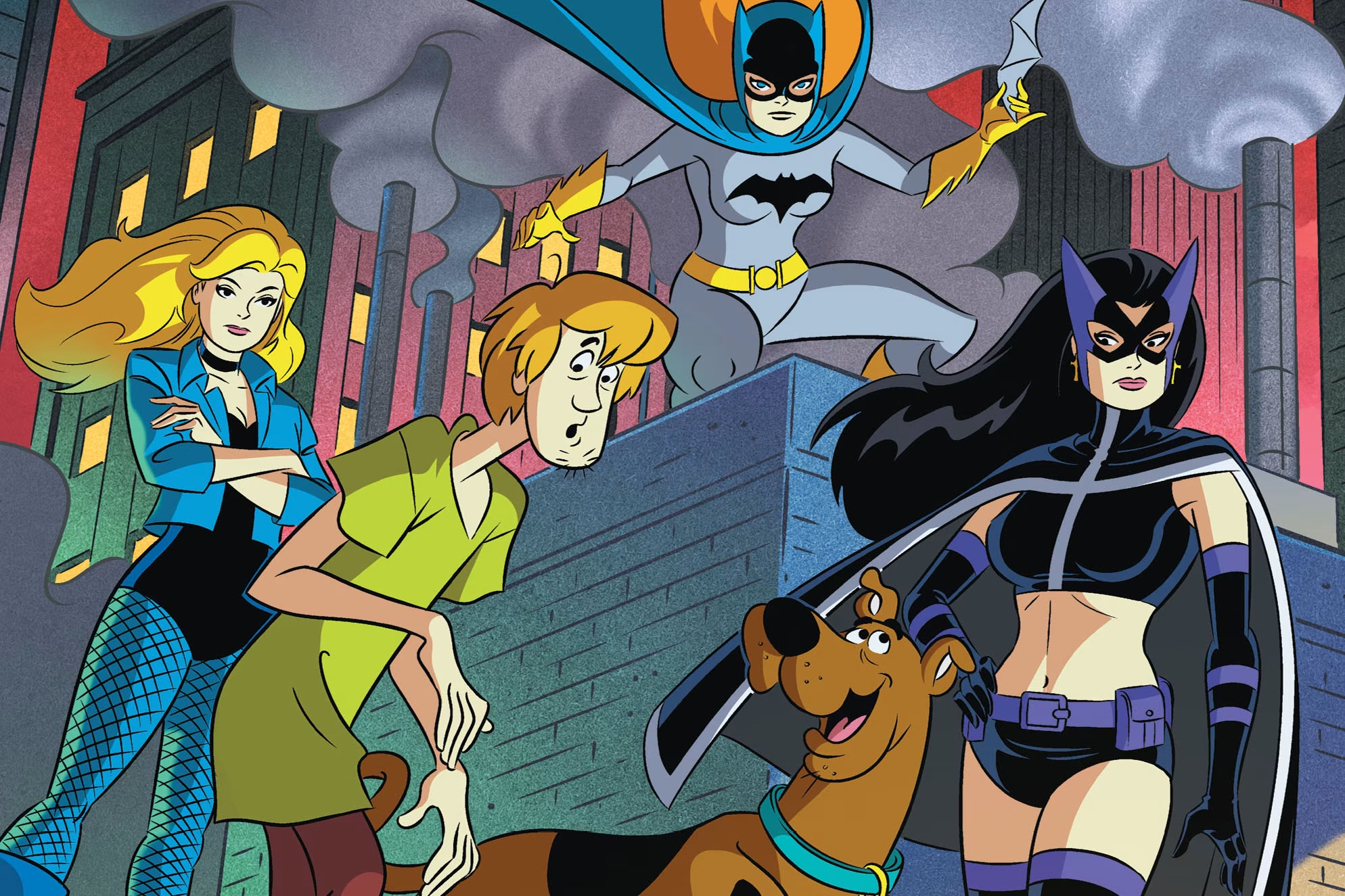
Gold Key’s Scooby-Dooseries lasted for thirty issues, running until 1974. The stories were a mixture of adaptations of episodes of the Scooby-Doo, Where Are You!series and new material; the first issue consisted of adaptations of season one episodes “What a Night For a Knight” (the series’ debut) and “Never Ape an Ape-Man.” As the comic lasted longer than the series, which was cancelled in 1970, it eventually ran short of material to adapt, necessitating the shift to original stories. Gold Key cancelled the comic in response to wavering sales, Hanna-Barbera moved the license to Charlton, a lower-budget publisher, the originator of several cult favorite DC characters like Blue Beetle, the Question, and Peacemaker. The Charlton Scooby-Doolasted for eleven issues, running throughout 1975 and 1976. The license changed hands for a third time in 1976, moving over to Marvel Comics, who began publishing their own Scooby-Doo comic in 1977. Apocryphally, the shift was because of the poor quality of Charlton’s inks and papers, which made it difficult for Hanna-Barbera’s international partners to reprint the comics for overseas audiences.
After the Marvel Comics series ceased publication in 1979, Scooby-Doocomics entered a fourteen years period of dormancy, revived in 1993 as reprints of Charlton-era issues. In 1995, Archie Comics would briefly take over the comic book rights to the franchise, publishing a twenty-one issue regular series notable (or notorious) for being the only Scooby-Doocomic to feature the much-maligned Scrappy-Doo as a member of Mystery Inc. Archie would lose the license to DC Comics in 1997, following a 1996 corporate merger that made Hanna-Barbera a subsidiary of DC’s parent company, Warner Brothers. The property has remained with DC since. DC’s 1997 to 2010 Scooby-Doocomic series lasted one hundred and fifty-nine issues, making it the longest-lived Scooby-Doocomic from any publisher. It was relaunched as Scooby-Doo, Where Are You?in 2010, and was only cancelled last year, after one-hundred and thirty-two issues. Both were standard Scooby-Dootitles, featuring mysteries and monsters in the vein of the characters’ televised adventures.
The best use of the character in the comic book medium would come in 2013, with DC’s sublimely ridiculous Scooby-Doo Team-Up, an immensely underrated title that paired Mystery Inc. with a different DC Comics or Hanna-Barbera character each issue. Lasting from 2013 to 2019, it ran for fifty issues, and its guest-stars ran the gamut from the requisite Batman and Robin to impressively deep cuts like Angel and the Ape. Each issue was an incredibly fun, low-stakes throwback to the DC Comics of the Silver and Bronze Age, and the run maintains a cult favorite reputation among hardcore fans of DC and Hanna-Barbera alike. It does mark a significant departure from the Mystery Gang’s other adventures, as, when facing off against Solomon Grundy or teaming up with the Phantom Stranger, the ghosts and monsters they’re facing are no trick. Due to a limited print run (about a quarter of the size of many other DC Comics of the past decade), back-issues of Scooby-Doo Team-Up are hard to come by, and it is one of the more difficult and costly runs in recent publishing history for a collector to assemble.
What Makes Gold Key’s Scooby-Doo#1 So Rare?
With any vintage collectible, rarity is often the result of no one having the foresight to anticipate a secondary market and hold onto an item. Coupled with demands, this limited supply drives value. By the early 1970s, the growing popularity of comic book conventions, fanzines, and letter pages meant that the comic collecting community knew to hold onto their super-hero books. This is why there are tens of thousands of copies of key issues like Giant-Size X-Men#1 in circulation. Cartoon comics, and even comics from Gold Key in general, were not taken seriously by the early comic collecting community, and were neither bought nor preserved. Instead, they were purchased and read by a younger, non-collector audience, and were by-and-large disposed of. This is why Scooby-Doo#1 is difficult to find in anycondition, let alone in a high grade.
That scarce supply combines with the still-strong demand for Scooby-Dooamong collectors to make this comic one of the absolute rarest of its era. Even though demand is significantly less than for a comic like X-Men#101, the dramatically reduced supply helps drive its price well-above more iconic, collectible keys. Despite this, the price already attained by the Heritage auction is unprecedented, and pushes it toward the record price of key issues like the first appearances of Conan the Barbarian or John Stewart. The price is also nearly triple the Overstreet Price Guide’s estimated 2026 value for a 9.2-graded copy, which it lists as $5.7k. This record-setting auction is a reminder that comic books, both as a medium and a collectible, are far more than just super-heroes, as well as a monetary, tangible manifestation of just how much fans love Scooby-Doo.
58 Years Ago Today This Cartoon Parodied a Classic Movie and Kicked Off A Shared Universe
More Collectibles
-
Collectibles
2 days agoThis Near-Mint 1940 Issue of Batman is One of Just Three Like It in the World
-

Courtesy of Warner Bros. Pictures Collectibles
2 days agoAna de Armas’ Futuristic Costumes Are a Surprise Instant Hit in This Auction (While One Movie Legend is Left Waiting for a Bid)
-

Collectibles
2 days agoYou Might Not Even Remember This Star Wars Starship, But It’s One Of Kenner’s Most Unique Vintage Toys
-
Collectibles
3 days agoNear-Mint, First-Ever She-Ra Action Figure Makes a Rare Auction Appearance
-

Courtesy of Cannon Film Distributors Collectibles
3 days agoThese Masters of the Universe Animation Cels Finally Allowed Skeletor to Defeat He-Man (and Anyone Could Afford Them)
-
Comics
3 days agoThe Value Of This Captain America Original Artwork Is So High Because Someone At Marvel Wanted To Save Money
-
Courtesy of MGM Collectibles
4 days agoA Signed Photo from a Quentin Tarantino Masterpiece Just Took Down a 64-Year-Old James Bond Promo at Auction
-

Courtesy of The Walt Disney Company Collectibles
4 days agoStar Wars Was No Match For Steven Spielberg’s Iconic Horror Masterpiece (At Least When It Comes to One Collectible)
