

The ‘Brown Box’ That Pioneered Home Gaming | HISTORY
The ‘Brown Box’ That Pioneered Home Gaming
In 1969, a homely device helped launch the video game industry.
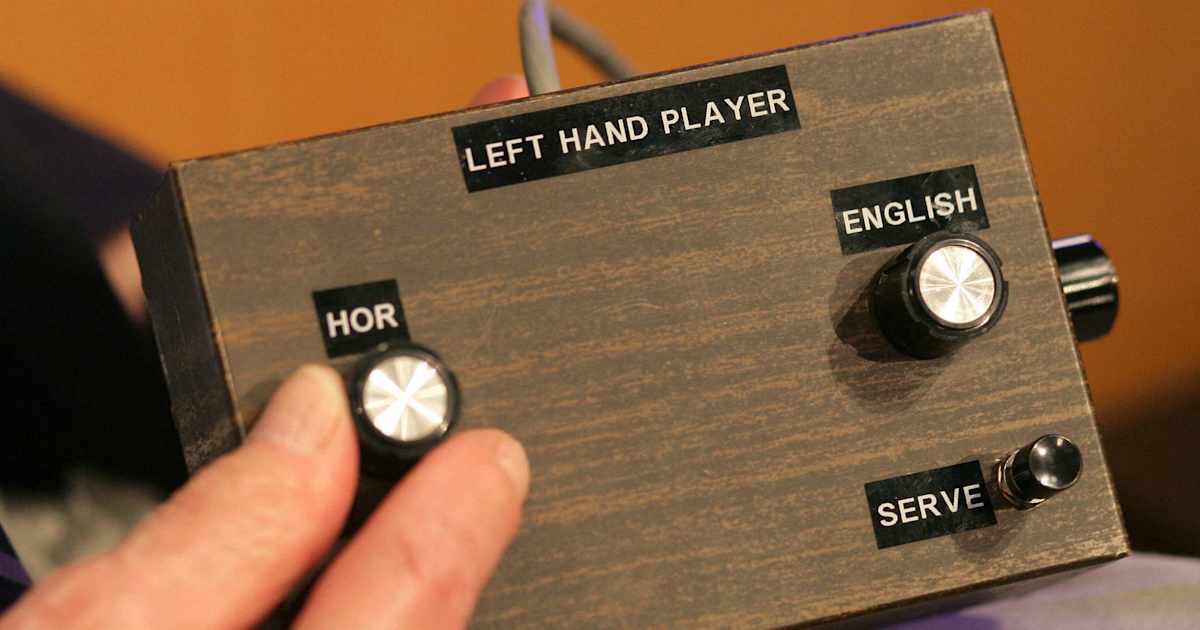
Ralph Baer shows the prototype of his “Brown Box,” the first video game console, in July 2009.
Jens Wolf/dpa/Alamy Live NewsPublished: September 14, 2026Last Updated: September 14, 2026
Before there was Nintendo, before there were arcade games like Pac-Man, before the term “video game” even existed, there was the Brown Box. In the late 1960s, engineer Ralph Baer and his colleague Bill Harrison plugged a clunky, faux wood-paneled box into a TV and played an electronic game of ping-pong.
The Brown Box was the first proof-of-concept device for home gaming, a form of entertainment that sprung from Baer’s imagination at a time when television was anything but “interactive.”
“Television in the 1960s was a very static medium,” says Alexander Smith, video game historian and author. “You had three channels in most places. Ralph Baer is the person who asked the question: what if we could do more on our television sets than just have programs spoon-fed to us?”
Baer eventually licensed the Brown Box technology to TV manufacturer Magnavox, which released the Odyssey—the world’s first commercial home video game console—in 1972. While the Odyssey wasn’t a huge hit, its “Table Tennis” game was the direct inspiration for Pong, Atari’s addictive arcade game that helped launch the $200-billion video game industry.
The Video Game Origins of AI
In 1959, AI and machine learning pioneer Arthur Samuel devised the Samuel Checkers-playing Program. This was one of the first instances of successful self-learning programs in the world, and a clear insight into the power and future of AI.
A Eureka! Moment for Video Games
Before the Brown Box, there had been other early attempts at making video games. In the late 1940s, two engineers at a New Jersey electronics company filed a patent for a “cathode-ray tube amusement device” that let users shoot an electromagnetic beam at on-screen dots. In 1958, Brookhaven National Laboratory in New York drew visitors to its annual exhibition with an electronic tennis game displayed on an oscilloscope. And in 1962, programmers at MIT created Spacewar!, one of the earliest video games played with joysticks on a circular computer display.
But those early gaming technologies were confined to high-tech labs with supercomputers, says Smith, author of They Create Worlds: The Story of the People and Companies That Shaped the Video Game Industry, Vol. I: 1971-1982.
“They were all running on very expensive hardware and was nothing that could in any way be considered suitable for consumers or for home use. There truly was nothing out there like what Ralph Baer envisioned in 1966.”
Baer was born in Germany and his Jewish family fled to the United States in 1938, months before Kristallnacht.As a teenager, Baer worked in a factory and studied radio repair by correspondence, then served in the U.S. Army during World War II. Baer attended college on the G.I. Bill and received a bachelor’s degree in television engineering, the first degree of its kind.
In 1951, while working for a TV company called Loral, Baer first dreamed of using a TV for something other than broadcast signals. He told his boss that they should build some kind of game into a TV set to differentiate it from the competition. Baer’s boss shot him down and the idea went nowhere.
Fifteen years later, in 1966, Baer was an engineer at Sanders Associates, a large defense contractor in New Hampshire. On a business trip to New York, Baer was waiting at a bus terminal when the “TV gaming” idea randomly bubbled back into his brain.
In what can only be described as a “Eureka!” moment, Baer scribbled handwritten notes about a small “game box” that could plug into a regular TV set. He even listed the kinds of games that could be played: action games, board games, games of chance, card games, sports games, artistic games and educational games. Those notes laid the groundwork for what would become the first commercial home video game console.
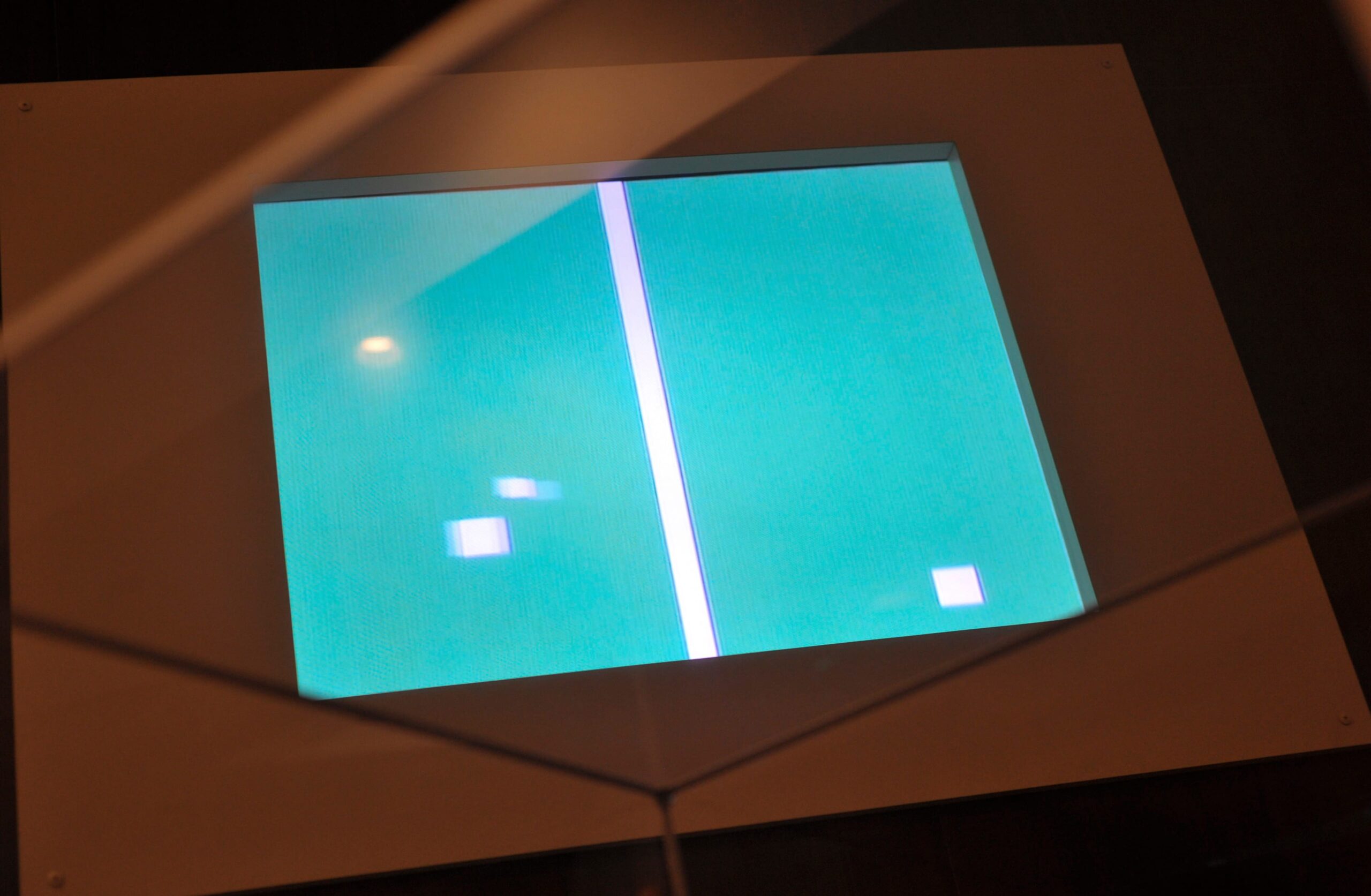
A video screen showing the ping-pong game invented by Ralph Baer at the National Museum of American History on July 1, 2015.
Ping-Pong Breakthrough
Back at Sanders, Baer convinced his bosses to let him assemble a small experimental team (a “skunkworks” in engineering lingo) to take a crack at building what Baer was calling a “TV Gaming Display” or “TV Game Unit.” Baer’s main collaborator was Bill Harrison, a skilled technician who could translate Baer’s pen-and-paper concepts into diodes and transistors.
Although integrated circuits were becoming increasingly available in the 1960s, Baer’s team initially relied on familiar components such as vacuum tubes and transistors. As a result, the first prototypes of the TV Game Unit could only generate two dots and a line. Not surprisingly, the early demonstrations for Sanders execs were less than thrilling.
“They had a chase game where one dot is chasing the other dot, and they had a ‘pumping’ game in which you pressed a button furiously to make the dot expand,” says Smith. “They were all pretty simplistic and slow-paced.”
The breakthrough came when engineer Bill Rusch joined the team. Rusch figured out how to wrangle the circuitry to add a third dot. And not just any dot, but a dot controlled by the computer. It was Rusch who came up with the game-changing (literally) idea of programming the box to play ping-pong.
To play the new game, the team built two controllers. Each one had three knobs: one for horizontal movement, a second for vertical movement and a third for putting “English” or spin on the ball. The ping-pong game was fast-paced, competitive and instantly addictive.
“The minute we played ping-pong, we knew we had a product,” Baer said in an oral history. “Before that we weren’t too sure.”
Introducing the Brown Box
In 1968, Baer and his team completed the seventh prototype of their TV Game Unit. To make the aluminum box look a little more stylish, Harrison covered it with strips of self-adhesive, wood-grained vinyl, hence its nickname, the Brown Box.
The Brown Box had evolved from a pile of circuits and wires into a full-fledged gaming system. The box could be programmed to play nine different games by inserting cards that showed players how to configure the box’s switches:
The Brown Box could still only generate three dots and a line, so it took some creativity to turn those simple graphics into different games. Some games relied on accessories to expand what players could do. The Brown Box included a light-sensitive rifle for shooting games, a golf putting unit that used a real golf ball attached to a joystick and two controllers. But for all the fancy overlays and extras, the biggest hit with early testers of the Brown Box was still the simplest game, Ping-Pong.
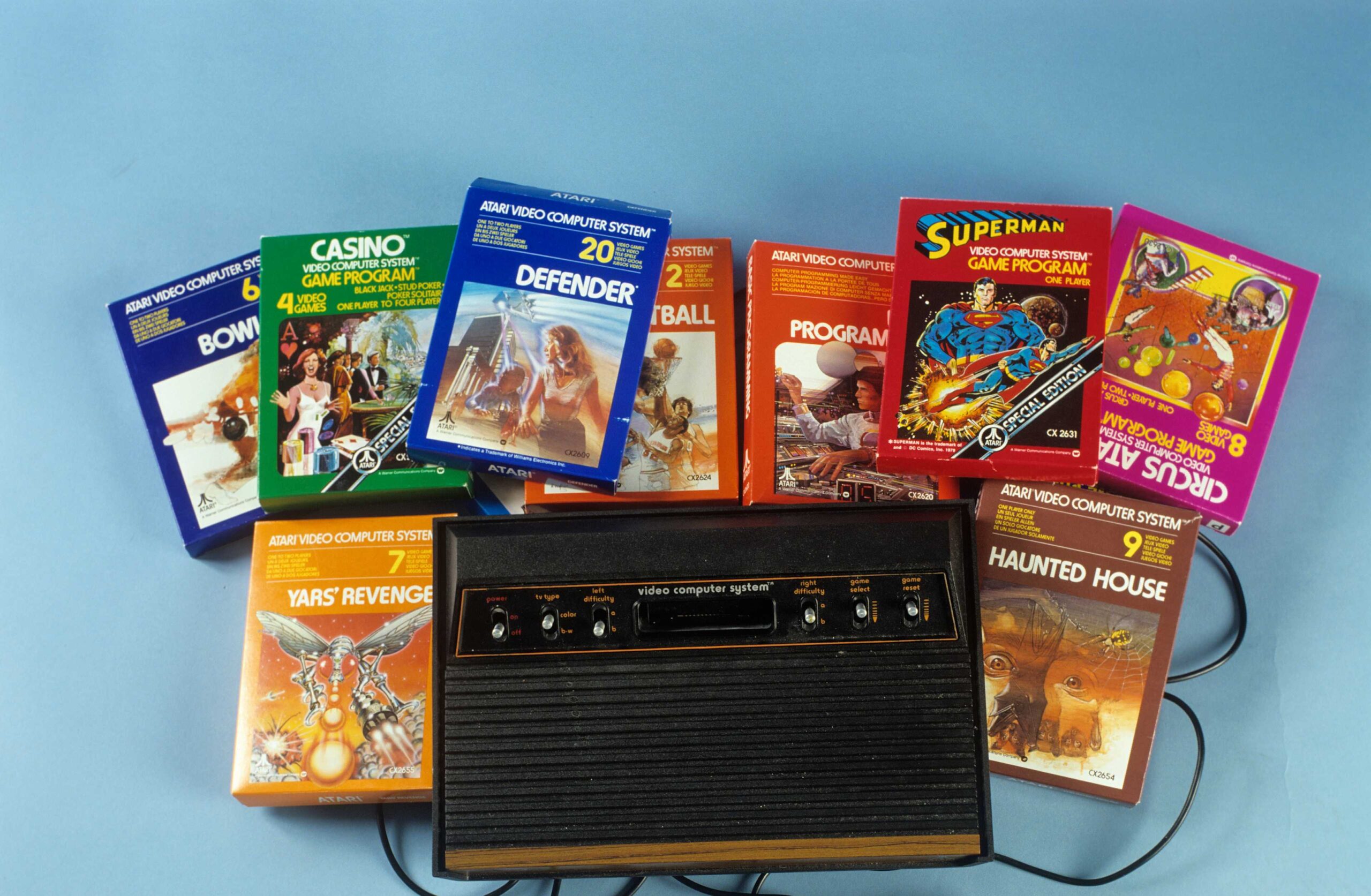
Atari was a leading video game manufacturer in the 1970s and 1980s, producing home consoles and computers. An Atari video game console and games are pictured in 1982.
From Brown Box to Odyssey
In 1969, Baer and Sanders Associates were ready to shop the Brown Box to potential customers, namely major U.S. television manufacturers like Zenith, RCA and Magnavox. But despite being the seed of a world-changing idea, the sales pitch for the TV Game Unit fell flat. Most of the TV companies failed to catch the vision of what the Brown Box could become.
“People were accustomed to this idea that television is something you watch, that’s all,” says Smith. “The Brown Box was very primitive technology, and I think it was probably hard to see what three dots and a line on the screen could grow into, because it requires a pretty big leap.”
Magnavox initially passed on the Brown Box like other TV manufacturers, but Bill Enders, a former RCA executive who had seen Baer demonstrate the device, later joined Magnavox and pushed the company to take another look. At the time, Magnavox was struggling against both U.S. and Japanese competition, and the company was looking for new products to get customers into their stores.
“Magnavox was looking at alarm security systems, audiovisual systems and even office furniture, because televisions back then were basically big pieces of furniture,” says Smith. “I think they were amenable to doing this video game thing, because they needed something to bring people back to Magnavox dealerships.”
In 1971, Magnavox signed a licensing agreement with Sanders Associates to use Baer’s Brown Box technology to make the first home gaming system, originally called the Skill-O-Vision and then the Odyssey.
The Magnavox Odyssey debuted in 1972 and retailed for $99.95 (about $800 in 2026 dollars). Gone was the humble, wood-paneled box, replaced by a sleek white plastic device marketed as an “electronic game simulator.” The Odyssey came with a dozen games, including Table Tennis, along with screen overlays and board game-style accessories. A light-sensitive rifle and additional shooting games were sold separately. The golf gadget didn’t make the cut.
The Odyssey sold 350,000 units from 1972 to 1975, when it was discontinued. Compared to the wild success of the Atari 2600, which debuted in 1977, the Odyssey is often labeled a failure, but Smith disagrees. If anything, Atari would never have enjoyed such fame without the Odyssey.
It was at an Odyssey demonstration in 1972 that Nolan Bushnell, who would co-found Atari later that year, saw Table Tennis, which helped inspire Atari’s breakout arcade game Pong. Magnavox and Sanders Associates later accused Atari of infringing patents covering Baer’s video game technology. Atari settled the case and became a licensee, but by then, few people were talking about the Magnavox Odyssey or Ralph Baer’s revolutionary Brown Box.
Baer, who died in 2014, dubbed himself the “father of video games” for his role in dreaming up the Brown Box. “I would say that the video game industry, rather than having a ‘father,’ has ‘founding fathers,’” says Smith. “But there’s no doubt that Baer is one of the founding fathers of this industry.”
Advertisement
Advertisement
Advertisement

HISTORY EducationHISTORY Vault™HISTORY AppsHISTORY en Español®Military HISTORY®Newsletter Sign UpShare Your OpinionsFAQ / Contact UsAdvertise with UsA+E Factual Studios™A+E Studios®Employment OpportunitiesAccessibility SupportTV Parental Guidelines


Advertise with UsA+E Factual Studios™A+E Studios®Employment OpportunitiesAccessibility SupportTV Parental Guidelines
Terms of UsePrivacy PolicyCopyright PolicyCookie NoticeAd Choices
Advertisement
Advertisement
Advertisement
