

The strips that ran in the free Providence comics newspaperPaper Rodeowere largely anonymous, although the trained eye learned to identify individual styles, and associate them with works credited to an artist. Brian Chippendale’s work is identifiable by its stamp lettering and “read-like-a-snake” layouts. Mat Brinkman’sMulti-Forceruns in all of its nineteen issues, with a set of narrative threads, and has been collected by Picturebox and Hollow Press. Co-editor Leif Goldberg’s anthropomorphic animals are identifiably the same as seen in his zine seriesNational Waste,or his bookLost In The Fun Zone. The work of CF andPaper Radis immediately recognizable to fans.
Other artists are more obscure: TheZissy And Ritastrips have an e-mail address attached, which connects it to an electronic music project still ongoing,Libythth, which possesses a certain anarchic weirdo spirit that connects it to the cartooning. Devin Flynn’s work is there, credited to the pseudonym Tedious Limbs. Still, it is partially the anonymity that makesPaper Rodeosuch a beautiful utopian project. Everything insists you confront it on its own terms, without received impressions dictating how you are meant to feel about anything. That the issues were free meant you didn’t have to judge any particular contribution by how it contributes to the value of the whole.
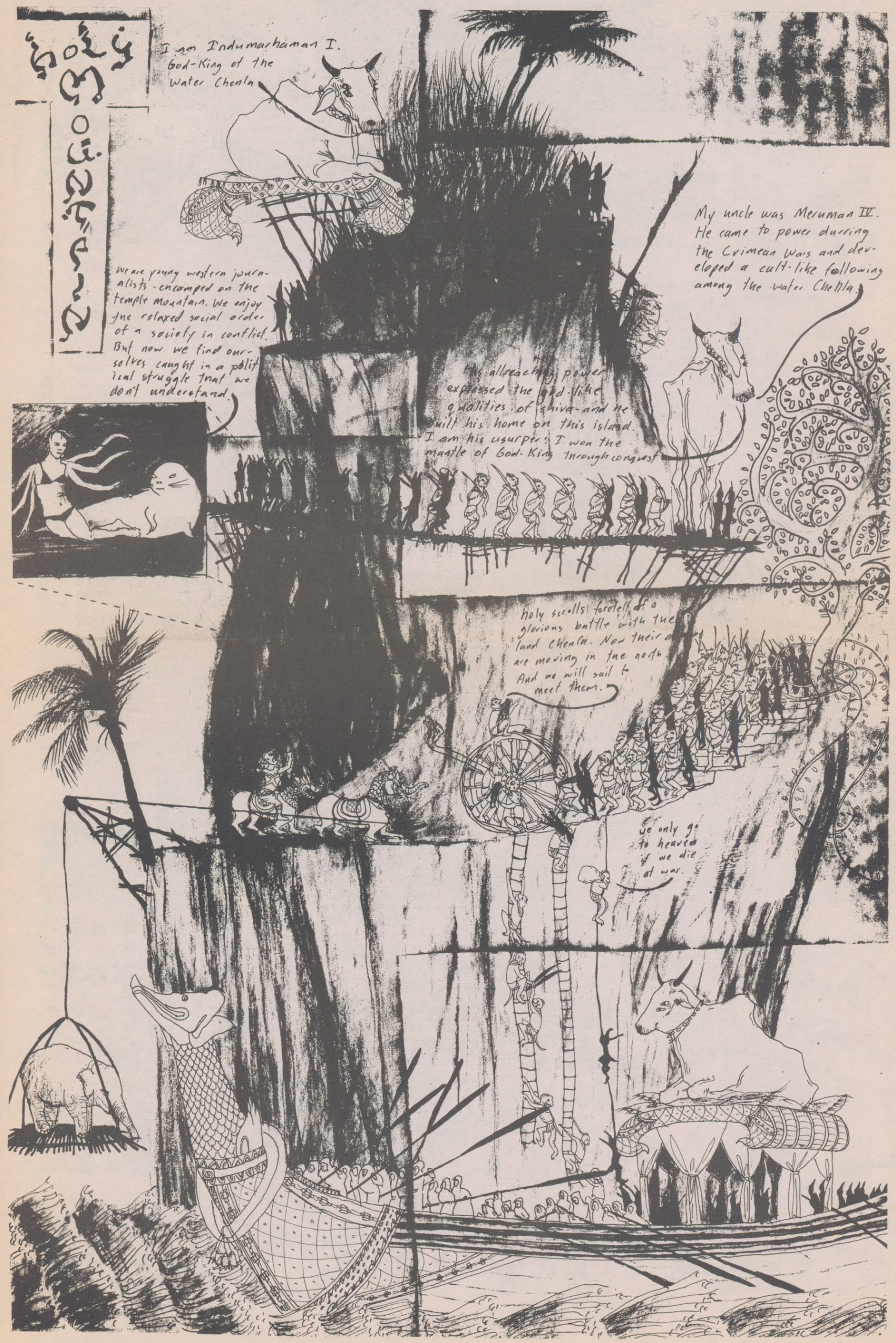
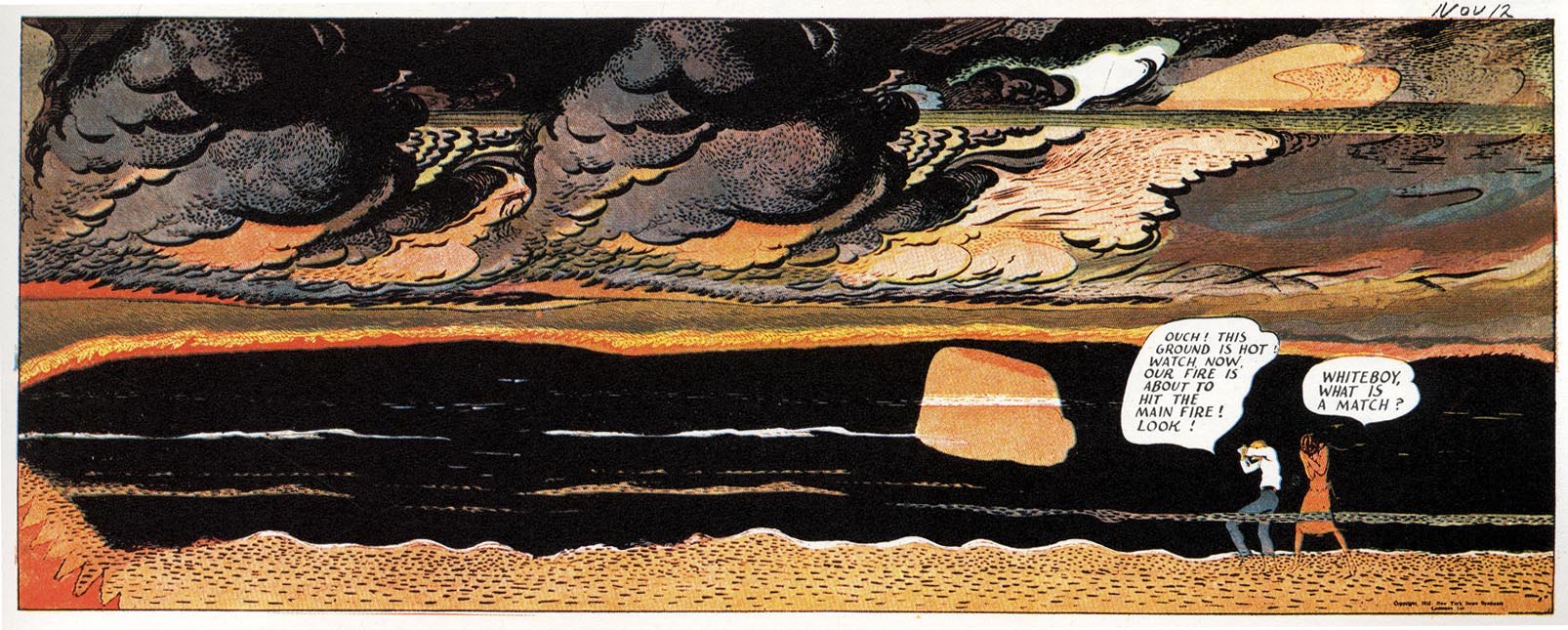
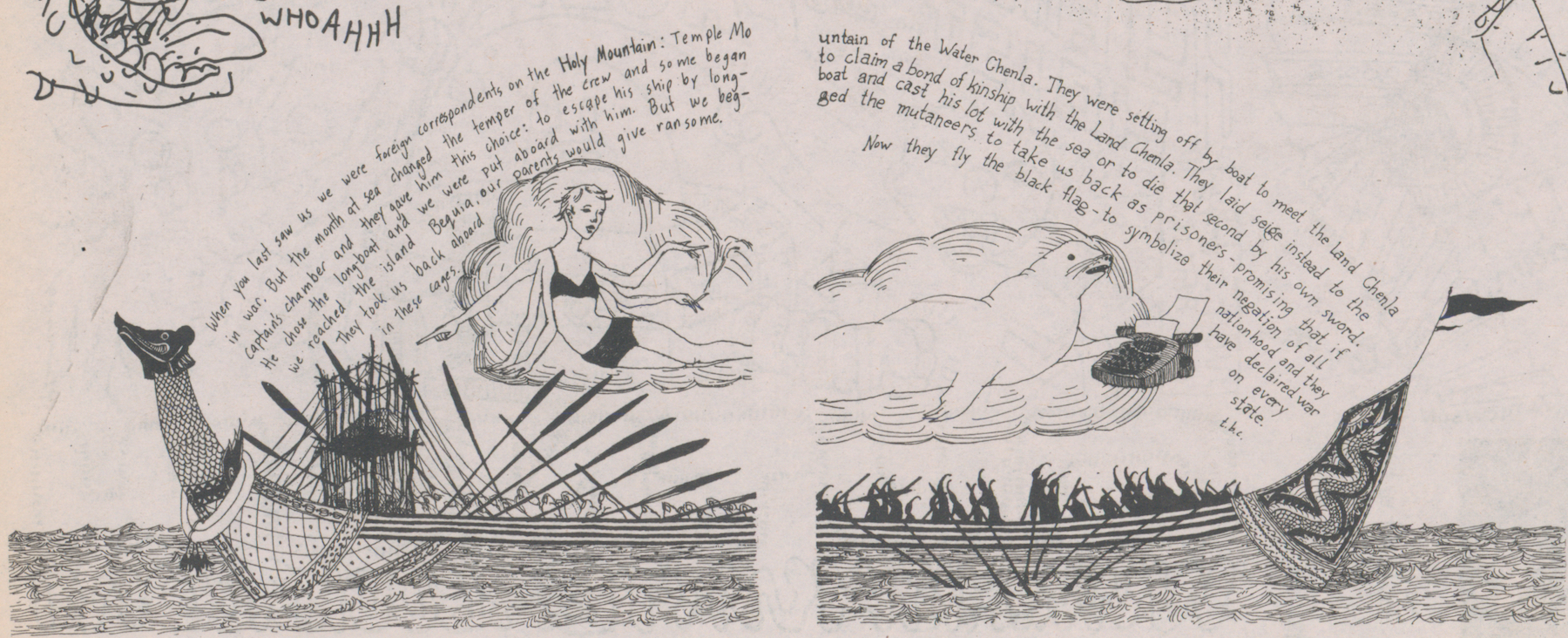
Now the issues are rare and coveted, fetching a premium on the aftermarket. Sifting through the contents of the issues I’ve been able to accrue, the biggest revelation was a handful of strips with the nameHoly Mountain,which in its tales of nautical combat and encounters with the gods present the fragments of a fantasy or adventure narrative marked by a poetic voice and spindly linework that turns plumes of smoke into architecture of semi-abstract pages. I couldn’t put a name to the artistry evident, but another one-page strip preceding the appearance of that title suggested it was made by the same hand, judging by the lettering and approach to layout. This strip too possessed an emotional power not immediately apparent elsewhere among the wild drawing for its own sake that characterizes most of thePaper Rodeo work whose artists I couldn’t immediately identify. That strip spoke of surfing and water, which connected it toHoly Mountain’soceanic setting in an elemental way. Each of these strips struck me as beautiful, and there were so few of them. I felt what I imagine people in the ’70s felt, looking at the one Garrett PriceWhite Boystrip reprinted in Bill Blackbeard’s Smithsonian anthology, but these were all black and white, in quality and spirit a middle ground between punk zines and engraving.
I e-mailed Leif Goldberg and learned those pieces were the work of Marie Lorenz, who further research revealed had maintained an active art practice, though this work lacks the identifiable marks of drawing and lettering in her comic strips, being divided between a performance project operating a water taxi in New York that follows the tides, and sculptural installations built around materials she salvages. The throughline from the comic strips to the current work is water. The comics provided me with an entry point into her larger body of work, given the immediacy of narrative, but I wanted to talk to her about how it all connected, and what animated the spirit of those strips I found so moving.
I am grateful to the artist for taking the time to speak with me over a Google video chat. Almost everything she said blew my mind. She was very warm, with a down-to-earth quality intrinsic to someone who works and exists in such proximity to nature, and a thoughtfulness and ability to place the facts of her life into a narrative in response to my questions befitting her work as faculty at Cooper Union.
BRIAN NICHOLSON: Is it fair to say that water is the big throughline throughout your work?
MARIE LORENZ: Yes. Exactly.
So what came first: an awareness of your fascination in water, or a sense of yourself as an artist?
I guess they were kind of simultaneous, but it all comes together around Providence. My dad was in the military, we moved all over the U.S. when I was growing up. He was stationed in California for when I was a kid, we moved coast to coast. We also lived in Japan and my dad was a canoer and a kayaker, he taught me to sail when I was four, I was always around small boats and the water, and also interested in art. When I went to art school and moved to Providence, there was this canal through the middle of the city, and in the ’90s they were daylighting the Woonasquatucket River, so they were removing I-95 and the train tracks, removing it from the river to make it into what you see now as the downtown waterfront. When I was in school that was all a muddy construction site. There were these cranes and these ditches and they had peeled back the sides of the canal and removed all these bridges and there were these tunnels under the city. I had grown up canoeing and kayaking, so I was like, “Why aren’t people in boats in this thing? It seems like a fun place to explore,” so I started making boats and going into these tunnels. Now they’ve kind of sealed off all those entrances but at the time, it was basically the drainage sewer; you’d go in these sewer tunnels and you could paddle for miles underneath the city. So I was working in the RISD hardware store and I started making these tiny homemade boats that could navigate into those places.
How do you start making boats?
I just made it out of the weirdest materials. When I look at the early boats, they were these really weird forms. The first one had this aluminum sheeting that was drilled into this plywood frame. Eventually I started reading about how to make a skin-on-frame boat, and looking at actual designs that people would do, but the first ones were completely my own weird brain. It was always the cheapest way I could think to do it too, with scrap wood sealed with roofing pitch. I was majoring in printmaking at the Rhode Island School of Design [and] Brian Chippendale and Mat Brinkman were in the printmaking department, and we were all freshman at RISD together. So they were part of these adventures that I’d go on in the canals. I guess at the time there might be a boat in one of my shows but they were pretty different at the time. I was making drawings and prints and the boat projects were separate, but I was always trying to figure out how to unite them, and make prints that were about them, and performances that were about them. It’s sort of been a lifelong confusing project to figure out how the work I do in the studio and this more exploratory relational work fit together.
What comics had you seen? How do comics fit into this?
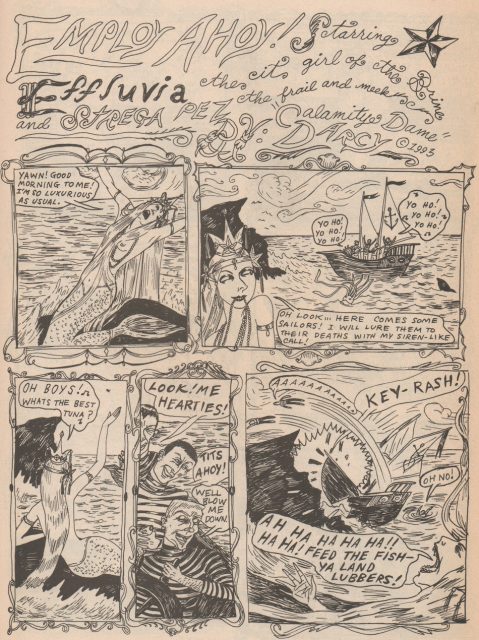
I have to say I wasn’t a voracious comic fan like Mat and Brian were. It was Mat and Brian really that were showing me. I was thinking about when I was starting to look at underground comics, and because I graduated from high school in 1991, everybody had that Twisted Sisters anthology. That had Dame Darcy,Julie Doucet, maybe Aline Kominsky, but I really loved Julie Doucet and looked into her stuff more. I was getting this stuff secondhand from the real fans of it, who were Mat and Brian looking at those things. They were like, “Hey, you’d like this” and when I look at some of those early submissions to Paper Rodeo, I can really see this. Because I loved the Julie Doucet really diary type comics. When I read those excerpts in the Twisted Sisters anthology, I was just enchanted at the idea that your basic life happenings could be this absolutely riveting, horrible comic strip. So I see when I was doing those things for Paper Rodeo, I was always stuck between this idea of something diaristic and revealing, and something more allegorical and fantastical. I always see this pull between wanting to be diaristic and wanting to be allegorical, so when I look at those things I’m embarrassed because I know what I was trying to say. It’s this embarrassing pull between those two worlds. I would have to say Mat and Brian were also big influences in terms of their work. Brian had a really beautiful way to weave the diary into his fantastical world, and Mat was just total fantasy. It was just completely another world. I was interested and influenced by the way they wove fantasy and life together.
It’s funny you mention Dame Darcy, I can see a visual similarity to how you were drawing.
Yeah, I love just those spindly [lines] and her relation to the fantasy world. And everything is so chaotic in her work, I really love the freedom. Just because she drew it one way in one strip doesn’t mean she has to stick to that size or that scale or that line weight. It’s very free.
I feel like, with all those Providence people, and I can see it in your work too, there’s a desire to make your life into an adventure.
Yeah.
And I feel like maybe it is. Is that what making the boats is and the exploration and all of that is?
Yeah. It really was. Providence was this crazy place because, like most industrial waterfront cities, there had been this blight in downtown, and all of this building they had done in the forties through the seventies was in real disrepair. Downtown would be abandoned between 6 p.m., when the bankers went home, until 6 a.m. the next morning. There was no one downtown, so we would just go on these nightlong adventures, exploring abandoned buildings, exploring the canals. It was fairly safe, as a twenty-year-old, to be out at night and going on adventures in these spaces. And the canal was completely empty. It still would be, if you went down there.
What about water stuff you do now? Does that feel safe, or like an adventure? Going out on the New York waterways?
I guess I think some of my most adventuresome stories are from the first couple years of it. I’ve definitely gotten more careful over the years. The boat sank in a really early iteration of the taxi, and there’s this very adventuresome story of swimming for shore and stuff. And now I would never want to put somebody through that so I’m a little more careful. But I like to make the water taxi as much of an adventure as somebody is willing to have, without any kind of … I’ll tell you an example. There was this guy, Steve Duncan, who’s an urban explorer. I think he made a book about urban exploration. He’s been across Paris underground. He was in New York for years and is sort of a famous urban explorer. I took him one time to explore these sewer tunnels that were in Harlem. There’s these entrances to the sewer drainage system from the Harlem River. I basically took him by boat and he walked for a long time inside one of these tunnels. When he got back I was like, “Oh we should change around the blog and fictionalize it a little bit, we’ll drive people bananas thinking that you found this secret passageway under Manhattan.” And he’s like, “We did. You don’t have to change anything. That is what we did.” And I was like, “Oh yeah, right. It is that.” You can do something really simple in New York and have it be pretty profound because nobody looks at it. Nobody knows what’s under there. It’s adventuresome but you don’t even have to try. You just get in the water and look at the bulkhead or the seawall or any of the stuff that’s down below our eye-level and you’re already in this complete fantasy world. In the early years of the Tide Taxi, I would maybe slightly push the dangerous aspects of adventure, but now I feel like I can make these really eye-opening and completely alternate universe experiences just by slowing down and paying attention.
Where does your awareness of surf culture come from?
I lived in Southern California, but not near the beach, for the nine years before I turned eighteen, but moving away and moving back, we always lived in the same neighborhood. We were in Vista, California, which is like a half-hour from the ocean. The surfers were sort of the cool kids, the jocks of high school. I wasn’t myself too much of a surfer but I was aware of it. I liked the skateboarders more. But I found this sketchbook that I think became that one that talks about God looking like Corky Carroll, and Corky Carroll was this pro surfer who I think was also the cousin of one of my friends growing up, so I was aware of what ’70s professional surfboard culture was. But I wouldn’t say that I was a part of it, I just sort of peripherally saw it.
In the Holy Mountain strips there’s a type of drawing of a ship that I think of as related to a sort of nautical tradition, of engraving or something, but there’s also a depiction of Garuda, who has text as a chest tattoo, and I was thinking of tattoos as being a navy thing, they’re a part of “water culture” for lack of a better phrase. Is folk art an influence? Are tattoos folk art?
When I made that, I had just come back from traveling in Cambodia, so I was completely steeped in all of that imagery from the Khmer Hindu mythology. I had been looking at these murals and frescoes of the Ramayana. The Holy Mountain was supposed to be Mount Meru, but I do love Jodorowsky and the Holy Mountain film, so that’s in there somewhere, too. I had taken all of these photographs in Cambodia of the frescoes, so those images are mashed up in there. And yeah, I studied printmaking so I loved engravings, and all of that nautical stuff. Because I made boats and liked waterways and exploring, I feel like every gift I’ve ever gotten is “Here’s this book of etchings of sailboats.” Especially at that point, I was just so inundated and loved all of that. I should say, I have no desire to actually sail the open ocean; most of my experience in boating is urban, but I love reading about nautical adventure. I was reading a ton about pirates. I love all that sort of myth and romance.
It’s also so New England to me.
Totally! Totally.
So the chronology is: you move to Providence from Southern California to go to RISD in the ’90s and then you’re there for what, like ten years?
I was in Providence just for the four years of college but then I moved to San Francisco for awhile between ’95 and ’99, but then I went to Russia. So lots of moving. Then I was at Yale in 2000-02 and I was going up to Providence a lot. I moved to New Haven, decided to go to Yale, but thought grad school was going to be like RISD. I pictured me and my new grad school friends exploring abandoned train tunnels and being such good friends, and it was way different than that. Now I also think it was wonderful but at the time I was going up to Providence every weekend and missing my other college experience. Those Paper Rodeo submissions must’ve been from that. I think I lived in Providence for half a year after grad school, so between 2000 and 2003 I was going back a lot. Then when I first lived in New York in 2003 I was going up to Providence a lot, had stayed in touch and went to Providence a lot.
And these other minicomics you just sent me photos of, when are those from? Is that before grad school?
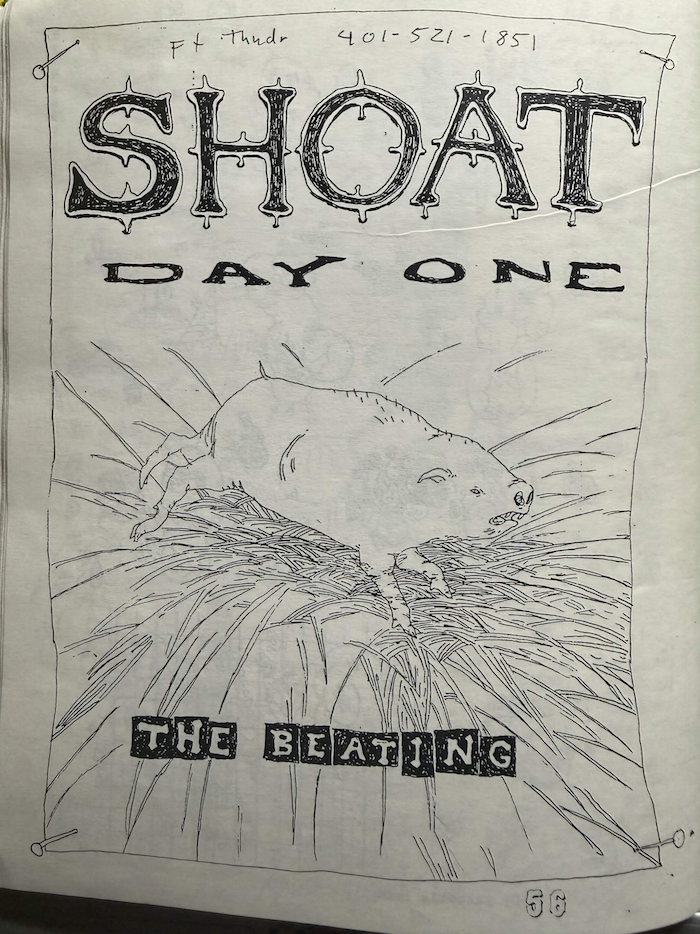
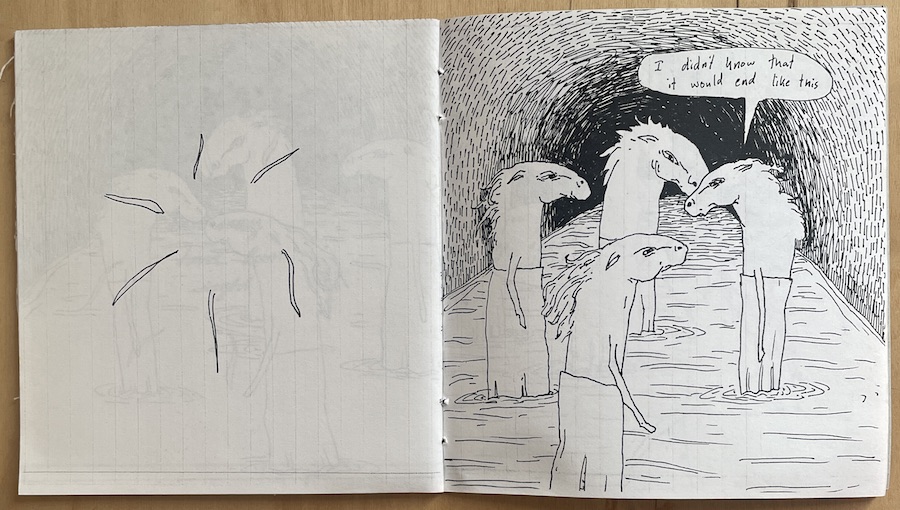
The red one is probably the most involved printing that I ever tried to do. When I moved to San Francisco in 1995 I worked at a silkscreen factory, we silkscreened these decals for the sides of buses. Because I had majored in printmaking I knew how to do this thing but nobody in that factory went to college. I didn’t need a degree. It was a commercial print shop. But I made this silkscreened book, all the interior pages were silkscreened. That one was big but these ones, the one with the wave on the front, and the hand, these ones I made in 2001, 2002, when I was at Yale but visiting friends in Providence. I look at them now and am like, what was I thinking? It was so weird, there’s no words, it’s just pictures. They all had corresponding sculptures. I made this big sculpture of a smoke cloud with silkscreens, it was this structure that had this silkscreen skin. I made this book that was supposed to be an accompaniment to it. That’s what that blue one is. When I look at it, I’m like, oh it was as though I never thought that the book would be an entity to itself. I didn’t give it enough credit to hold somebody’s attention. It was always accompanying this other thing. When I look back, I wasn’t trusting either world of sculpture as this unique thing, it exists in a gallery, people come to see it, it exists for itself and this world of a comic entry point, which is also a unique experience. It’s intimate, it’s handheld, the entire world is described to you in this one drawing or book. I could never completely trust either one. So that’s what that one with the hands pushing the window was about. There’s no words, there’s no story really. It was meant to accompany this other thing that existed in my studio or the gallery.
I think the language in the strips is really great. It’s really evocative. A sentence like “We only go to heaven if we die in war,” there’s something so intense about that thought. How big were the Paper Rodeo pieces drawn?
I think they must’ve just been slightly bigger than they were printed. I’m not sure what I would’ve given them, but I think I shrank it a little bit. They weren’t massive. They were just a little bigger than that.
I feel like with painting you go to a gallery — not so much now, because now a lot of people work huge — but I feel like an older painter would draw at a certain size and then the idea is “What if I did a big one?” and one of the things that’s cool about Paper Rodeo is, you’re just doing a “big one,” you’re working at a scale that even if you’re not drawing it huge is very involved.
Because each person was one page or whatever.
Yeah. Your approach to line is spindly but it accumulates into assemblages in a way that feels sculptural to me. When you’re making sculpture is it rooted in sketchbook work first or is it all just based on the materials?
Well the sculptures I was making that accompanied those couple books had these silkscreened patterns, I would silkscreen these pages and pages of a wave pattern and then wheatpaste it onto these big forms, so the forms had a drawn mark on them. Now they don’t look like that, but at the time, but there was some dialogue with that drawn mark. And coming from printmaking, I loved woodblock printing and the look of an engraving or a carved mark.
So let’s talk about your sculptures now, for those that might not be familiar with your practice.
What I’m working on in my studio now — I did a residency at Kohler in Wisconsin, this time [November] last year [2024], I made these porcelain casts of garbage I found on the beach. Now I’m in my studio, I’m taking all those porcelain casts and putting them inside these kinetic sculptures so they have a little bit of motion, they’re usually pendulums and they rock back and forth. They look like garbage but also a ship rocking, or somebody paddling an oar or a clock or a metronome, but then the weight on the metronome is made of this big conglomeration of what’s clearly ropes and plastic bottles and beach debris, but it all looks like a big rock or a stone because it’s cast in porcelain.
That sounds beautiful.
A lot of the sculptures now are related to things I find out on the waterways. There’s such amazing stuff out there. It’s like your most amazing art supply store, on a beach in New York City.
But you’ve moved away from the drawing or printmaking aspect and now you’re documenting with photography for the most part. Do you feel the same affection for photography as a medium?
Well the point I was gonna try to thread here was that I was making those works at Yale, these sculptures, but I was making these accompanying books of drawings that would put you in this place, this imaginary world the sculpture was meant to represent as well. And the drawings got simpler and simpler, with the most complex being those Paper Rodeo submissions. But they just got simpler and simpler until they were these stick figures almost, but they had a line of text. This was the thing I was trying to find for you that hopefully I can get in the next couple days. They would just be a drawing and a line of text. I was letting myself indulge in that Julie Doucet diary mode and the drawings just got really pared down. So when I started doing the Tide Taxi blog, [it] was born around the same time I started to do the boat project in New York, and the tide taxi blog had the same sort of rhythm, a photograph and a line of text, a photograph and a line of text. But the way I was writing the text was similar to the way I had been writing the text for the little comic strips I was trying to make. And so I realized it was those diaristic comic books that led the way to the Tide Taxi blog, and having the photographs alleviated the need. The drawings had gotten so simple it was like they were second fiddle to the idea of the text telling the story. I was thinking I’d try to show you side by side what those two things look like. But also I still make prints, I can show you pictures of that too, I still love that kind of engraved look, though I get that a different way now. The printmaking that I make is all indexical so I use nature printing and collagraph to get these images out of the object. But in a weird way it still kind of looks like an engraving even though it’s a direct contact print. Then once in a while I still make drawings that are in the style of those Paper Rodeo submissions, I do this calendar with a friend of mine, Jennifer Coates, this sexy men calendar we’ve done every couple years. I’ll send you one when we make it this year. I still make some of that stuff but the printmaking and the sculpture has taken a more primary road.
