

Manga Worth Having on Your Shelves
Looking at the Lasting Appeal of “Yotsuba&!”
CultureMangaArtSep 14, 2026
Azuma Kiyohiko’s manga Yotsuba&! presents deceptively simple narratives spun around Yotsuba, the young girl protagonist, while crafting deeper explorations of her youthful exuberance and the adult gaze on the world as we accompany her through her days.
- English
- 日本語
- 简体字
- 繁體字
- Français
- Español
- العربية
- Русский
The Value of the Unadorned Everyday
Our story starts with slightly special five-year-old Koiwai Yotsuba and her father Yōsuke moving to town one summer’s day.
From there, Yotsuba&! focuses largely on minor events in Yotsuba’s everyday life, with most stories winding up in a single chapter. (The quirky title in English plays on the Japanese title’s Yotsuba to, with the to meaning “and.”) The scenes are idyllic: Yotsuba playing at the park or going shopping, making curry on a camping trip, and sometimes going on special adventures like taking a ride in a hot-air balloon. Occasionally, there are scenes with a roster of unusual side characters, like the three Ayase sisters living next door, or Yōsuke’s friends Jumbo and Yanda.
The adults around Yotsuba, regardless of age or family connection, all keep a watchful eye on the girl, whose wild behavior keeps them on their toes even as it inspires them to see the world through her eyes and enjoy every moment.
Yotsuba&! shows the daily life of family and neighbors alike. Volumes 2 and 8. (© Azuma Kiyohiko, Kadokawa/Dengeki Comics)
Yotsuba, innocent and full of life, is always bouncing between moods, crying one moment and laughing the next. The world she sees is always fresh and new, expanding with each new story as she grows with it.
The core theme of this manga is perhaps best expressed by that exclamation mark in the title. In other words, it is discovery, excitement, and surprise. The reader is shown the world through Yotsuba’s eyes and reminded of the beauty of daily life that we so often forget: how it feels to enjoy getting soaking wet in the rain, or the elation of successfully flipping a pancake for the first time. It reminds us how every new experience, no matter how mundane, felt like a thrilling great adventure when we were children.
Slow Pace Inherited from Azumanga Daioh
The artist, Azuma Kiyohiko, drew a four-panel, or yonkoma, comedy manga called Azumanga Daioh about the daily lives of high-school girls in 1999–2002. This work avoids any serious drama and barely even mentions themes like romance, aiming instead for laughs through conversations between unusual characters in a school setting, with an emphasis on timing and tempo. It was one of the origins of a boom in yonkomamanga in the 2000s that all shared a certain sensibility: a light atmosphere, focus on the mundane, and cute “moe” characterization. That focus on the everyday, without any need for big trouble, is an element the author has carried into Yotsuba&!
Around the time Yotsuba&! began serialization in 2003, the term “slow life” began to gain traction in Japan and people started to think about ways to live with less hustle and bustle. That was, for example, when video games like Boku no natsuyasumi (My Summer Vacation) and the Animal Crossingseries became more popular for making carefree living and small discoveries central to their enjoyment. Yotsuba&! was likely a perfect fit for the times, and that is why it caught the hearts of so many readers. Indeed, the series has sold some 15 million volumes in Japan, and 3.5 million in translation overseas.
Viewing the World from a New Angle
One other element that helps to carry on the emotional resonance is the highly detailed art. The 2015 touring art exhibit Drawing Manga! featured a deep-dive into the artistic styling of Yotsuba&!
For example, exhibition director Itō Gō discussed the camera angles used in the comic by saying, “Basically, the angles are rarely exactly from Yotsuba’s own perspective . . . But that doesn’t mean that they are from an adult perspective, either. Readers aren’t identifying directly with Yotsuba, nor are they watching from a distance; they are walking through that space and observing the world along with the character.”
The manga artist Tanaka Keiichi points out that while the backgrounds convince readers through their realistic details, the characters are quite “mangalike” and symbolic. This allows for direct emotional communication, giving readers a sense of unobstructed presence in the scenes.
The angles and realistic background create a unique ambiance. From Volumes 9 and 14 of Yotsuba&! (© Azuma Kiyohiko, Kadokawa/Dengeki Comics)
Yotsuba&! is a work that conjures up nostalgia, recalling the excitement of experiencing the world as a child. But more than simple nostalgia, it almost comes across as a utopian vision. In a sense, it stands in the gap between those two.
I have a child who is about the same age as Yotsuba. While I can nod along when I see her acting much the same way my own child does, and the manga can feel a bit like an essay about parenting, there is also a slight sense of disconnect.
Yotsuba’s world and experiences are nostalgic, reminding us of our past. But at the same time, they are unrealistic. Idealized. Perhaps the reason for that is how Yotsuba’s birth and life before the story begins is left a mystery, or how the actual difficulties of raising a child are left out of the story, and how everyone who meets Yotsuba is naturally accepting of her idiosyncrasies. The world around her is simply too gentle.
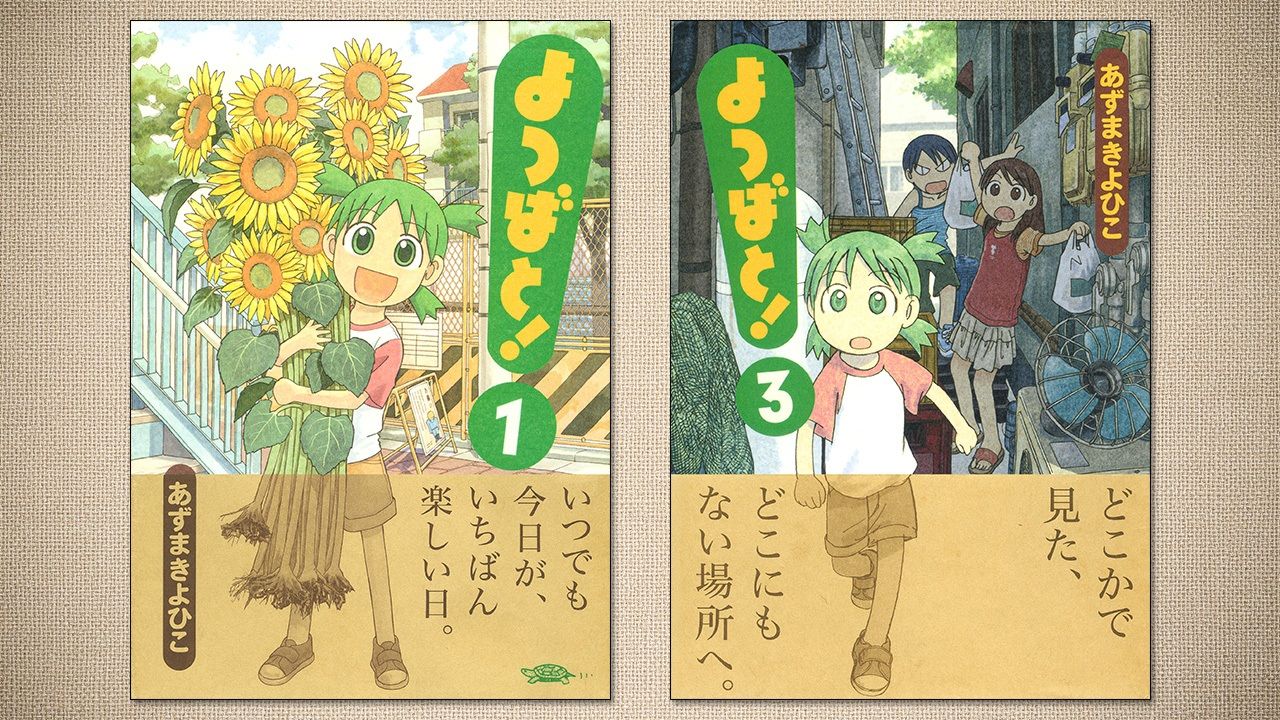
“A world that seems familiar, but exists nowhere.” Those words were printed on the cover wrap for the third volume, and seem to sum up exactly the worldview of Yotsuba&! This is a worldview created through the previously described camera angles that avoid the adult perspective, and the combination of photorealistic backgrounds and symbolic characterization.
Preserving the Worldview
A powerful force for protecting that unique Yotsuba&! worldview is Yotsuba Studio, headed up by Satomi Hideki. A special feature in the May 2009 issue of the design-industry magazine Idea showcased how that studio differs from conventional publisher-led production systems. It takes a comprehensive approach to every element involved, handling everything from cover design to promotional copy and materials, even merchandise.
Yotsuba Studio also makes sure to aim Azuma Kiyohiko’s works at a wider audience, looking beyond manga’s traditional otakudemographic, carefully calculating the works’ external exposure and maintaining a tight brand strategy. That strategy has clearly paid off, as Yotsuba&! has won steadfast readers across generations and tastes.
That care extends to overseas expansion. The translations published across the globe preserve the Japanese formats in their localization to all possible extent, to avoid any possible damage to that worldview.
Slowly Moving Through the Seasons
The series begins in the heat of summer, but in the 20 years since it began serialization, the story has slowly passed through autumn and is now approaching Christmas. In that slow passage of time, Yotsuba has learned to ride her bicycle without training wheels, climbed to the top of Mount Takao in west Tokyo, and slowly but surely is growing up.
And as the story goes on, there is even a little treat for fans of Azumanga Daioh, linking the two worlds together.
As Yotsuba&! continues to show us a place that seems so oddly familiar, but exists nowhere, fans around the world wait with gentle excitement for the turning of the next season.
(Originally published in Japanese. Banner photo: The covers to volumes 1 and 3 ofYotsuba&!© Azuma Kiyohiko, Kadokawa/Dengeki Comics.)
mangaanimeartManga and Anime in Japan
